Alcide Liotard, known as André Liotard (1887-1973). A senator, an architect, an engraver, a painter. He built the Tananarive railway station, decorated the Excelsior cinema-theatre, and etched a Malagasy Way of the Cross in fourteen plates, commissioned by subscription in 1938. Studio 16, at the back of the courtyard of 34 boulevard de Clichy, was his Paris home from 1952 until his death in 1973 — twenty-one years. He was one of the last representatives of a generation of architect-artists trained at the École des Arts et Métiers and shaped by the colonial adventure.
From Béziers to Lyon — the making of an architect-painter
Alcide Liotard was born on 30 April 1887 in Béziers, in the Hérault. Early on, he moved to Lyon, where in parallel he followed two courses of study that would define his whole trajectory: the evening classes at the École des Arts et Métiers — the serious, technical path, the one that would make him an architect — and the painting classes at the École des Beaux-Arts. That double enrolment, elite craftsman by day, painter by night, is typical of a generation that refused to choose between the ruler and the brush. Liotard never did choose.
Military service in the 1st Alpine Infantry Regiment at Briançon. In 1914, at twenty-seven, he was mobilised — but a leg disabled by a tram accident in Lyon kept him behind the lines. He spent the war at the Saint-Chamas powder works, on the Étang de Berre. The biographical detail is thin, except that it was precisely this disability that, indirectly, opened the next chapter: Africa.
Gabon, Belgian Congo — the works director
Out of the war with a half-dead leg but an architect's diploma in his pocket, Liotard left for Africa as works director. According to the Senate notice, he "termina, après la Première Guerre mondiale, la ligne ferroviaire qui relie le littoral du Gabon à Léopoldville, alors au Congo belge" (completed, after the First World War, the railway line linking the Gabonese coast to Léopoldville, then in the Belgian Congo) — today Kinshasa. The site was brutal — mosquitoes, malaria, forced labour — the kind of operation polite biographies skip over. But Liotard completed the line. Belgium made him an officer of the Order of the Crown. It was the first time he was honoured for work done overseas; it would not be the last.
1926 — Madagascar, the encounter of a lifetime
In 1926, at thirty-nine, André Liotard was appointed director of the Compagnie coloniale de Madagascar. The brief was administrative — developing the production and trade of commodities between metropolitan France and the Great Island — but the post did not suit him. In 1934 he resigned to return to his first profession, architecture. And there, on the Tananarive highlands, the architect-painter found his ground.
Over some fifteen years he built in Madagascar churches, convents and the Tananarive railway station (still standing, with its iconic clock under a campanile), and decorated the Excelsior cinema-theatre on the square of the same name — one of the capital's great entertainment halls. When the Second World War cut the island off from metropolitan France (1940), Liotard did not stand down: he invented construction techniques that made it possible to use local materials only — Malagasy timber, raw earth, substitute cement — so that the building sites could keep going. In 1940-1942, from Tananarive, he fought against the Vichy government. The detail is worth noting: Madagascar officially turned Gaullist only in 1942, after Operation Ironclad; until then the resident-general Annet was a Vichy man. Liotard was therefore one of that handful of French residents of Madagascar who, on the ground, rejected the French State.
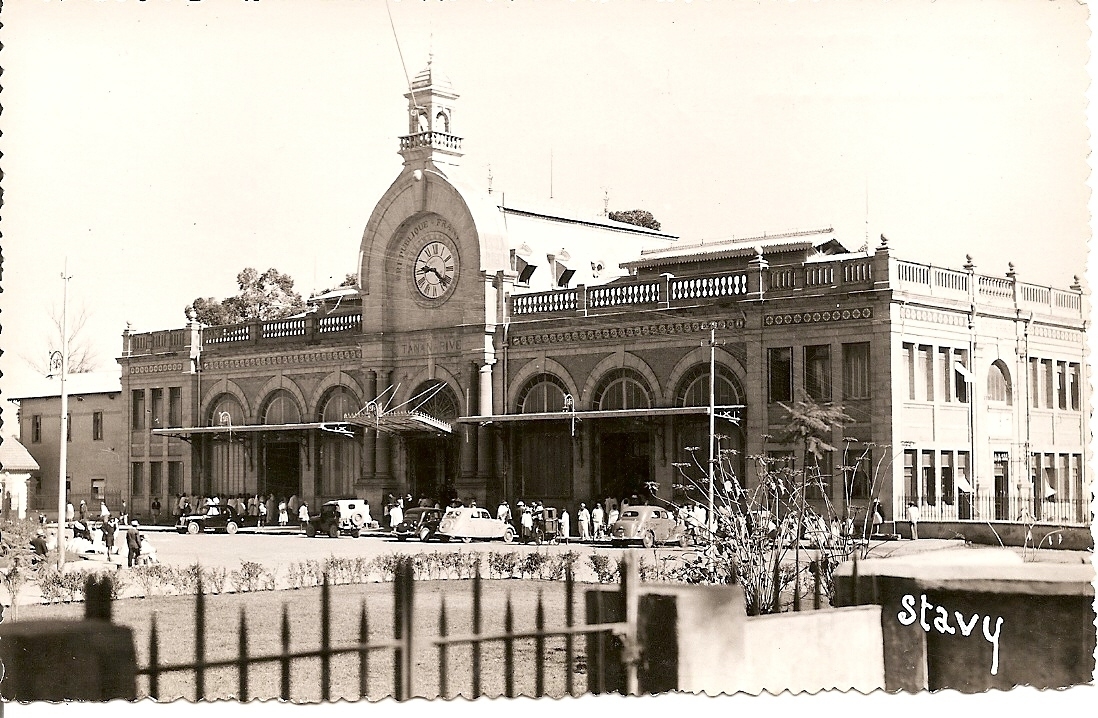
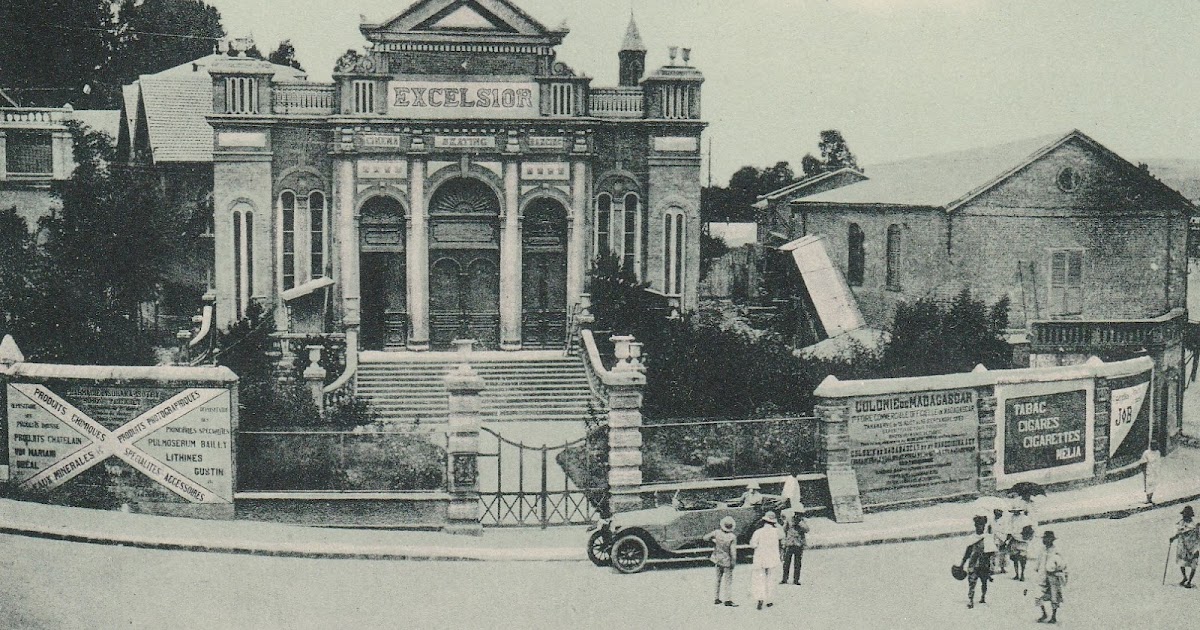
In 1944, André Liotard was elected municipal councillor of Tananarive. He was also appointed expert to the courts and a member of the provisional committee of the chamber of commerce. When the anti-French rebellion of 1947 broke out, it was he who chaired the Ligue de défense des intérêts franco-malgaches (League for the Defence of Franco-Malagasy Interests), attempting an impossible dialogue.
An architect speaking to both sides. A rare stance.
1938 — the Malagasy Way of the Cross, fourteen etchings
In the midst of this architect's career, Liotard never let go of the brush or the burin. In 1938 he undertook the major engraved work of his life: a Way of the Cross entirely transposed into Black Africa. Black Christ, Malagasy soldiers, women in white wrappers, the cross carried against palm trees and colonnades — the classic Christian motif put through the mill of a tropical iconography. A radical move for 1938: to indigenise the Passion, to make a god of Galilee into an equatorial god.
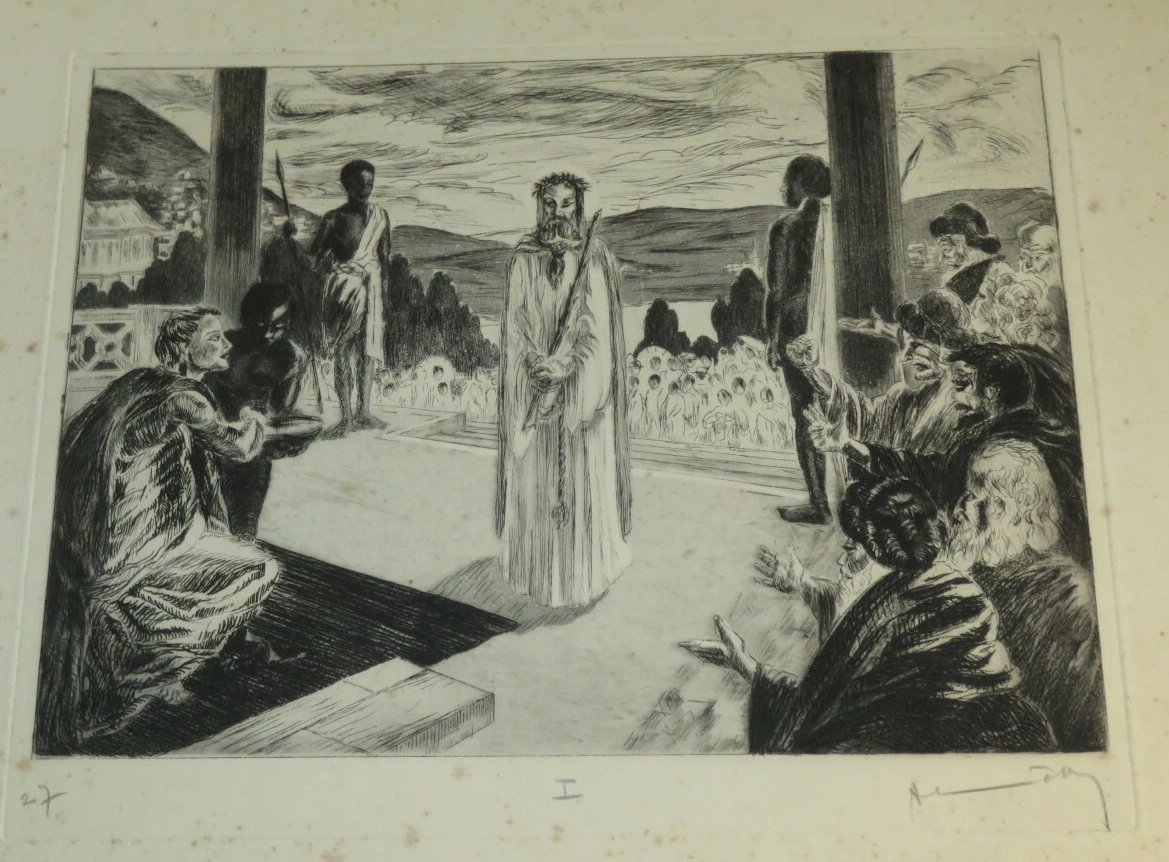
Christ standing under the colonnade; at left, Pontius Pilate washes his hands; at right, the indigenous crowd; a Black soldier with a spear in the background. Etching 23 × 29 cm on half-imperial Rives vellum, plate I of the cycle of fourteen.
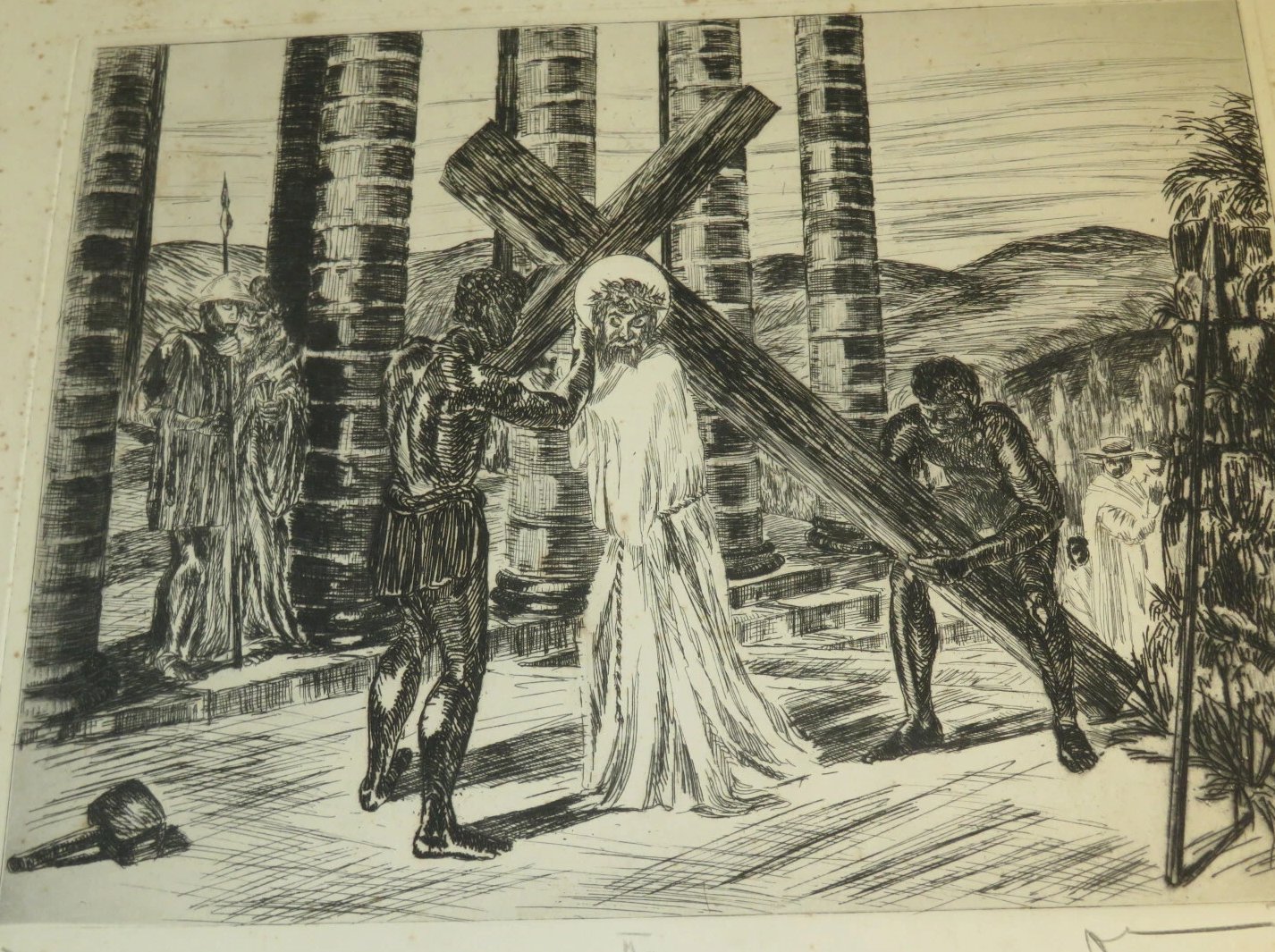
Christ flanked by two Malagasy figures: one helps him carry the cross, the other, on the right, pulls the crossbeam. The shaft of a Roman soldier's spear at left, stone colonnades, a palm tree at right — the tropical setting absorbs the classical iconography without friction.
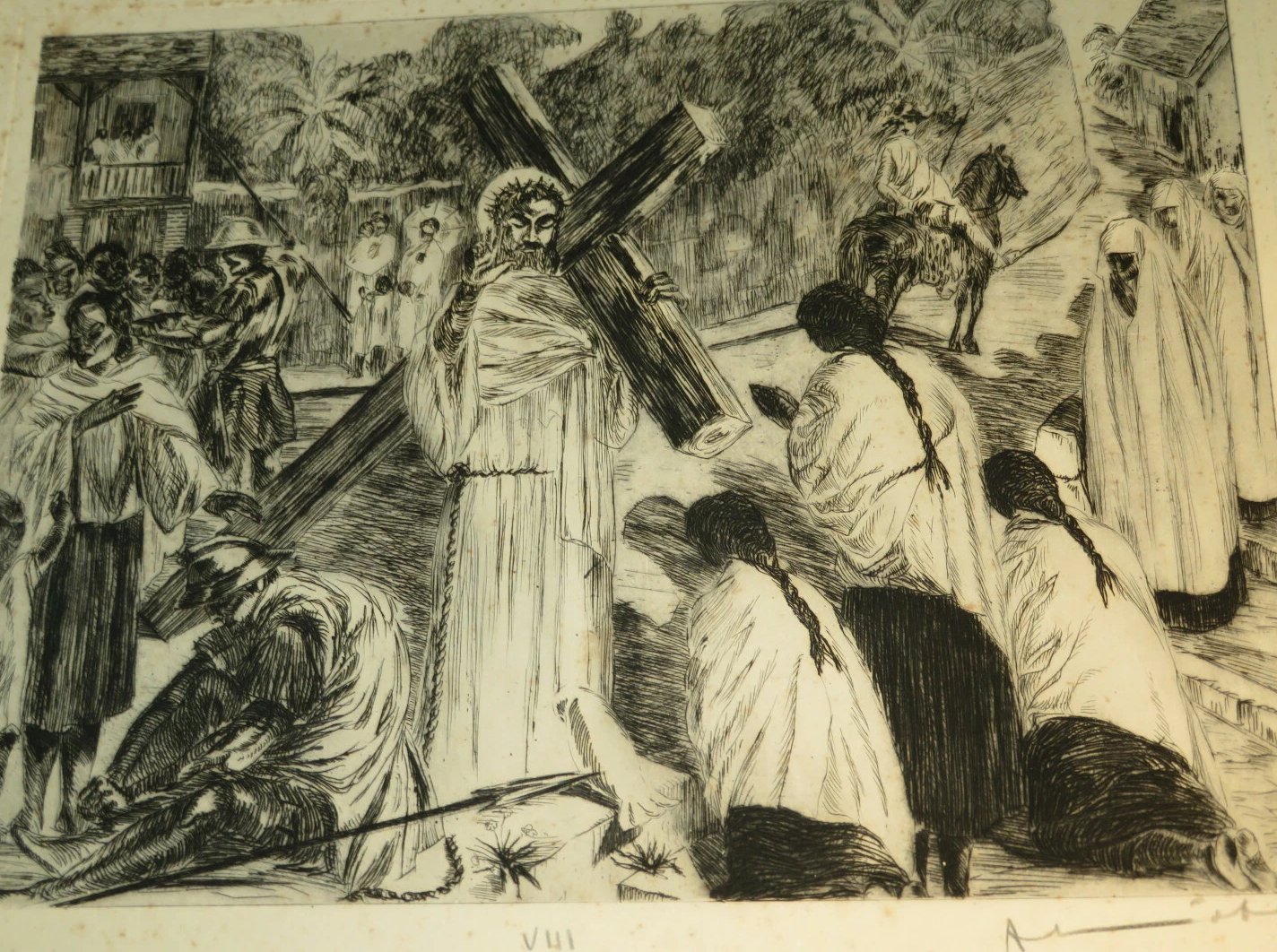
The daughters of Jerusalem become Malagasy women in white wrappers and braided hair, kneeling before Christ. A veiled rider at right, stilt houses, palm trees — the gospel transposed to the tropics. Plate VIII of the cycle, signed lower right.
The way the work was distributed is itself a historical fact: a Comité Liotard pour la réalisation d'une œuvre décorative d'art religieux malgache was formed in Tananarive, with His Excellency Mgr Fourcadier, vicar apostolic, as honorary president, and Doctor Fontoynont — a scientific and cultural figure of the colonial administration — as acting president. The subscription was paid in monthly instalments: « Fr. 360 l'exemplaire, livrable au fur et à mesure de l'exécution » (360 francs per copy, deliverable as the work progresses), at 20 francs a month. A subscription system for a work of art, by instalments, allowing Malagasy civil servants to build up a complete cycle of fourteen plates on half-imperial Rives vellum. Receipt no. 20, dated 3 November 1938, bears witness to it.
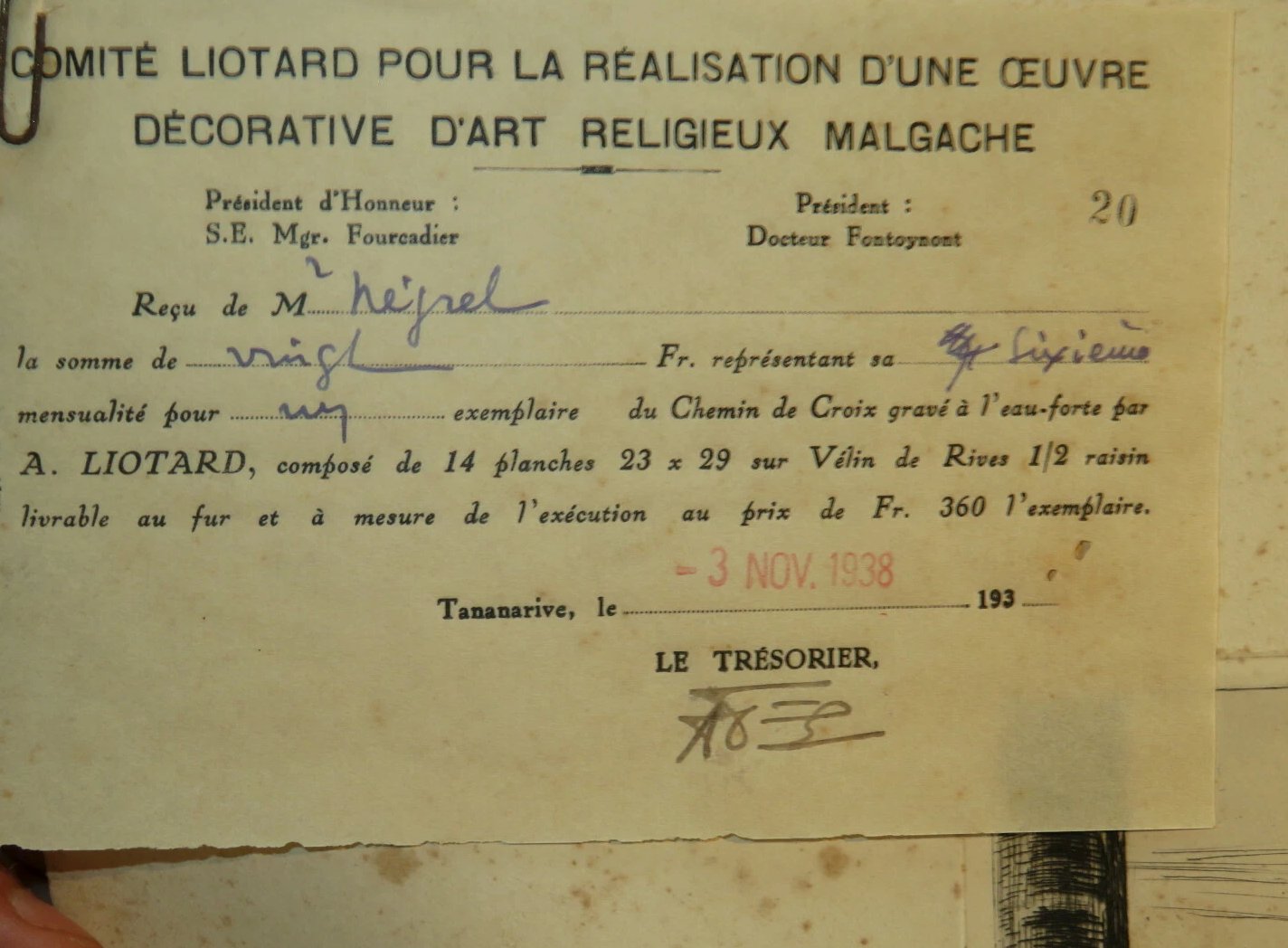
"Received from Mr [Néjrel] the sum of twenty francs representing his sixth monthly instalment for one copy of the Way of the Cross etched by A. Liotard, comprising 14 plates 23 × 29 on half-imperial Rives vellum, deliverable as the work progresses at a price of 360 francs per copy." Private archive document, 34 boulevard de Clichy holdings.
1948-1952 — Senator of Madagascar
In November 1948, Alcide Liotard was elected Senator of Madagascar under the Républicains Indépendants banner. At the Palais du Luxembourg, his interventions turned on a single axis: overseas France. He spoke on the status of Cochinchina within the French Union, asked the Minister of Foreign Affairs how he intended to "combat the external influences tending to disorganise French undertakings in the overseas territories", and — above all — campaigned on the front of natural disasters.
In 1951, the cyclone that devastated Fort-Dauphin, in the far south-east of Madagascar, became his cause. He tabled a draft resolution, then a report, to secure immediate aid. He pressed for a permanent credit reserve to deal with overseas cyclones. In miniature, it was a very modern debate — anticipating disaster rather than suffering it.
Alongside overseas questions, Liotard was also a substitute and then full member of the Commission de la Reconstruction et des Dommages de Guerre (Committee on Reconstruction and War Damage). The minutes of its sittings show him in action from 11 January 1951 — questioning the Minister of Reconstruction and Town Planning Eugène Claudius-Petit on the lack of coordination in planning, on the Caisse autonome de la Reconstruction, on the 45 billion francs of overall credits. He wrote letters to the minister, agreed to draft reports — in short, he was a senator who worked, not a senator for show.
At the elections of 18 May 1952, he was not re-elected. The political trajectory ended there. At sixty-five, Liotard brought down the parliamentary curtain and chose the studio.
1952 — the Le Monde article on « autochtones »
In the very year his mandate ended, Liotard published a much-noticed article in Le Monde. In it he rejected the term « autochtones » (natives), which he called « non-sens de la constitution » (a nonsense of the constitution), because it froze "independent fractions" in a precarious situation. His thesis:
« Le développement normal de [ces] territoires ne saurait être que celui des populations toutes entières qui les peuplent aujourd'hui, ensemble, dans tous les domaines d'activité, et non point en séparant une fraction, dite autochtone. »
(The normal development of [these] territories can only be that of the entire populations who inhabit them today, together, in every field of activity, and not by separating off one fraction, called native.)
— Alcide Liotard, Le Monde, 1952. Quoted in the Senate biographical notice.
It was a rare position for a former colonial official of his generation. Where official doctrine distinguished settlers from natives, and where the "independence movements" of Madagascar (1947) and then Algeria demanded, on the contrary, recognition of a native identity, Liotard argued for a unitary approach, in which Europeans and local populations would belong to one and the same territorial people. Not a supporter of assimilation, not a supporter of rupture: a republican who still believed in the French Union as a shared contract. The Senate notice counts this text among his most frequently cited statements.
1952 — 1973: studio 16 at 34 boulevard de Clichy
According to the official Senate biographical notice, after his withdrawal from politics in 1952, "he withdraws from public life to live in an artist's studio in Montmartre and, in the fine season, a small house above the harbour of Toulon. There he draws and paints until his death."
That studio is studio 16 at 34 boulevard de Clichy, at the back of the courtyard. Liotard acquired it in 1952. He retained the usufruct until 18 September 1973, the day of his death. Twenty-one years at no. 34 — a span comparable to that of Hella Guth (1951-1992, 41 years in studio 6), but in the mode of another generation: Guth was in full artistic maturity when she arrived; Liotard, for his part, was sixty-five in 1952 and had just left the Senate. It was the last act of a life.
"A politician but also a painter, sculptor and engraver, he withdraws from public life to live in an artist's studio in Montmartre."
— Official biographical notice, Senate of the Republic, records of the senators of the Fourth Republic.
Liotard's arrival at no. 34 in 1952 fits the logic of the place. At the same time, studio 6 had been occupied since 1951 by Hella Guth — Czech painter, lyrical abstraction, School of Paris. In the first courtyard, studio 4 had seen Henri Marre and Sébastienne Marre in succession. Studio 7 had housed Pierre-Luc Feitu, a Breton sculptor. After the war, no. 34 had become a working artists' courtyard — neither museum nor official residence, simply an address where the rent (or, for Liotard, ownership) made it possible to keep working in the north light of the glass roofs.
The painted work — Madagascar as matrix
Throughout the twenty-one years in studio 16, Liotard painted and engraved mainly from his Malagasy memories. The collection of the musée du quai Branly–Jacques Chirac holds his most monumental canvas: Escale à Diego-Suarez, 1931, oil on canvas, 197 × 212 cm (inv. no. 75.9137.1), donated by the artist himself. The painting was shown in the travelling exhibition Peintures des lointains organised by the quai Branly from 2018.
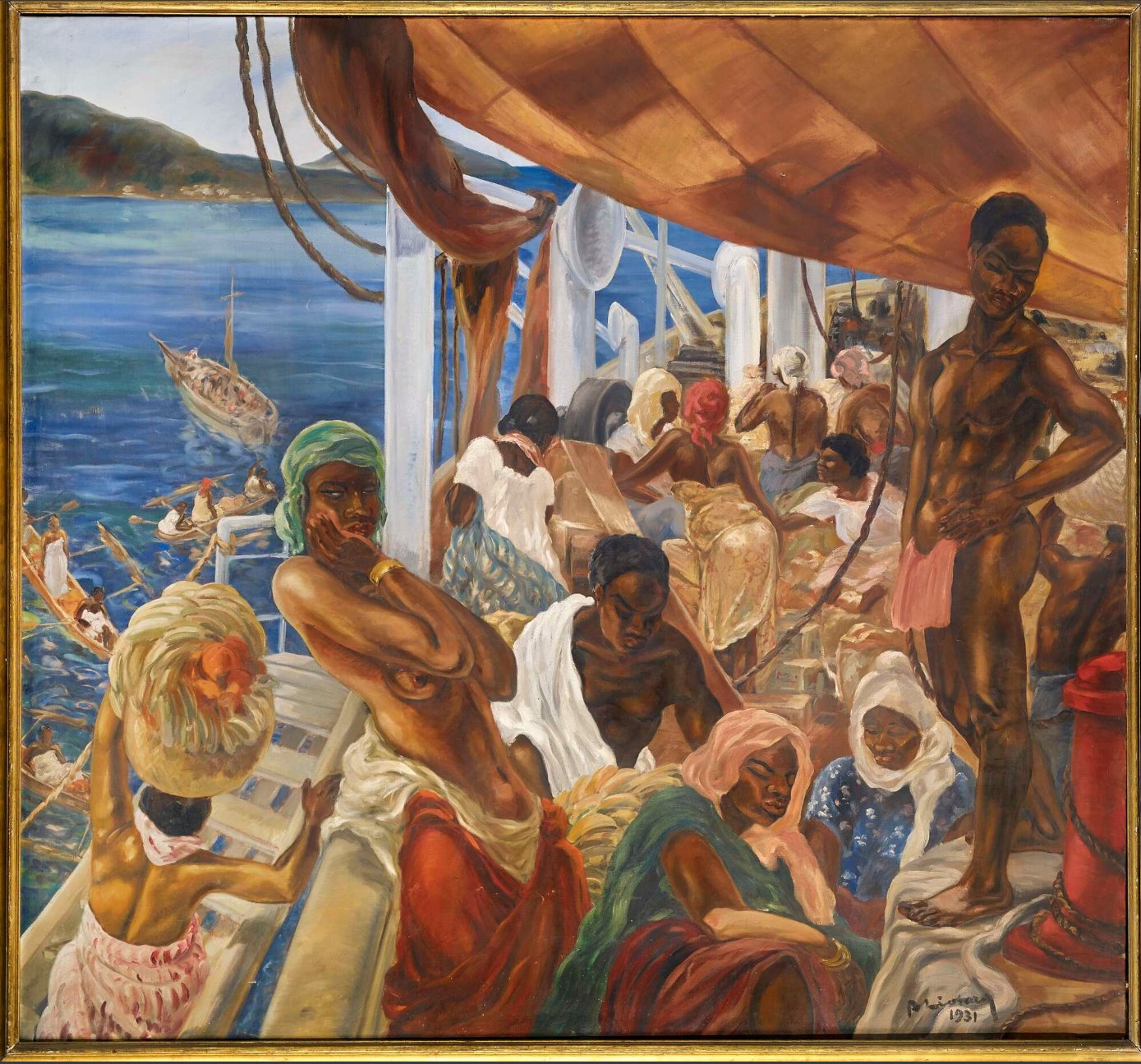
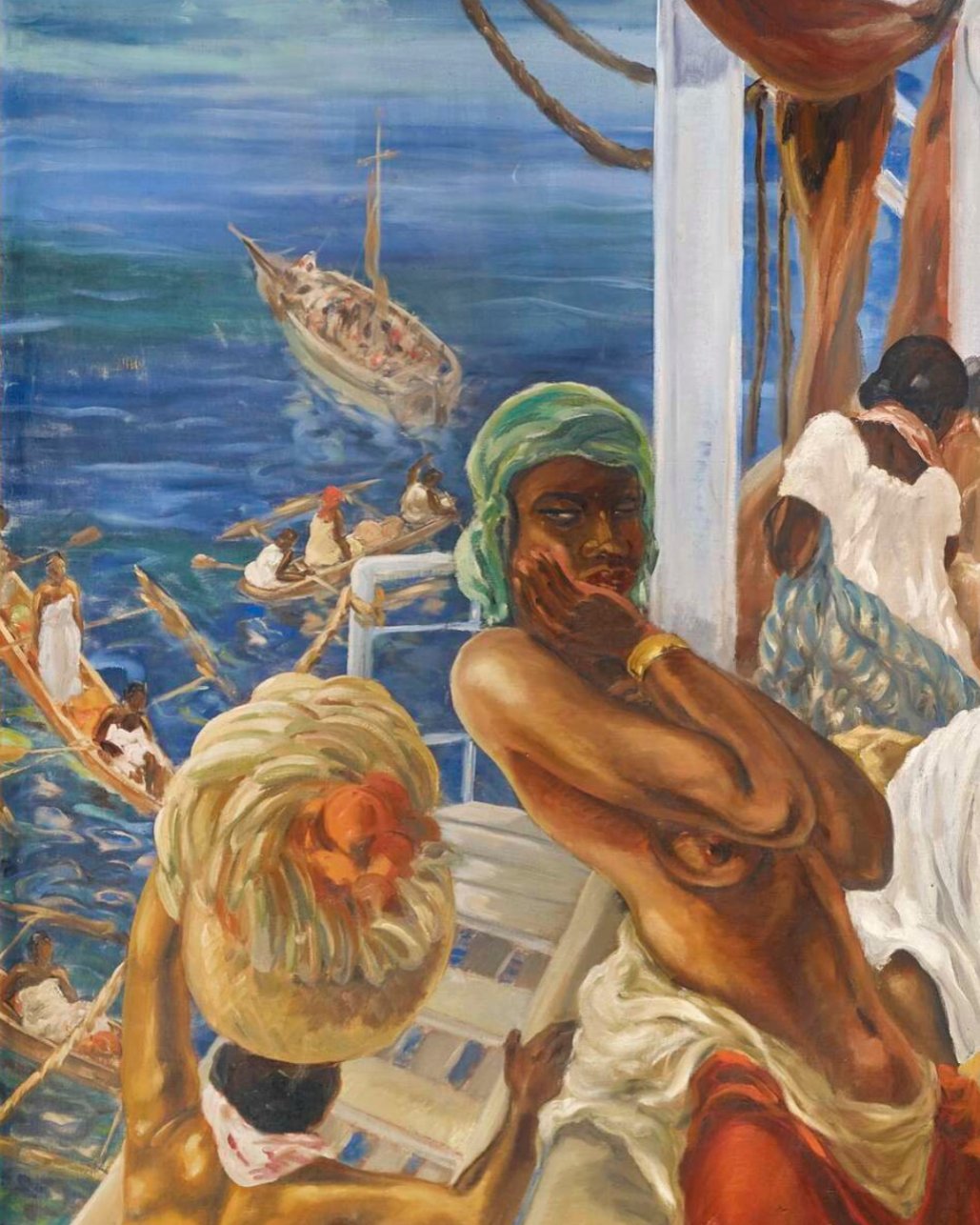
A woman in a green headscarf and gold bracelet watches the dugouts arrive below the ship's deck. A sailing dhow on the horizon, an indigenous rowing boat in the foreground. Oil on canvas, musée du quai Branly–Jacques Chirac collection.
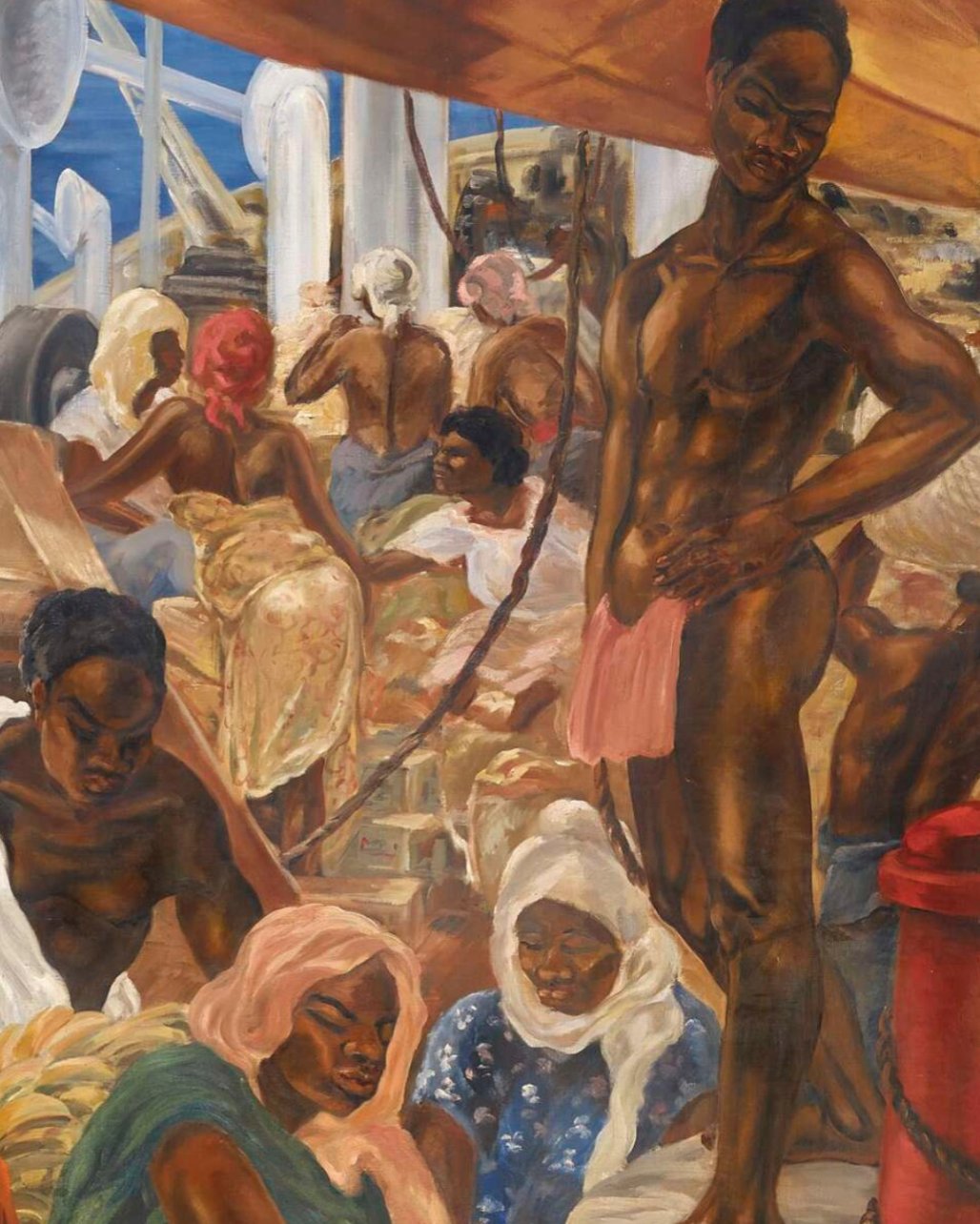
Standing male figure in the foreground, dominating a group of women seated at the foot of the mast. Masts, rigging and azure sky behind. The composition is taut, almost sculptural, and bears witness to Liotard's double eye — that of the architect who frames the canvas, and that of the painter who models the flesh.
Beyond Diego-Suarez, Liotard worked in series: procession scenes under French flags — national-day celebrations on the Great Island —, highland landscapes of the Imerina, harbour views. The signature "Liotard" sits at the lower right, in tight letters.
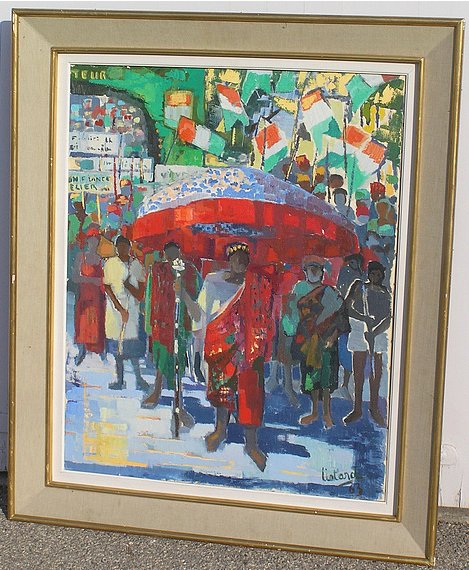
Oil on canvas, signed "Liotard" lower right. A central figure in a red wrapper walks under the great crowned parasol, flanked by a crowd of Malagasy in white and red; in the background, tricolour flags and wall inscriptions evoke the 14 July national holiday in the colonies. A layered composition — band of blues at the bottom, band of greens and flags at the top, parasol-sun in the centre — the architect's eye gives itself away.
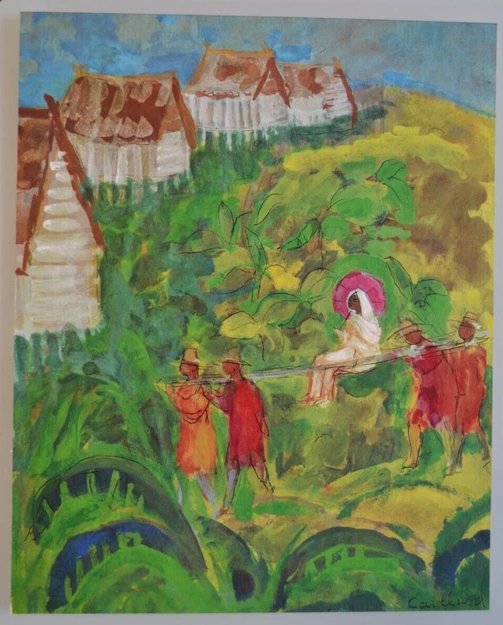
A gouache of more intimate format: a palanquin (filanjana, the traditional means of transport of the Malagasy highlands) carried by four men in red, a landscape of thatched-roof houses against a backdrop of hills, tropical vegetation. The handwritten signature lower right, only partly legible, needs confirmation.
Toulon harbour — the summer residence
Throughout his years in studio 16 (1952-1973), Liotard left Montmartre in the fine season for a small house above the harbour of Toulon. He kept up the Paris-Toulon back-and-forth until his death in Toulon on 18 September 1973, aged eighty-six. The Paris-Toulon rhythm is, moreover, a tradition of his generation: Bonnard, Matisse, Dunoyer de Segonzac — the light of the Midi for the palette, the Paris studio for the market and commissions. Liotard followed the same rhythm, on his own scale, for twenty-one years.
Bouquet de fleurs — the late work, 1964
Among the canvases left in studio 16 is a still life with a bouquet — hyacinths, irises, white and pink flowers in a turquoise vase against a dark background — signed and dated "Liotard 1964" lower right. The canvas was painted a year before the sale of the studio; it is one of the last works of the Paris period. The paint is thick, worked with the palette knife, the palette dark and abrupt — a long way from the luminous watercolours of the Malagasy highlands. A late colourist, almost expressionist.
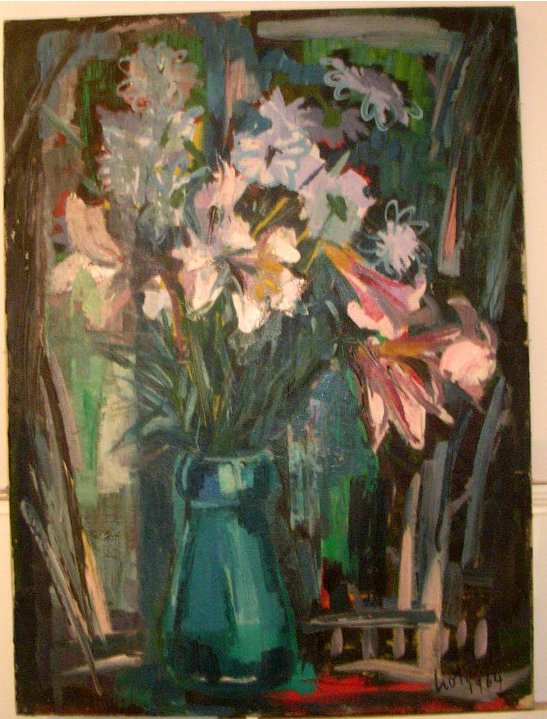
Oil on canvas, signed and dated "Liotard 1964" lower right. Irises, hyacinths and white flowers in a turquoise vase against a deep green background. Thick palette-knife impasto. Studio 16, 34 boulevard de Clichy.
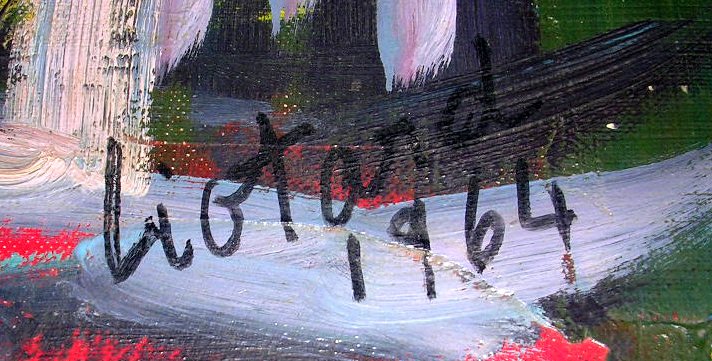
Brushed in black paint in the light zone at the bottom of the canvas. Dating confirmed to the year — painted in studio 16, a year before its sale in June 1965.
A figure of no. 34 in the timeline
Liotard brings a particular colour to the story of no. 34 in the 1950s. The other rear-courtyard studios were then occupied by foreign artists (Hella Guth, Czech; Pierre-Luc Feitu, Breton; later Michel Batlle, from Toulouse). Liotard adds a different layer: that of the former colonial official turned painter, the architect who built churches in the tropics and ended his life etching Black Christs in Pigalle. A trajectory in itself.
When he arrived in studio 16 in 1952, he was sixty-five, with a lame leg since 1913, a senatorial mandate just ended, twenty years of Madagascar in his pencil, the Belgian Order of the Crown on his lapel — and the wish to set himself up with a painter's studio in Pigalle for the years ahead. He painted and engraved there for twenty-one years, until his death in September 1973 in Toulon, in his summer house — faithful to the end to the double pole of Pigalle and Toulon harbour that had structured his whole retirement.
Sources & resources
- Senate of the Republic — Official biographical notice "LIOTARD Alcide dit LIOTARD André", records of the senators of the Fourth Republic.
- Title deed, studio 16 — Notarised deed of sale of 11 September 1998 (office of Maître Thabeault, Paris) (private archives, unpublished). The section « Origine de propriété du chef du vendeur » (vendor's chain of title) names Monsieur Alcide Liotard, architecte, demeurant au 34 Boulevard de Clichy, né à Béziers le 30 avril 1887, and records his death on 18 September 1973.
- Musée du quai Branly–Jacques Chirac — Catalogue entry for Escale à Diego-Suarez, André Liotard, 1931, oil on canvas 197×212 cm, inv. no. 75.9137.1, donor Liotard.
- Les Clionautes — Review of the exhibition Peintures des lointains (quai Branly, 2018), mentioning Liotard and his Malagasy stay of 1920-1930.
- Comité Liotard pour la réalisation d'une œuvre décorative d'art religieux malgache, Tananarive, 1938 — subscription for the Way of the Cross in 14 etchings on half-imperial Rives vellum (honorary president Mgr Fourcadier, president Doctor Fontoynont). Receipt no. 20 dated 3 November 1938.
- Senate, Commission de la Reconstruction et des Dommages de Guerre, minutes of sittings 1951-1952 (procès-verbaux 030S, Senate archives) — Liotard's interventions on the coordination of planning and the Caisse autonome de la Reconstruction, exchanges with Minister Claudius Petit.
- French Madagascar — Wikipedia · Malagasy Uprising of 1947 — historical context.
- Not to be confused with another André Liotard, architect (1927-2019), born in Madagascar, probably of the same family, but with a distinct trajectory.