Jeanne Fusier-Gir is one of the most recognisable figures of 20th-century French cinema — a face that any lover of classic French film immediately spots, a high-pitched voice running through more than forty years of films, and hilarious facial expressions that punctuated the comedies of Sacha Guitry and the post-war French fresques. She made more than 180 films from 1909 to 1966, alongside Fernandel, Louis de Funès, Bourvil and Michel Simon. With her husband, the painter Charles Gir, she lived in Building C of 34 boulevard de Clichy, to the left.
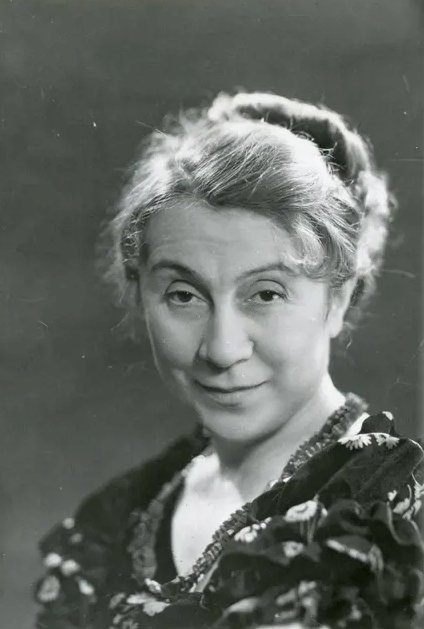
The actress in a classic pose, dress embroidered with flowers and chignon — the "distinctive look" which, according to the Cinémathèque française, made her "the antithesis of the beautiful young seductress", steering her toward the character roles that became her trademark.
A child of the stage
Born on 22 April 1885 at 53 rue Lafayette, in the 9th arrondissement of Paris, Jeanne was the daughter of dramatic artist Léon Fusier and Isabelle Adolphine Mulot. She was by birth an "enfant de la balle" — the French expression for children born into theatrical families, destined for the stage. She naturally enrolled in the dramatic art classes of Firmin Gémier, who would later, in 1920, create the Théâtre National Populaire.
Meeting Sacha Guitry — a sixty-year friendship
Jeanne Fusier met Sacha Guitry when they were both 16 years old. She would become one of his most faithful interpreters, on stage and on screen. In the theatre, she created at his side many of Guitry's works: Le Mot de Cambronne, N'écoutez pas Mesdames, Tu m'as sauvé la vie, Vive l'empereur, Aux deux colombes, Il y a longtemps que je t'aime. In cinema, Guitry offered her the quirky-servant roles that became her trademark: Le Destin fabuleux de Désirée Clary, Donne-moi tes yeux, La Malibran, Le Diable boiteux, Toa, Le Trésor de Cantenac, Tu m'as sauvé la vie, Deburau, La Poison.
Marriage to Charles Gir (1911)
At the Opéra Garnier, where the young Charles Gir came daily to fill sketchbooks for seventeen years, Jeanne met him. The marriage was celebrated on 12 October 1911. She then added her husband's name to her own and became Jeanne Fusier-Gir. Two children were born to the couple: Françoise in 1925 (who would take the name Lamy upon marriage) and François on 13 March 1920 in the 18th arrondissement of Paris — therefore very probably at the apartment of 34 boulevard de Clichy, where the couple had then settled.
In the theatre — from Théâtre Antoine to Bouffes-Parisiens
From 1912, alongside Firmin Gémier, Jeanne played at the Théâtre Antoine in many classics: César Birotteau after Balzac (Émile Fabre adaptation, 1910), Les Petits by Lucien Népoty (1912), Le Procureur Hallers by Louis Forest and Henry de Gorsse (1913), L'École du piston by Tristan Bernard (1916). She acted in operettas (No, No, Nanette by Vincent Youmans) and plays such as Une nuit chez vous, Madame by Jean de Létraz, Une femme trop honnête by Armand Salacrou, Coralie et Cie by Maurice Hennequin and Albin Valabrègue. At the Bouffes-Parisiens she created Guitry's L'Illusionniste (1916), at the Vaudeville Guitry's Deburau (1918), at the Théâtre Sarah Bernhardt La Jeune Fille aux joues roses by François Porché (1919), at the Théâtre des Arts Le Lâche by Henri-René Lenormand staged by Georges Pitoëff (1925).
180 films, 35 years of cinema
Having come to cinema in 1928, Jeanne Fusier-Gir held what was once called a "second role" on screen — a term that is nothing pejorative when one works with every great French director of the period: Max Ophüls, Christian-Jaque, Julien Duvivier, Maurice Tourneur, Henri-Georges Clouzot, Jacques Becker, Henri Verneuil, André Hunebelle, Gilles Grangier, Raymond Rouleau, Jean Boyer, Marcel Carné, Jean-Paul Le Chanois. She gained lasting popularity with audiences thanks to the vivacity of her acting and to her distinctive voice. She notably appeared in:
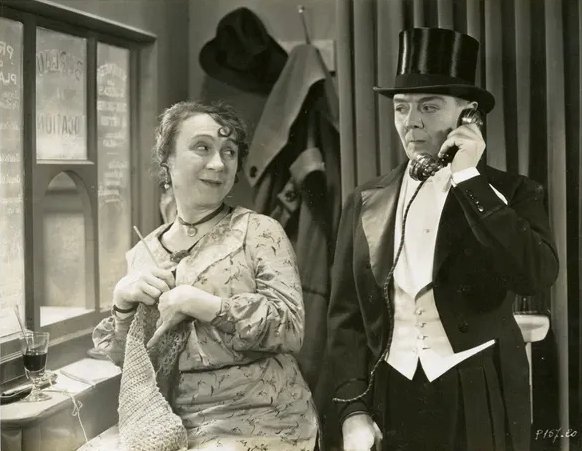
Production photograph (studio reference P157) showing the actress in her favourite role — laughing knitter facing a top-hatted partner. This photograph illustrates exactly what critics of the day called her "gouaille" (cheek) and her "mimiques" (facial play): everything is in the sidelong gaze, at once complicit and mocking.
- Falbalas by Jacques Becker (1945) — where she runs the seamstresses of a great fashion house
- Quai des Orfèvres by Henri-Georges Clouzot (1947) — her role became emblematic of post-war French cinema
- Le Diable boiteux by Sacha Guitry (1948) — playing Marie-Thérèse Champignon, Talleyrand's youthful love
- La Poison by Sacha Guitry (1951) — the florist, a cult scene
- Numerous comedies by Émile Couzinet, Jean Loubignac, Maurice Cammage with Fernandel
In comedy, she was for a long time the rival of Pauline Carton and Alice Tissot. "To earn one's living, it is great luck to be funny," she would say. "I am, and ultimately, it is to that gift that I owe my career." Her 180th and final film, she shot at over 80 years of age in 1966 — a rare achievement in the cinema of her time.
34 boulevard de Clichy — a home between theatre and cinema
While Charles painted and sculpted in his studio — first in Paris, then from 1929 at Grisy-les-Plâtres in the Vexin —, Jeanne maintained her Parisian career, which required her near-daily presence in the capital. She was "more often in Paris than at Grisy", her daughter testifies. The 34 boulevard de Clichy became her Parisian home base, a few minutes' walk from the theatres of the 9th and Bd Rochechouart, and a quarter-hour from the studios. She joined her husband at weekends, "as soon as possible", at Grisy. After Charles's death in 1941, Jeanne continued her career, crossing the end of the Occupation, the Trente Glorieuses, until her last shoot in 1966. She died in a Paris-region clinic on 24 April 1973, aged 88, and was buried at Grisy-les-Plâtres alongside her husband.
Legacy — the Maison Charles Gir and Jeanne Fusier-Gir
In September 2012, the Maison des associations of Grisy-les-Plâtres was inaugurated under the name "Charles Gir, peintre-sculpteur et Jeanne Fusier-Gir, comédienne" — a homage from the Vexin to this couple of artists who made the village their second home. Her films continue to circulate on television and on heritage platforms: France 3 Patrimoine, film clubs, art-house cinemas — regularly bringing her face and voice back into French homes.
A memory of n°34
With Charles, Jeanne and their son François, 34 boulevard de Clichy hosted over nearly fifty years a family of artists combining painting, sculpture, theatre, cinema and television. This family continuity, in a single building, across two generations, is one of the best-documented cases in the oral memory of n°34. The Building C apartment, to the left, and the ground floor of the same building — two distinct yet connected dwellings — formed a kind of vertical family cell of artists, where each generation practised its own art in its own discipline.
Sources & resources
- Wikipedia — Jeanne Fusier-Gir: biography, complete filmography, theatrography
- Municipality of Grisy-les-Plâtres — biography written by Charles Girard, her grandson, from the writings of his father François Gir
- Cinefil — Jeanne Fusier-Gir: annotated filmography
- Theatres: Théâtre Antoine, Théâtre des Bouffes-Parisiens, Théâtre du Vaudeville, Théâtre Sarah Bernhardt, Théâtre des Arts
- Directors: Sacha Guitry, Henri-Georges Clouzot, Jacques Becker, Max Ophüls, Christian-Jaque, Julien Duvivier, Henri Verneuil, Marcel Carné
- Public tribute: Maison des associations "Charles Gir, peintre-sculpteur et Jeanne Fusier-Gir, comédienne", Grisy-les-Plâtres, inaugurated September 2012