François Gir — real name François Pierre Girard — belongs to the second artistic generation of 34 boulevard de Clichy. Son of painter-sculptor Charles Gir and actress Jeanne Fusier-Gir, he was born on 13 March 1920 in the 18th arrondissement of Paris — that is, in all likelihood, at the 34 boulevard de Clichy itself, in his parents' apartment in Building C. As an adult, he lived on the ground floor of the same building, one floor below his parents: a rather exceptional configuration of a vertical family cell of artists, where three generations never parted while each practised its own art.
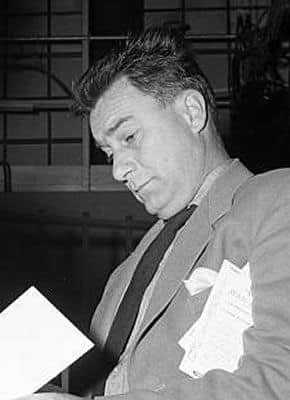
Undated set photograph, most likely from the 1950s-1960s. The director, his face absorbed, studies a document — script, shooting plan, or shot list.
A technical training in cinema
Unlike his parents, who were self-taught or trained by traditional masters (École Boulle for Charles, Gémier classes for Jeanne), François took a resolutely modern and technical path: he enrolled at the École Technique de Photographie et de Cinématographie, known as the École de Vaugirard — an emblematic institution of French cinema teaching in the 20th century, which trained generations of cinematographers and editors. A significant choice: François would not be a painter like his father, nor an actor like his mother, but a maker of moving images. A technological leap from one generation to the next.
Assistant to Sacha Guitry
The near-family friendship between the Girs and Sacha Guitry — sixty years of complicity between Jeanne and Sacha, from their teens — naturally opened the door to film sets for François. He became, on several occasions, assistant director to Sacha Guitry, from whom he learnt to translate theatrical staging into cinema — a cinema of dialogues, of authorial wit, of historical portraits, which would lastingly mark French style. Through Guitry, François understood the director's craft from the inside.
Marriage to Maria de Funès (1952)
Towards the end of the 1940s, François met Maria de Funès (1907-1993), elder sister of the actor Louis de Funès. Maria, then separated from her first husband, was raising two children: Charles, born on 9 April 1942, and Isabelle, born on 27 July 1944. François adopted both children as his own. He married Maria in 1952. The couple would live together until the end of the 1970s, and François thus became the brother-in-law of Louis de Funès — a family relationship that, as we shall see, would seal his fate as a filmmaker.
Mon pote le gitan (1959) — the only cinema feature
In 1959, François Gir directed his only cinema feature film: Mon pote le gitan, a comedy based on the play Les Pittuiti's by Michel Duran. The casting was a family affair: he directed his brother-in-law Louis de Funès, who was not yet the worldwide star he would become with Le Gendarme de Saint-Tropez (1964) and La Grande Vadrouille (1966) — but the film is one of the first in which he landed a lead role, that of the bourgeois publisher Védrines, after more than a hundred supporting appearances. Officially top-billed: Jean Richard, then a popular comic actor (later seen, twenty years on, as Inspector Maigret on television), in the role of the Gypsy Pittuiti. Also in the cast: a very young Michel Subor, future lead of Godard's Le Petit Soldat (1963), and Brigitte Auber, already known for Hitchcock's To Catch a Thief (La Main au collet, 1955).
The plot pits two families against each other: the Védrines, Parisian publishers, and the Pittuiti, Gypsies camping in the suburbs. Young Zita Pittuiti becomes pregnant by the Védrines son; to restore the family honour, father Pittuiti instructs his son Bruno (M. Subor) to seduce the Védrines daughter in turn. Shot from 20 June to 31 July 1959 in 35 mm black and white, the comedy was released in cinemas on 2 December 1959. Though its critical reception was modest, Mon pote le gitan remains memorable as one of the first showcases for Louis de Funès's comic genius — a turning point in the actor's career that his brother-in-law François Gir helped to bring about.
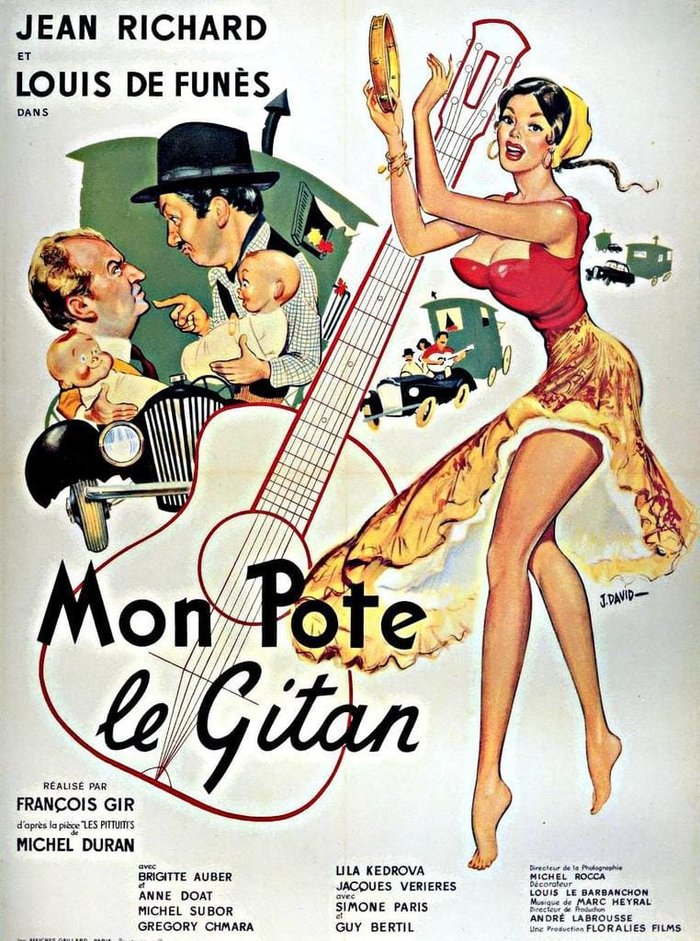
With Jean Richard in the title role of the Romani Pittuiti and Louis de Funès as the publisher Védrines. Adapted from the play Les Pittuiti's by Michel Duran. Sets by Michel Rocca, photography Louis Le Barbenchon, music Marc Heyral. A Floralies Films / CICC / Les Films de la Licorne production. Illustration signed J. David.
A long career as a television director
After Mon pote le gitan, François Gir resolutely turned to television from the 1960s — a symptomatic decision of an era when French television was experiencing its golden age and attracting talents trained in cinema. He directed numerous literary and dramatic adaptations for ORTF, then for FR3. Notable among these is La Veuve (FR3, 1974), a TV film based on a short story by Marcel Haedrich, with Monique Mélinand, Giani Esposito and Pierre Vernier. His television poetic belongs to the classical French school: careful sets, measured acting, mastered duration — an obvious inheritance from Sacha Guitry's model.
An extended family: Isabelle de Funès
Among the two children he adopted, Isabelle de Funès became a familiar figure to the French public: singer (singles in the 1960s-1970s, hits like Ferme la porte, Lapin lapin), actress (married to actor Michel Duchaussoy from May 1970 to October 1971), then photographer. She would emigrate at the end of the 1980s to Colombia, where she would fully develop her passion for photography. François Gir thus passed on to his adopted children, without passing on his blood, his culture of the image.
34 boulevard de Clichy — the ground floor of Building C
According to the oral tradition of n°34, François Gir as an adult occupied the ground floor of Building C, just below his parents' apartment (Charles and Jeanne on Building C to the left). This vertical configuration is one of the most remarkable cases in the history of n°34: a family of artists settled across two generations in two distinct dwellings of the same building. At Jeanne's death in 1973, the Gir occupation of 34 had lasted nearly sixty years (since Charles and Jeanne's marriage in 1911), crossing two world wars, the Vichy Republic, the Fourth and Fifth Republics. François therefore grew up in this building, made it his Parisian home port while accumulating houses and shoots — and probably received, in his ground-floor apartment of Building C, Sacha Guitry, Louis de Funès, his technicians and his actors.
The end — Pontoise
François Gir died at Pontoise, in the Val-d'Oise, on 12 December 2003, aged 83. Pontoise is a few kilometres from Grisy-les-Plâtres, where his parents had rested since 1941 (Charles) and 1973 (Jeanne) in the village cemetery. The geographical loop is thus closed: from 34 boulevard de Clichy where he was born in 1920, to the Vexin of the family house and his death, passing through the Parisian studios of Vaugirard and the television sets — François lived his artist's life within the Pigalle-Vaugirard-Vexin triangle that his parents had already traced for him.
Sources & resources
- Wikipedia — François Gir: biography, filmography
- frwiki.org — François Gir: biographical complements
- Encyclopedia of French film directors — entry "Gir, François (François Pierre Girard / March 13, 1920, Paris, France – December 12, 2003, Pontoise, France)"
- Feature film: Mon pote le gitan, 1959, with Louis de Funès
- TV films: La Veuve, FR3, 1974, after a short story by Marcel Haedrich, with Monique Mélinand, Giani Esposito, Pierre Vernier; many other productions for ORTF and FR3
- Training school: École Technique de Photographie et de Cinématographie (ENS Louis-Lumière since 1991)
- Family: Maria de Funès (wife, 1907-1993), Louis de Funès (brother-in-law), Charles Girard (adopted son), Isabelle de Funès (adopted daughter)