Sébastienne Marre is one of the "forgotten women painters of the early 20th century" recently rehabilitated by research in art history from a feminist perspective. Her entry at 34 boulevard de Clichy completes the Marre cycle of studio 4 and constitutes a link between her father's southern post-impressionism and great Parisian modernity.
A painter's daughter, a painter in her turn
Jeannette Marre was born from the late marriage (1910) of Henri Marre — then aged 52 — to Marie Castanié, 22 years his junior. She was their only child. Brought up between Montauban, Paris and Collioure, immersed in the artistic milieu of the Augustins circle (Bourdelle, Henri Martin, Achille Laugé, Paul Gervais — all friends of her father), she developed a pictorial vocation very early on.
When the time came to sign her works, she chose the pseudonym Sébastienne Marre — a singular choice, in direct tribute to Sébastien, her father's birth name (Henri Marre, born Sébastien Marre in Montauban). This signature inscribes her painting in the patrilineal memory while affirming her own authorial autonomy.
Studio 4 of the 34 — the transmission
Henri Marre died in Collioure on 26 August 1927. Sébastienne Marre then took over studio 4, in the inner courtyard of 34 boulevard de Clichy. The transmission of a studio from father to daughter, in the same courtyard, at the same Parisian address, testifies to a practice characteristic of Parisian artists' colonies: studios are passed on by filiation, sometimes over several generations.
This transmission would extend well beyond Sébastienne. Studio 4 would later be taken over by Michel Batlle, painter and sculptor born in Toulouse in 1946, French pioneer of Body Art, also from the South-West. The same studio thus saw Henri Marre (1858-1927), Sébastienne Marre (his daughter), then Michel Batlle — almost a century of Toulousain art in the same Parisian room.
A Parisian public career
Sébastienne Marre had a real Parisian career. She exhibited in particular at the Galerie Jeanne Castel, a renowned Parisian dealer — it was in this gallery that Bernard Buffet exhibited at his beginnings. This presence in a major gallery attests to a professional recognition that goes beyond the simple family or regional setting.
Several works signed S. Marre or Sébastienne Marre are documented today. Pêcheurs à Collioure (1935) and Scène de bal populaire (1936) appear in regional public collections. Her painting falls within the continuity of her father's post-impressionism, marked by Catalan landscapes and scenes of popular life in the South-West.
Recent rehabilitation — the Lavaur exhibition (2019)
In 2019, the Musée du Pays Vaurais (Lavaur, Tarn) devoted an exhibition entitled Regards de femmes: femmes peintres oubliées du début du XXᵉ siècle ("Women's Gazes: forgotten women painters of the early 20th century"), in which Sébastienne Marre figures among the rediscovered artists. This exhibition is part of the broader movement of re-evaluating the trajectories of French women painters of the inter-war period, long relegated to the shadow of their fathers, husbands or more famous male friends.
The Collioure house and Picasso's children
Sébastienne Marre owned a house in Collioure (Pyrénées-Orientales) located in the Mouré quarter. Local testimony: surrounded by cats, she was nicknamed by her neighbours "the lady with the cats". This house functioned as a place of welcome for artists visiting Collioure — the Catalan town has been, since the founding stay of Matisse and Derain in 1905, a high place of modern painting.
According to family tradition, during Pablo Picasso's stays in Collioure, Sébastienne Marre took care of his children. This anecdote, transmitted orally and documented in several local sources, illustrates the very dense human fabric of artistic circles between Paris, the South-West and Catalonia in the 20th century.
A figure to rediscover
Sébastienne Marre was long known only as "Henri Marre's daughter". Recent research in art history (Musée du Pays Vaurais, family archives, regional catalogues) gradually restores the coherence of her own career: a painter of the second generation of the Toulouse School, anchored at Collioure, present on the Parisian scene, and inscribed — through studio 4 of 34 boulevard de Clichy — in a lineage of South-Western artists that extends from Bourdelle to Michel Batlle.
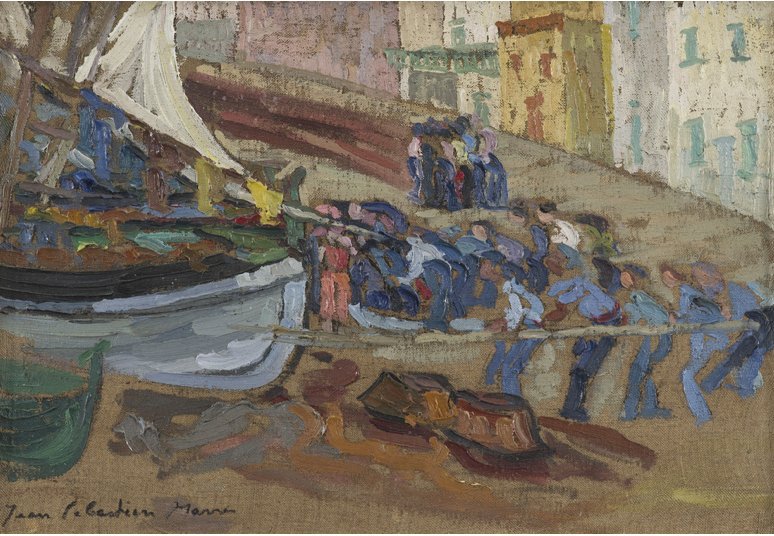
A tightly-built composition with vibrant brushwork, inherited from her father's post-impressionism. In the foreground, beached boats on the sand; in the background, the colourful row of port buildings. Work signed lower left.
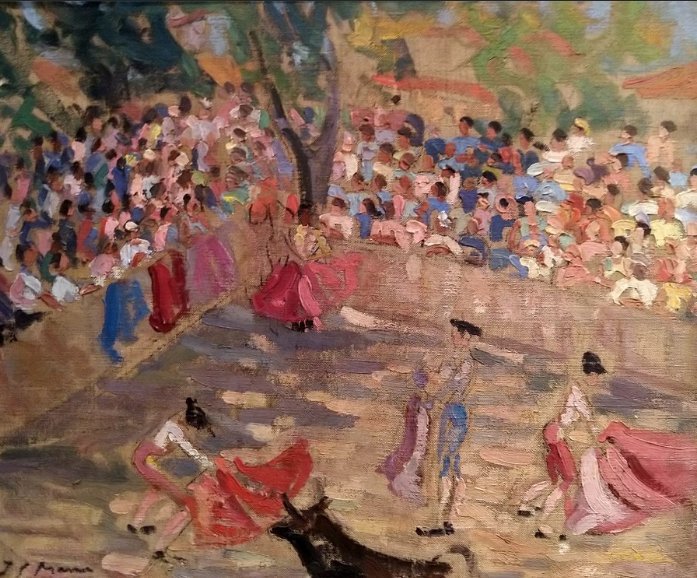
A tiered crowd treated in colour patches — pinks, blues, ochres — recalling her father's popular festival compositions. At the centre of the arena, the bullfighter and his cape make the reds sing. Testimony to Sébastienne Marre's taste for the popular life of south-western France, alongside her Catalan landscapes.
Sources & resources
- Musée du Pays Vaurais (Lavaur, Tarn) — exhibition Regards de femmes: femmes peintres oubliées du début du XXᵉ siècle, 2019
- Ingres-Bourdelle Museum, Montauban — Henri Marre collection, sources on his family
- Henri Marre page — sources on the Augustins circle, the marriage to Marie Castanié and the birth of Jeannette in 1911
- Marre family archives — Collioure (Mouré quarter), oral testimonies on the care of Picasso's children
- Bernard Buffet — Wikipedia (Galerie Jeanne Castel, Paris)
- Collioure — Wikipedia (founding city of Fauvism since Matisse and Derain in 1905)