Alongside Manet's Reichshoffen cycle (ground floor, 1878-1879), a second major pictorial presence of the 19th century is attested at 34 boulevard de Clichy: that of the painter, draughtsman, engraver and sculptor Paul-Joseph-Victor Dargaud, who had his working studio there.
The painter of Paris's construction sites
Son of Antoine Dargaud, a merchant tailor, Victor Dargaud studied with several masters before specialising in genre painting, still lifes and landscapes. A member of the Société des amis des monuments parisiens and of the Association of painters and sculptors, he became famous for his views of the Sacré-Cœur construction site (the basilica was begun in 1875) and of the reconstruction of the Hôtel de Ville after its burning by the Commune.
The construction of the Sacré-Cœur (1875-1914) — a forty-year building site
Dargaud's major subject — the Basilica of the Sacré-Cœur of Montmartre — was an exceptional building site, stretching over nearly forty years just six hundred metres from the studio at no. 34. Born from the Vœu national ("National Vow") formulated in 1870-1871 after the defeat at Sedan and the Paris Commune, the project was declared of public interest by the Assembly in 1873; an architectural competition was launched the following year, chaired by Charles Garnier (the architect of the Opera), which selected the design of Paul Abadie (1812-1884) — the diocesan architect of Paris, who also drew up the plans for the cathedral of Saint-Front in Périgueux, whose Romano-Byzantine style the basilica echoes.
The cornerstone was laid on 16 June 1875 by Cardinal Guibert, archbishop of Paris, in the presence of Marshal de Mac-Mahon, President of the Republic. But the soil of Montmartre, weakened by old gypsum quarries, required substantial foundation works: 83 wells, each 30 metres deep, were dug and filled with stone and concrete to act as underground pillars. Paul Abadie died in 1884 without ever seeing his work rise; five architects succeeded him in directing the site: Honoré Daumet, Charles-Jean Laisné, Henri-Pierre Rauline (1891-1904), Lucien Magne (1904-1916) and Jean-Louis Hulot (1916-1924).
The basilica was solemnly inaugurated on 5 June 1891, although the great dome was still missing — it was completed in 1899; the bell tower, rising to 91 metres, was finished in 1912; the façade as a whole was completed in 1914, but the First World War pushed back the official consecration to 16 October 1919. The stone chosen by Abadie was a Château-Landon limestone, famous for its self-whitening property when exposed to rain water — the same stone used for the foundations of the Eiffel Tower (1889), the Arc de Triomphe and parts of the Louvre. It is this gradual whiteness, this slow rising of a Neo-Byzantine basilica above the Butte, that Dargaud methodically painted from the studio at no. 34, in the afternoon light of north-eastern Paris.
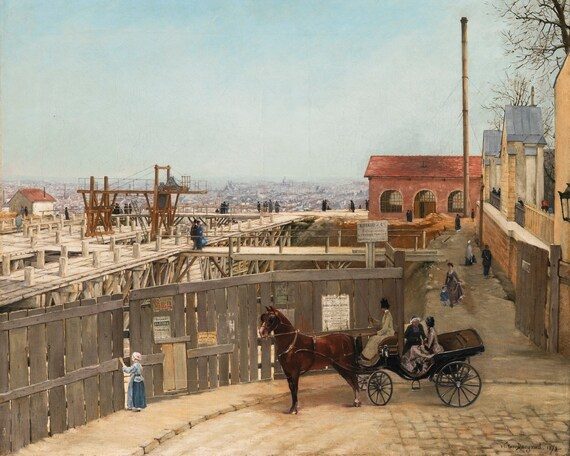
Scaffolding, workers, harnessed cab, hoardings: Dargaud methodically painted the basilica under construction from his studio at the 34, only 600 metres away.
The studio at 34 boulevard de Clichy
The presence of Dargaud's Parisian studio at the 34 is attested by several converging sources:
- The biography published by askArt.com places his studio at 34 boulevard de Clichy, not far from the Sacré-Cœur construction site.
- His entry in the Dictionary of Painters in Montmartre by André Roussard (Éditions Roussard, 1999), the reference work for artists who had a studio in Montmartre.
- Dargaud's favourite subject — he is famous for his views of the Sacré-Cœur under construction, located about 600 metres from the 34. The studio offered an ideal vantage point from which to follow the progress of the building site.
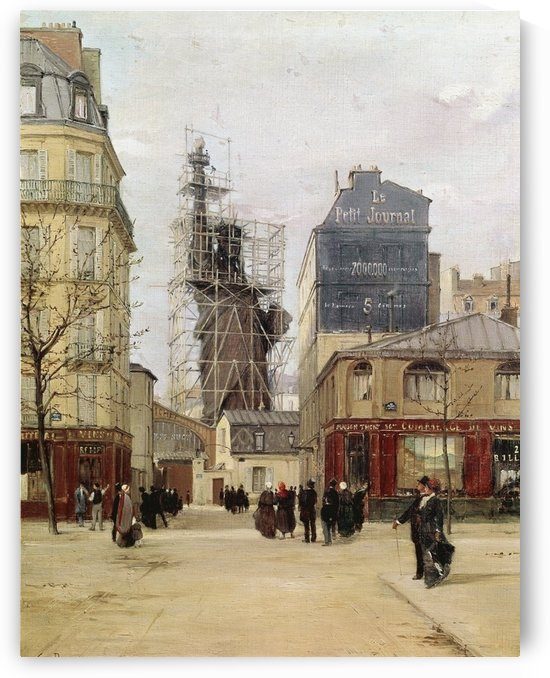
In the background: the Eiffel Tower under construction, surmounted by scaffolding. On the right: the bunting-covered façade of the Petit Journal, announcing its "7,000,000 copies". A typical scene of Dargaud's documentary painting.
The presence of a Dargaud studio at the 34 turns the ground floor and the courtyard-studio into a privileged observation point of the transformation of Paris at the end of the 19th century. While Manet, in the brasserie of the same building, was painting the sociological portrait of the waitress with beer mugs (1878-1879), Dargaud, in his studio, was painting the patrimonial portrait of the basilica under construction that would soon dominate the Butte.
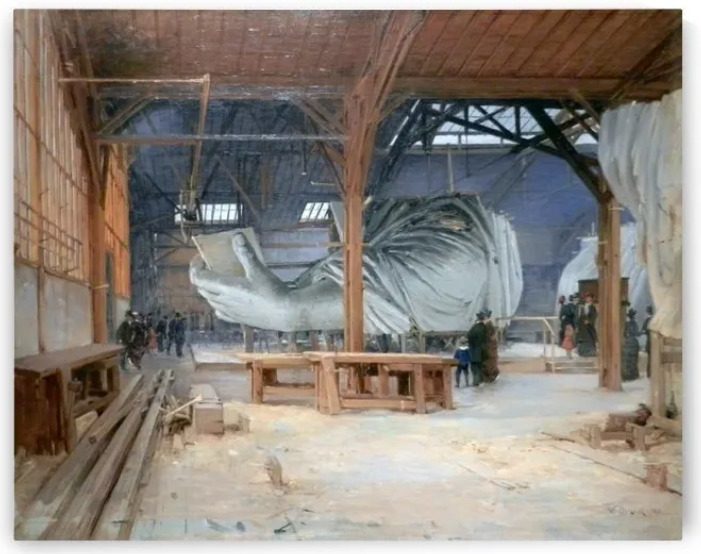
Several of Dargaud's canvases constitute direct pictorial documents of the Paris of that era. Here, the hand and arm of the statue offered to France by the United States, being assembled before being shipped to New York.
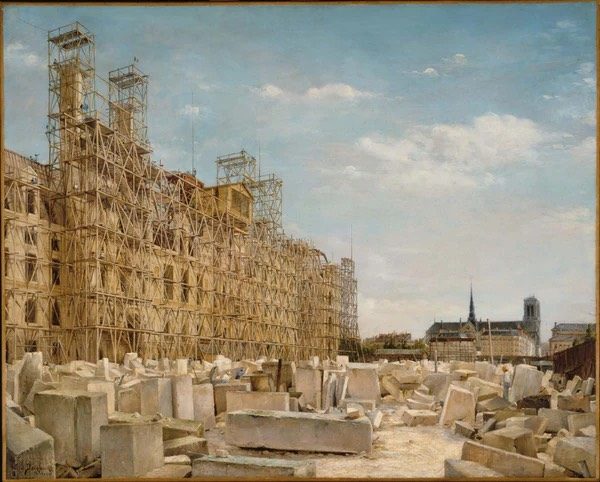
A forest of scaffolding, blocks of stone in the foreground, Notre-Dame in the background: the titanic worksite that followed the May 1871 fire, another favourite subject of the painter.
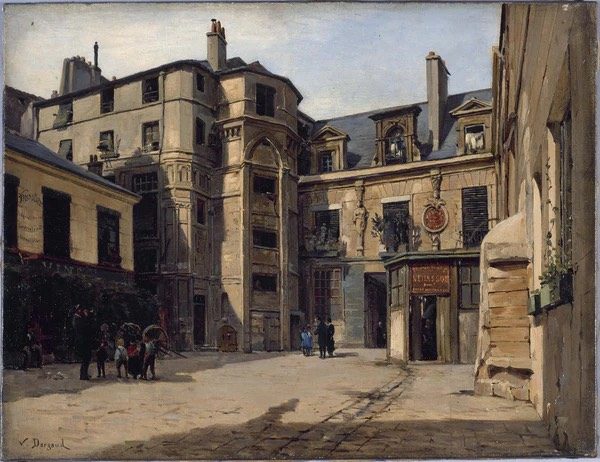
Canvas signed "V. Dargaud" at the bottom left. The painter set himself the task of fixing the memory of old Paris on the eve of its definitive Haussmannian transformation.
Sources & resources
- Victor Dargaud — Wikipedia
- BnF — Victor Dargaud authority record (id 14885431b)
- VIAF — cluster ID 95806007
- Bénézit Dictionary of Artists — id B00046840
- Union List of Artist Names (Getty) — id 500020302
- Carnavalet Museum — History of Paris, the main holder of his Parisian works
- askArt.com — biography, attestation of the studio at 34 boulevard de Clichy
- André Roussard, Dictionary of Painters in Montmartre, Éditions Roussard, 1999