The Brasserie Reichshoffen on the ground floor
On the ground floor of 34 boulevard de Clichy operated, in the 1870s and early 1880s, an Alsatian café-brasserie run by a man named Renault and called Reichshoffen — after the 1870 battle that sealed the loss of Alsace-Lorraine. The establishment offered, like many brasseries in the neighbourhood at the time, evenings of comic songs and sketches — exactly the type of establishment Manet painted.
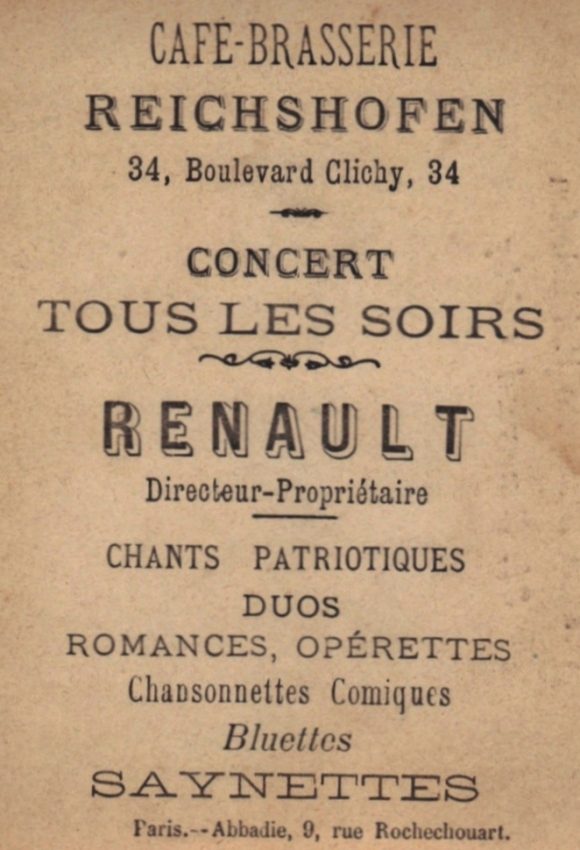
"Concert every evening · Renault, owner-director · Patriotic songs · Duets · Romances, operettas · Comic songs · Sketches · One-acts". Late 19th century.
Manet, painter of the Reichshoffen cycle — between 1874 and 1879
According to the National Gallery in London and Art UK, Manet began work as early as August 1874 on a large painting entitled Café-concert de Reichshoffen, fascinated by the skill of the waitresses in handling several beers at once without spilling a drop. The work intensified in autumn 1878 and continued until spring 1879. For this cycle, Manet did not use his usual studio but the studio of the Swedish painter Otto Rosen, at 70 rue d'Amsterdam (Paris 8th), from July 1878 to late March 1879.
According to Théodore Duret and then Adolphe Tabarant, Manet noticed the most skilful waitress and asked her to come and pose at the studio. She agreed — but on condition of being accompanied by her "protector", who would also demand payment. He is the man in the blue smock with a pipe, in the foreground of the London Corner of a Café-Concert, leaning on the table while the waitress sets a beer down in front of him. The studio work alternated with sketching sessions directly at the brasserie.
A "brasserie à femmes"
The Brasserie Reichshoffen is an example of a brasserie à femmes — a type of establishment that emerged in the late 1860s, employing waitresses associated, in contemporary perception, with prostitution. The Reichshoffen cycle was therefore controversial in its time: the subject was judged to be of an indecency not to be forgiven in a painter already accused of scandal since Olympia (1865) and Le Déjeuner sur l'herbe (1863). This is probably one of the reasons why Corner of a Café-Concert was never shown at the Salon. Manet exhibited it at his 1880 solo show at the Galerie La Vie Moderne, then in Lyon in 1883, and at the posthumous Salon des Beaux-Arts in 1884.
The literary context is that of the publication of L'Assommoir by Émile Zola in 1877. Critics have often suggested that the waitress in the painting could be a Gervaise, and the customers Rougon-Macquart characters — Manet establishes a direct dialogue between his painting and his friend's naturalist novel.
A cycle of four paintings from a cut composition
The Reichshoffen cycle, as reconstituted by X-rays and pigment analysis (Jean-Paul Rioux, 1989), is the outcome of a complex process: Manet cut a large initial painting entitled Café-concert de Reichshoffen into two unequal parts, then completed each half independently. X-rays show that the background window of the London Corner of a Café-Concert extends onto the Winterthur Au café — confirming that they are indeed the two halves of a single primitive canvas. Manet also enlarged the London painting by adding a strip of canvas about 7.5 inches (≈ 19 cm) on the right to recentre the waitress in the composition.
The complete cycle, today identified and held in four different museums, comprises:
- At the Café / The Café-Concert (1878), 47.3 × 39.1 cm, Walters Art Museum, Baltimore (Maryland, USA) — original title "At the Café"; the museum has since adopted "The Café-Concert". According to Tabarant, a café-concert scene at the Brasserie Reichshoffen, showing the waitress drinking a beer herself, a female customer smoking and a man watching the singer at the back.
- Corner of a Café-Concert (1878-79), 97.1 × 77.5 cm, National Gallery, London (NG3858) — right half of the cut primitive painting, enlarged by Manet. Sold in 1879 to Fernand Barroil of Marseille, who immediately had Manet take it back in exchange for Au café. Acquired by the Courtauld Fund in 1924 and given to the Tate Gallery, transferred to the National Gallery in 1952.
- Au café (1878-79), Sammlung Oskar Reinhart "Am Römerholz", Winterthur (Switzerland) — left half of the primitive painting. Shows a man and two women seated on the other side of the table.
- The Beer Waitress / La Serveuse de bocks (1879), 75.5 × 65 cm, Musée d'Orsay (RF 1959-4) — a tighter and more accomplished version. Wikipedia notes it is wrongly considered either as a second version or as a preparatory work for Corner of a Café-Concert; it is in fact the culmination of the cycle. Entered the Louvre in 1959 in application of the peace treaty with Japan (Matsukata collection), via the Pellerin, Bernheim-Jeune, Denys Cochin collections.
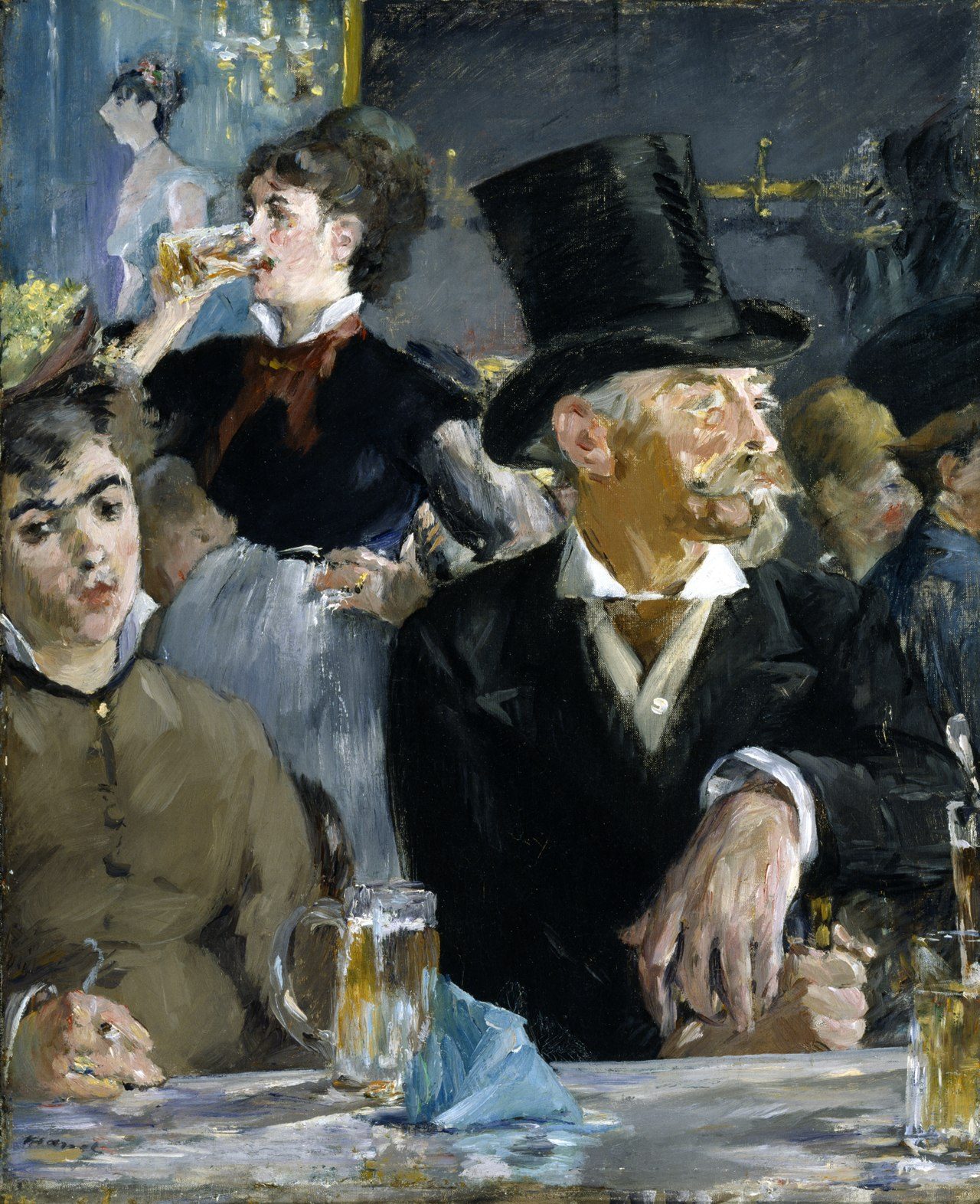
In the foreground, the drinker in the top hat; behind, the waitress and, in the background, the stage and the singer. This canvas is one of the fragments of an initial composition cut up by Manet himself.
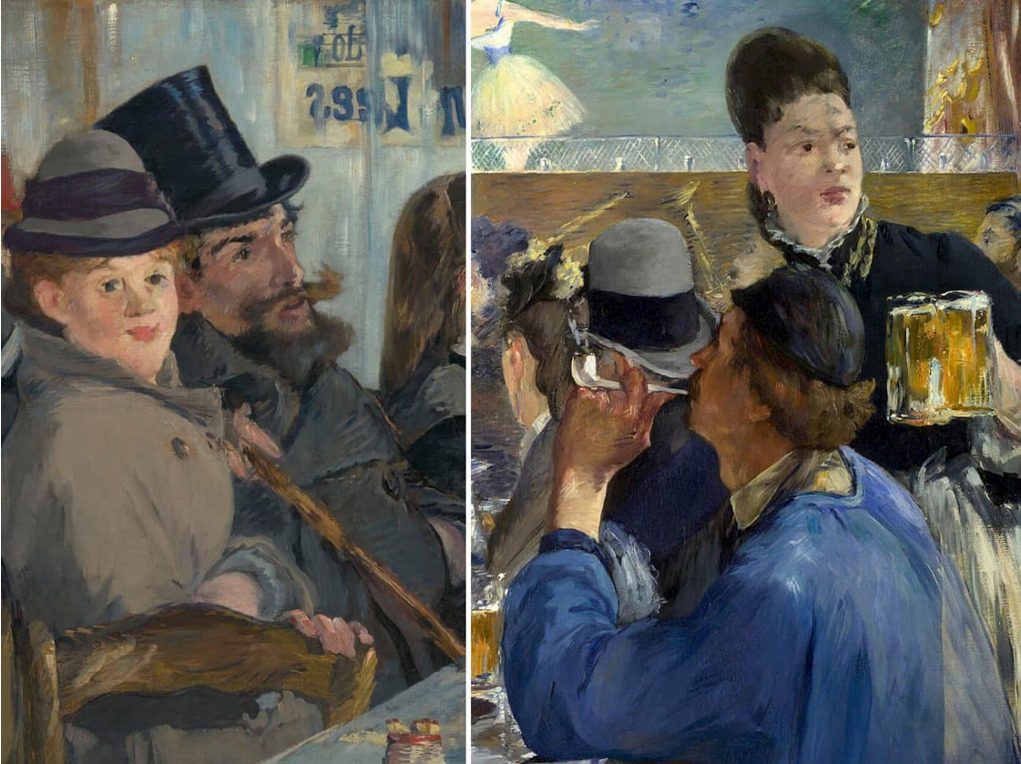
Manet cut an initial composition into two unequal parts before signing each half separately.
Location: a converging body of evidence pointing to 34 boulevard de Clichy
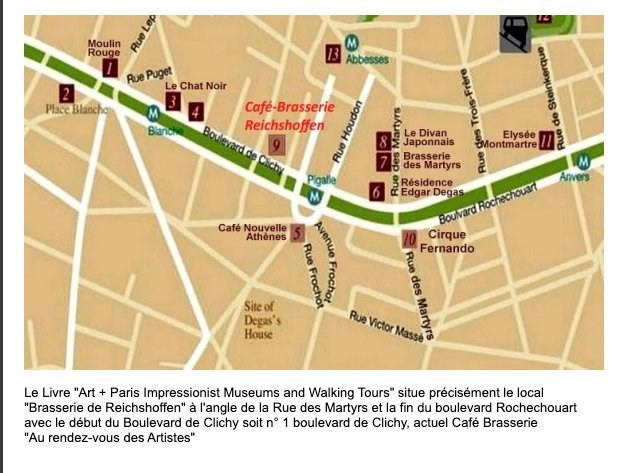
The exact address of the Brasserie Reichshoffen painted by Manet poses a classic historiographical question: contemporary sources do not explicitly settle the matter. Most American and British museum entries, following Tabarant (1947), prudently mention "boulevard Rochechouart", without giving a number. However, cross-checking the sources leads to a more precise conclusion: the establishment painted by Manet was most probably at 34 boulevard de Clichy, at the very corner where boulevard Rochechouart gives way to boulevard de Clichy. Here are the elements of the case.
1. The direct evidence: the invitation card of the Café-Brasserie Reichshofen at no. 34
The sign Café-Brasserie Reichshofen at 34 boulevard de Clichy is attested by a surviving period advertising document: "Café-Brasserie Reichshofen, 34 Boulevard Clichy, Renault, owner-director, concert every evening. Patriotic songs, duets, romances, operettas, comic songs, sketches, one-acts" — the menu reproduced at the top of this page. This is the only nominative archival mention linking a "Reichshoffen" establishment to a precise address in the neighbourhood during the period in question.
One detail of this same document deserves attention. Below the name of the brasserie appears the address "34, Boulevard Clichy"; but the printer's imprint at the foot of the page reads "Abbadie, 9 rue Rochechouart" — the address of the workshop that printed the menu, not that of the brasserie. The coexistence of these two addresses on a single document invites caution: the "boulevard de Rochechouart" location adopted by part of the critical literature could, hypothetically, stem from reading a printer's or supplier's address alone of the kind carried on such documents — though no source allows this to be established with certainty. The hypothesis is plausible but remains conjectural.
2. The historiographical confirmation by Étienne Moreau-Nélaton
Étienne Moreau-Nélaton (1859-1927) — painter, art historian, the Louvre's first major donor, and author in 1926 of the two-volume Manet raconté par lui-même, which remains one of the major biographical references on the painter — explicitly places the Brasserie Reichshoffen on boulevard de Clichy. This indication carries particular weight: Moreau-Nélaton personally knew and frequented Manet's circle in the painter's last years (Suzanne Manet, his brother Eugène, the dealers Durand-Ruel and Vollard, Berthe Morisot and her circle). His source is not bookish: it is the direct testimony of the painter's relatives.
3. Confirmation by a period journal (1875)
A nomenclature of Parisian cafés-concerts published on 11 April 1875 explicitly mentions, in the "Surroundings" section (Montmartre was then an independent commune annexed to Paris in 1860), the "Montmartre, café de Reischoffen" — Frenchified spelling, but clear identification. This primary source, found at the Bibliothèque nationale de France and unearthed by Juliet Wilson-Bareau — co-author of the Cachin/Moffett/Wilson-Bareau catalogue raisonné and a world authority on Manet — confirms the existence of the Reichshoffen on the boulevard at the level of Montmartre as early as 1875, that is the year preceding the start of Manet's great painting (August 1874-1877).
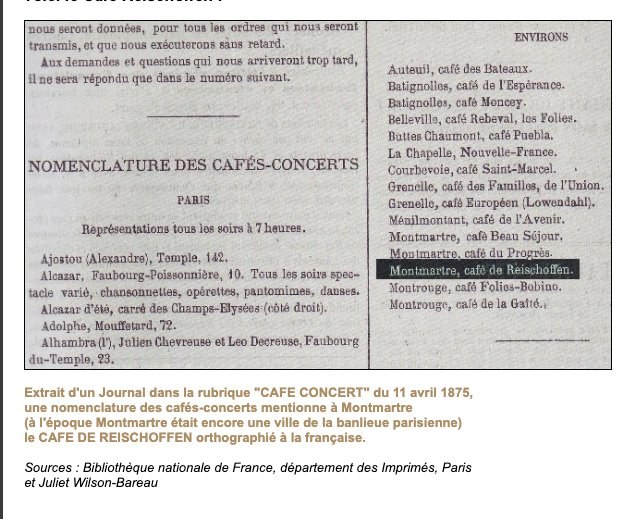
4. The Pigalle/Place Clichy perimeter confirmed by Françoise Cachin
Françoise Cachin (1936-2011) — director of the Musée d'Orsay and then of the Musées de France, curator of the great Manet retrospective at the Grand Palais in 1983, co-author of the Manet catalogue raisonné — in her book "Manet: J'ai fait ce que j'ai vu" (Découvertes Gallimard, 1994), locates the Brasserie de Reichshoffen "between Boulevard de Rochechouart and Place Clichy". 34 boulevard de Clichy lies precisely within this perimeter — at its very heart.
5. The Rochechouart-Clichy corridor geography: one boulevard, two names
The apparent Rochechouart/Clichy contradiction is partly resolved by geography. Boulevards de Rochechouart and de Clichy form one single continuous axis, which once ran along the Wall of the Farmers-General: they are merely two consecutive sections of the same outer boulevard. An establishment located at the corner or near the transition between the two could indifferently be called "boulevard Rochechouart" or "boulevard de Clichy" depending on the writers and their perception of the layout. 34 boulevard de Clichy lies very close to this transition.
6. The photographed shopfront of no. 34
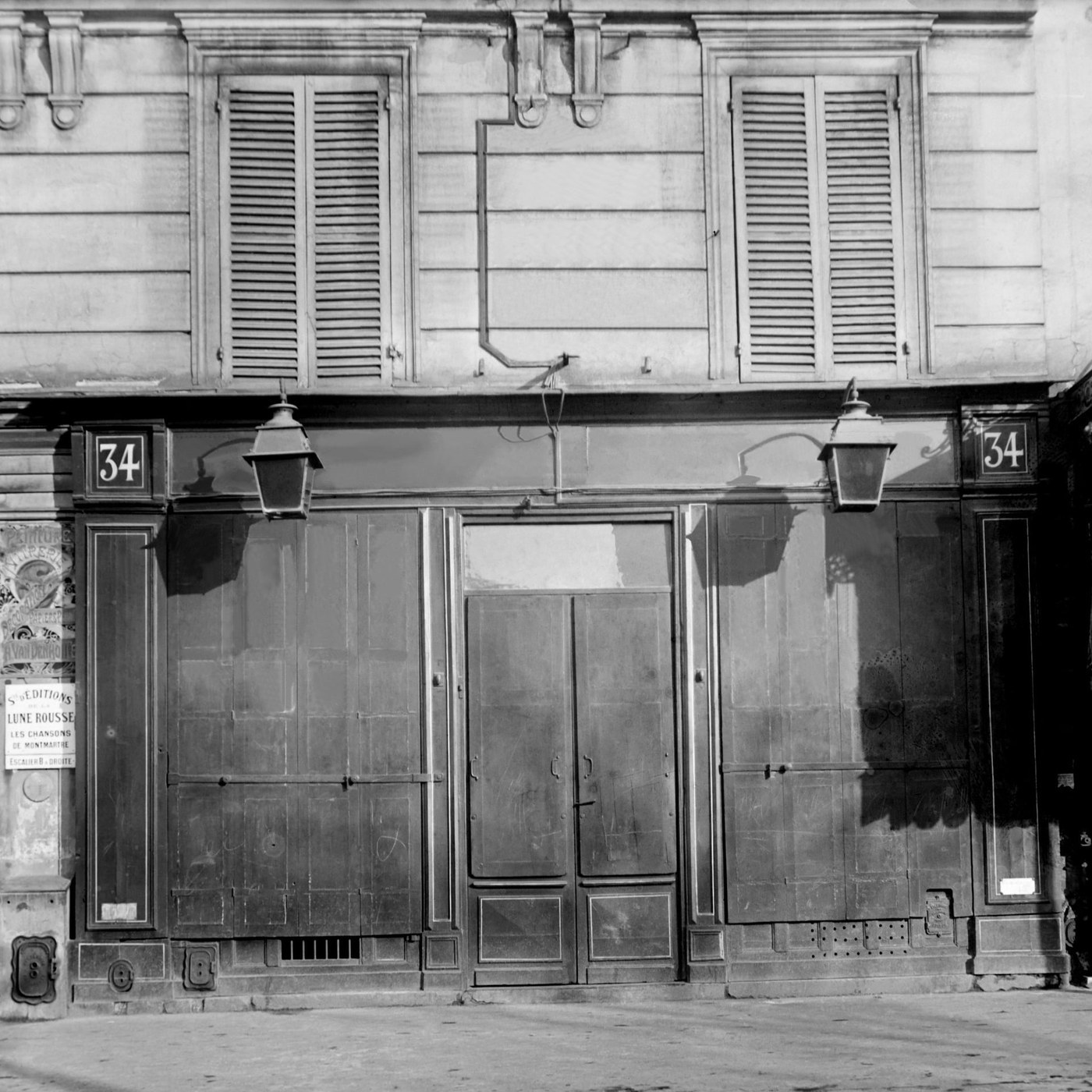
An old photograph of the shopfront of no. 34 shows the appearance the ground floor still kept after the closure of the brasserie: dark wooden doors, wall lanterns, two street numbers "34" placed in cartouches on either side of the window — the architectural memory of a corner café.
7. The cumulative argument: the only nominally documented establishment
No establishment named "Reichshoffen" has been able to be documented nominally at a precise address other than 34 boulevard de Clichy. The museum entries that mention "boulevard Rochechouart" never provide a number. In the absence of any other competing precise address, and in the presence of an explicit invitation card for no. 34, the principle of historiographical economy points to a single conclusion: the Café-Brasserie Reichshoffen painted by Manet is in all likelihood the one at 34 boulevard de Clichy.
The historical context supports this hypothesis: after the Franco-Prussian War of 1870 and the loss of Alsace-Lorraine, many Alsatians — including former cuirassiers from the Battle of Reichshoffen of 6 August 1870 — migrated to Paris and opened businesses with patriotic signs. The Café-Brasserie Reichshofen at 34 boulevard de Clichy, whose shopfront proclaimed "patriotic songs" and whose menu recalled, even in its spelling, the memory of the defeat, fits squarely into this Alsatian memory movement in Paris.
A site of memory: the Reichshoffen panorama and the memory of 1870
The Reichshoffen café — whose location at no. 34 is now well documented — was one of the meeting places of the Impressionists, according to Edmond Bazire (Manet, Paris, 1884, p. 71). It was a short walk from the Salle Valentino, 251 rue Saint-Honoré, where in November 1881 was exhibited the Panorama of Reichshoffen by Théophile Poilpot and Stephen Jacob — a gigantic circular canvas depicting the cavalry charge of Reichshoffen of 6 August 1870, one of the most deadly battles of the Franco-Prussian War. For an audience wounded by defeat and the amputation of Alsace-Lorraine, the very name Reichshoffen acted as a patriotic and melancholic signal. Manet, who had himself served in the National Guard during the siege of Paris in 1870-1871, could not have been unmoved by it.
Posterity: A Bar at the Folies-Bergère
The Reichshoffen cycle is one of the last great projects of Manet's career. Manet died on 30 April 1883, aged 51 — only four years after the cycle was completed. In 1881-1882, just before his death, he produced the definitive version of A Bar at the Folies-Bergère (Courtauld Institute, London) — a work that dialogues directly with the cycle painted at the Brasserie Reichshoffen: same setup of a waitress framed frontally, same reflection in the background, same tension between public life and feminine solitude at the counter.
No. 34, place of modern painting
The ground floor of 34 boulevard de Clichy gave birth, through Manet's eye, to one of the most famous images of Parisian modernity — or at the very least bore its sign. A few metres away, Eugène Pottier kept his textile-design studio (1880-1887), and Paul-Joseph-Victor Dargaud painted the construction sites of the Sacré-Cœur from the same building. Manet, Pottier and Dargaud very probably coexisted at this address between 1880 and 1883. No. 34 was at that time part of that ridge line where modern painting, popular song, Alsatian brasseries and the iconography of the 1870 defeat crossed paths — what Walter Benjamin would later call the "phantasmagoria of modernity".
A few years after Manet's death, no. 34 would extend its destiny as a cultural hub of the neighbourhood by hosting, from 1904, the Société d'éditions de la Lune Rousse at "staircase B right" — publisher of the sheet music of the famous neighbouring cabaret at no. 36. An enamelled plaque, still visible just next to the shopfront of the Café-Brasserie Reichshofen, bears witness to it.
Sources & resources
- Institutional sources on the works:
- Musée d'Orsay — work entry La Serveuse de bocks (RF 1959-4)
- National Gallery, London — Corner of a Café-Concert (NG3858)
- Walters Art Museum, Baltimore — The Café-Concert (formerly At the Café)
- Sammlung Oskar Reinhart "Am Römerholz", Winterthur — Au café
- Catalogue raisonné — Denis Rouart and Daniel Wildenstein, Édouard Manet. Catalogue raisonné. Tome I. Peintures, La Bibliothèque des arts, Lausanne/Paris, 1975, no. 311-313 (Reichshoffen cycle).
- Technical study — Jean-Paul Rioux, "La serveuse de bocks de Manet: étude technique et comparaison avec des œuvres apparentées", Histoire de l'art, no. 5-6, 1989, p. 109-120 — essential study, based on X-rays, which demonstrated that Corner of a Café-Concert and Au café are fragments of a single composition. Available on Persée.
- Period sources:
- Étienne Moreau-Nélaton, Manet raconté par lui-même, 2 vol., Paris, Henri Laurens, 1926 — reference biography by a direct witness of Manet's circle; locates the Brasserie Reichshoffen on boulevard de Clichy.
- Edmond Bazire, Manet, Paris, A. Quantin, 1884, p. 71 — the Brasserie Reichshoffen as a meeting place of the Impressionists.
- Théodore Duret, Histoire d'Édouard Manet et de son œuvre, Paris, H. Floury, 1902 — account of the choice of the model waitress.
- Adolphe Tabarant, Manet et ses œuvres, Paris, NRF/Gallimard, 1947 — which favours the "boulevard Rochechouart" reading.
- Modern scientific sources:
- Françoise Cachin, Charles S. Moffett and Juliet Wilson-Bareau, Manet 1832-1883, catalogue of the exhibition at the Grand Palais (Paris) and the Metropolitan Museum (New York), Réunion des musées nationaux, 1983 — reference catalogue raisonné of the Reichshoffen cycle.
- Françoise Cachin, Manet: "J'ai fait ce que j'ai vu", Découvertes Gallimard, 1994 — locates the Brasserie "between Boulevard de Rochechouart and Place Clichy".
- Juliet Wilson-Bareau, The Hidden Face of Manet: An Investigation of the Artist's Working Processes, Burlington Magazine Publications, 1986 — technical and X-ray study of the works; identification of the 1875 journal.
- Local research and documentary compilation:
- Bernard Schmitt, "Découverte récente: voici le Café Reischoffen!", site reichshoffen.free.fr, updated 2020 — compilation of primary sources (1875 journal, invitation card, testimonies of Alsatians migrating to Paris after 1870) which establishes the location at 34 boulevard de Clichy.
- Art + Paris Impressionist Museums and Walking Tours, Museyon Guides — Impressionist itinerary that places the Café-Brasserie Reichshoffen at the Rochechouart/Clichy corner.
- Encyclopaedic articles: Édouard Manet (Wikipedia EN) · Corner of a Café-Concert · La Serveuse de bocks (Wikipédia FR) · Au Café, Café-concert (Wikipédia FR).
- Nathaniel Greene, "Autour du Néant: Dorville et l'invention du cabaret macabre", revue 1895, no. 96, 2022 — commercial chronology of the ground floor of no. 34.
- BnF — Manet collection · Wikidata Q40599