Studio 4 of 34 boulevard de Clichy welcomed, in the first half of the 20th century, the post-impressionist painter Henri Marre and his daughter Sébastienne Marre, also a painter. This presence places the 34 in direct continuity with the École des Beaux-Arts de Toulouse and with the Augustins circle, one of the great centres of South-Western painting between 1875 and 1944.
The Augustins circle (Toulouse, 1875-1881)
On the benches of the École des Beaux-Arts of Toulouse — then housed at the Musée des Augustins — a group of friends formed in the years 1875-1881 that would lastingly mark the history of regional and national art. Five artists, all born between 1858 and 1861, formed there a friendship that would last all their lives:
- Henri Marre (1858-1927)
- Paul Gervais (1859-1944)
- Henri Martin (1860-1943)
- Antoine Bourdelle (1861-1929)
- Achille Laugé (1861-1944)
In 1877 and 1878, Gervais, Martin and Marre shared the prizes of the school. They all then went up to Paris, where they joined the studio of Alexandre Cabanel and that of Jean-Paul Laurens at the École nationale supérieure des Beaux-Arts.
Henri Marre's career
Born Sébastien Marre in Montauban on 24 January 1858, son of a carpenter, Henri Marre grew up on the banks of the Tarn. He studied at the Beaux-Arts of Toulouse from 1875 to 1878, then went up to Paris where he entered the École des Beaux-Arts. He joined Alexandre Cabanel's studio, where he studied from 1880 to 1883. He took part regularly in the Salon des Artistes Français until 1899.
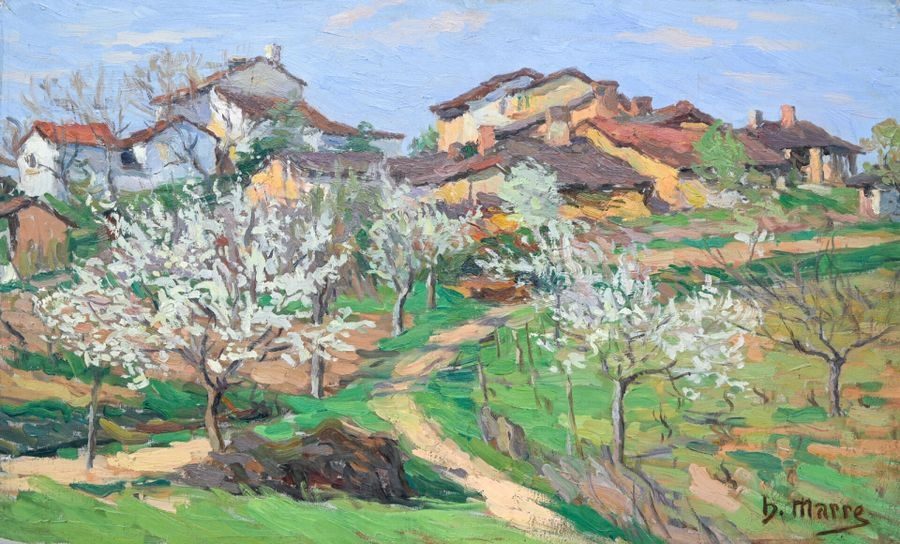
The fragmented brushwork and saturated light characterise Marre's manner in his Mediterranean landscapes, which he would discover fully at Collioure in the 1920s.
Not at ease in the capital, Marre returned to his native region in 1883, first to Saint-Maurice near Lafrançaise, then to Montauban. His painting evolved towards a luminous post-impressionism, devoted to the landscapes of the Quercy and later of Collioure — a village he made known to his friend Henri Martin in the early 1920s. In 1891, he was appointed professor of artistic drawing at the municipal public course in Montauban. He was raised to the rank of Officer of the Academy in 1901.
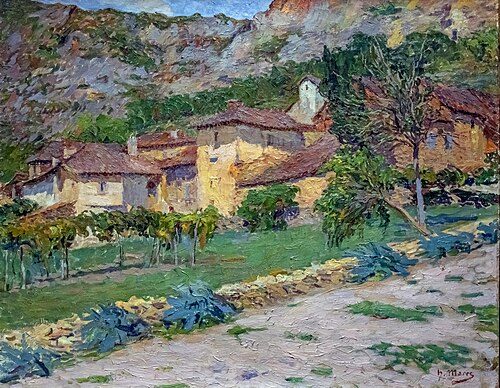
Houses with red roofs, gardens, the light of the Midi: a repertoire that Marre developed between Lafrançaise, Montauban and later Collioure.
Henri Marre married in 1910, at 52, Marie Castanié, 22 years his junior. The couple had an only daughter, Jeannette, who would later practise under the name Sébastienne Marre — a first name chosen in tribute to her father's birth name. Henri Marre died at Collioure on 26 August 1927.
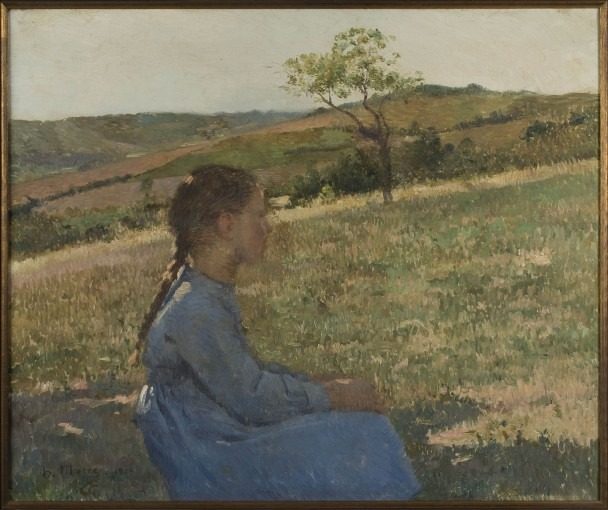
A softer, more academic touch, in the spirit of late 19th-century plein-air painting.
Sébastienne Marre, daughter and continuator
Jeannette Marre, known as Sébastienne Marre, was a painter in her father's lineage. Several of her works are documented and appear in regional public collections — in particular Pêcheurs à Collioure (1935) and Scène de bal populaire (1936). She was presented in 2019 at the Musée du Pays Vaurais (Lavaur, Tarn) in the exhibition Regards de femmes: femmes peintres oubliées du début du XXᵉ siècle.
Sébastienne Marre had a Parisian public career, exhibiting in particular at the Galerie Jeanne Castel, a Parisian dealer renowned in particular for having represented Bernard Buffet at his beginnings.
The house in Collioure
Sébastienne Marre owned a house in Collioure (Pyrénées-Orientales) located in the Mouré quarter. Local testimony: surrounded by cats, she was nicknamed by her neighbours "the lady with the cats". This house functioned as a place of welcome for artists visiting Collioure — the Catalan town has been, since the founding stay of Matisse and Derain in 1905, a high place of modern painting. According to family tradition, during Pablo Picasso's stays in Collioure, Sébastienne Marre took care of his children.
Studio 4 — the Marre / Batlle transmission
Henri Marre and Sébastienne Marre occupied studio 4 of the courtyard at the 34, then this studio was later taken over by the artist Michel Batlle — painter, sculptor and a French pioneer of Body Art, also originally from the South-West (born in 1946 in Toulouse, son of a Catalan political refugee).
This continuity of the same studio, passed on from one generation to another between South-Western artists, is characteristic of the Parisian artists' colonies. Studio 4 of the 34 thus constitutes, on its own, a real link between the late 19th-century Toulouse post-impressionism and French contemporary art.
Sources & resources
- Henri Marre — Wikipedia (FR)
- INHA — Agorha, authority record for Henri Marre
- Ingres-Bourdelle Museum, Montauban — main holder of Henri Marre's works
- Paul-Dupuy Museum, Toulouse — works in the context of the Toulouse School
- Musée du Pays Vaurais (Lavaur, Tarn) — exhibition Regards de femmes: femmes peintres oubliées du début du XXᵉ siècle, 2019
- Antoine Bourdelle — Wikipedia · Henri Martin — Wikipedia · Achille Laugé — Wikipédia (FR) (FR) · Paul Gervais — Wikipédia (FR) (FR) (Augustins circle)
- Catalogues of the Salon des Artistes Français, 1880-1899