In the first half of the 20th century, 34 boulevard de Clichy housed the Paris studio of Pierre-Luc Feitu, a Breton sculptor. His work combines official commissions, commemorative monuments and bronzes — divided between Paris (where he exhibited and worked) and Brittany, his native region.
A presence documented by the family and by the INHA
The studio at no. 34 is mentioned explicitly by the official website sculpteur-feitu.fr, run by the Feitu family (Yves Feitu), which brings together a biography and a gallery of works. The Agorha authority record of the Institut national d'histoire de l'art (INHA) gives the dates "Feitu, Pierre, 16/04/1868 - 01/02/1937, sculpteur" and refers to the Feitu/Germain correspondence with Jean-Émile Laboureur (1914-1926), held at the INHA library (Jacques Doucet collections, shelfmark Autographes 185, 84).
A career between Paris, Brittany and the wider world
A sociétaire of the Société des Artistes Français, Feitu made his Salon debut in 1901 with Portrait d'homme, a plaster bust. The Galeries Georges Petit and the Petit Palais showed his works; he also exhibited in New York, Philadelphia, Pittsburgh and Mexico City. The Bénézit records that he made the sword of Albert Iᵉʳ, King of the Belgians. Works in the Musée de Brest. Studio at 34 boulevard de Clichy.
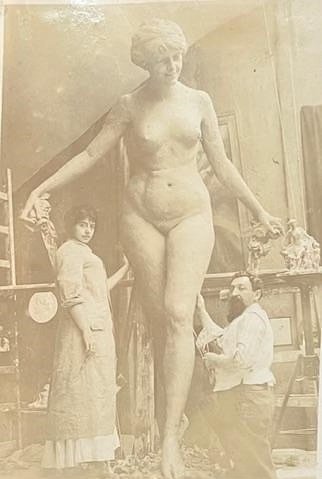
The classic layout of an early 20th-century sculptor's studio: a living model, a plaster being modelled, bronze sketches in the background. Family archive photograph.
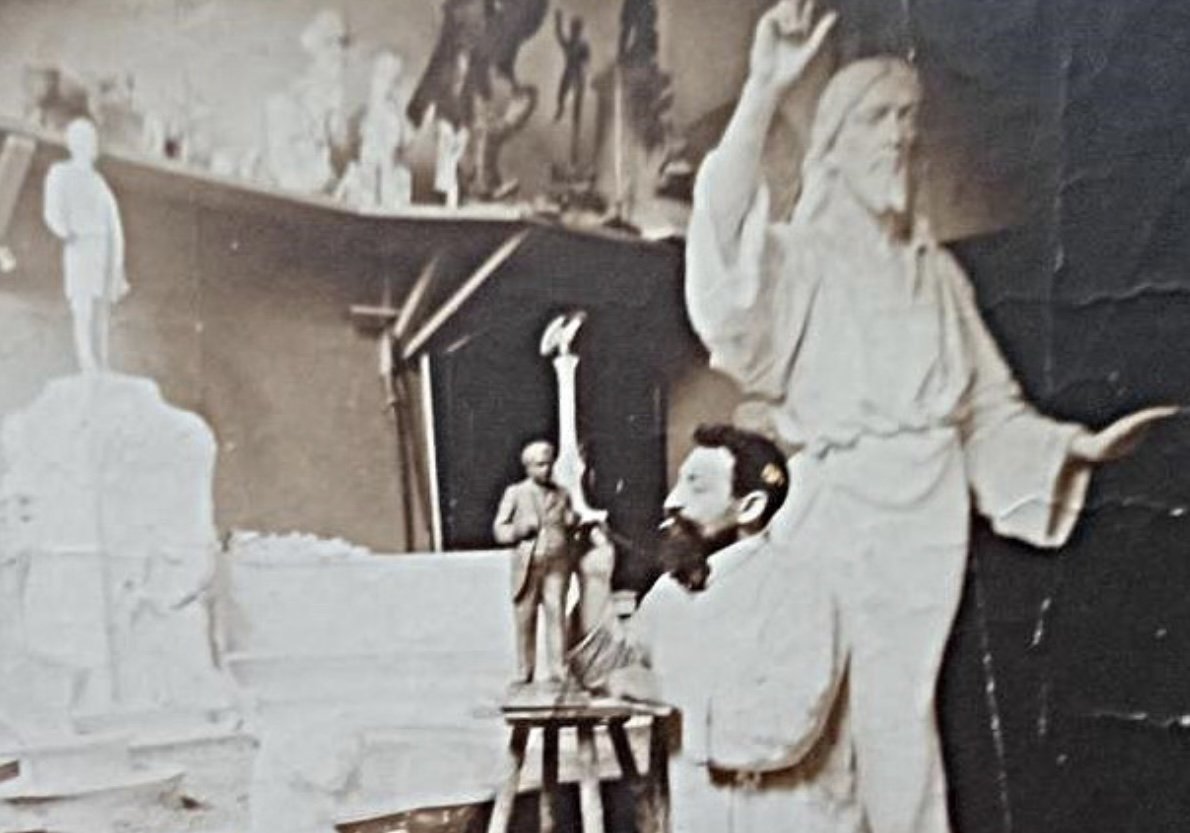
The studio then holds several works at once: a statuette in progress on a stool, bas-reliefs on the wall, and the large figure on the right. Archive photograph.
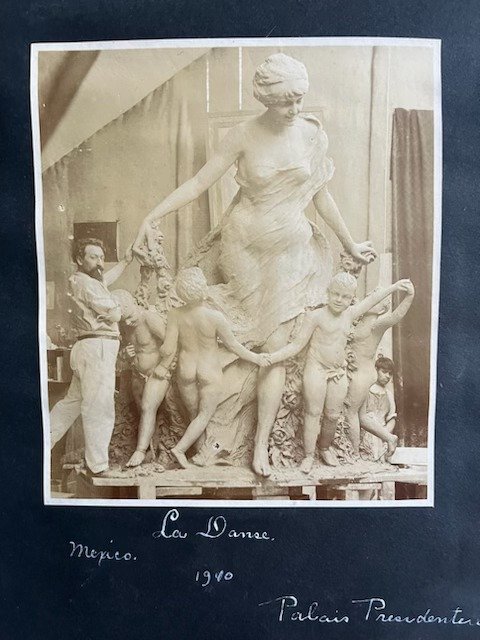
Archive photograph mounted in an album, handwritten caption. Monumental sculpture of a woman surrounded by dancing putti. Feitu's presence at the Presidential Palace in Mexico City illustrates the international dimension of his career.
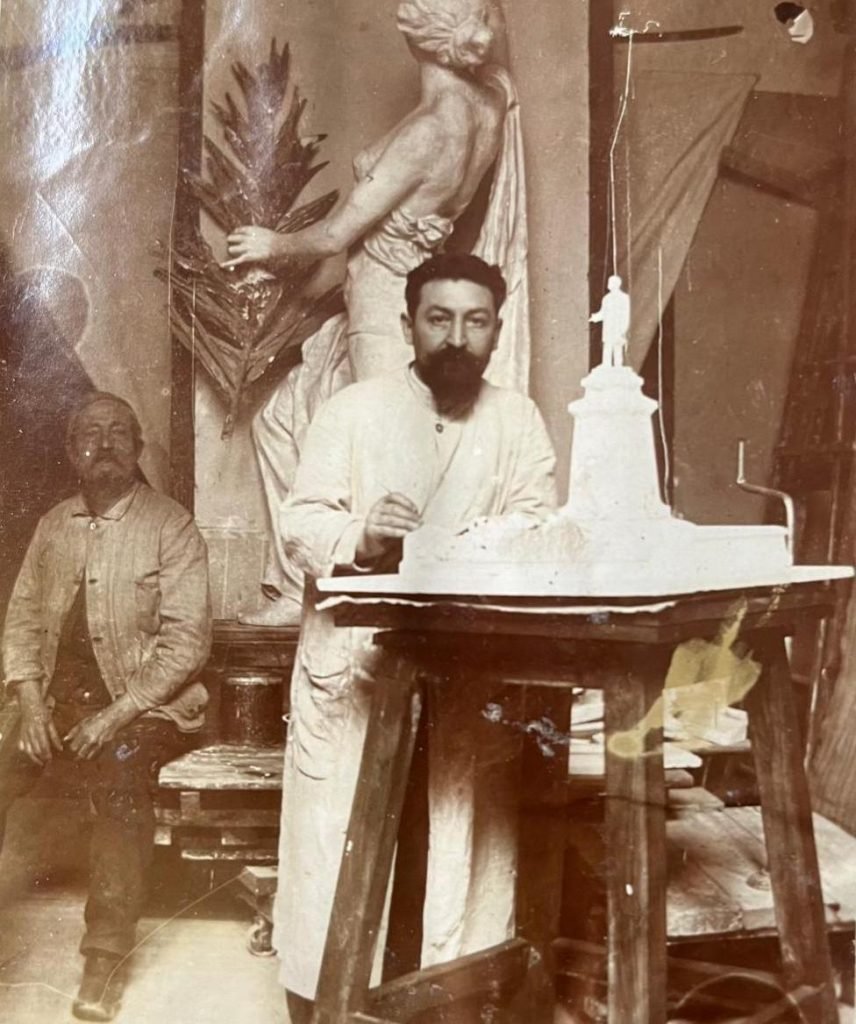
Probably a preparatory maquette for a commemorative monument, one of the many official commissions Feitu carried out between Paris and Brittany.
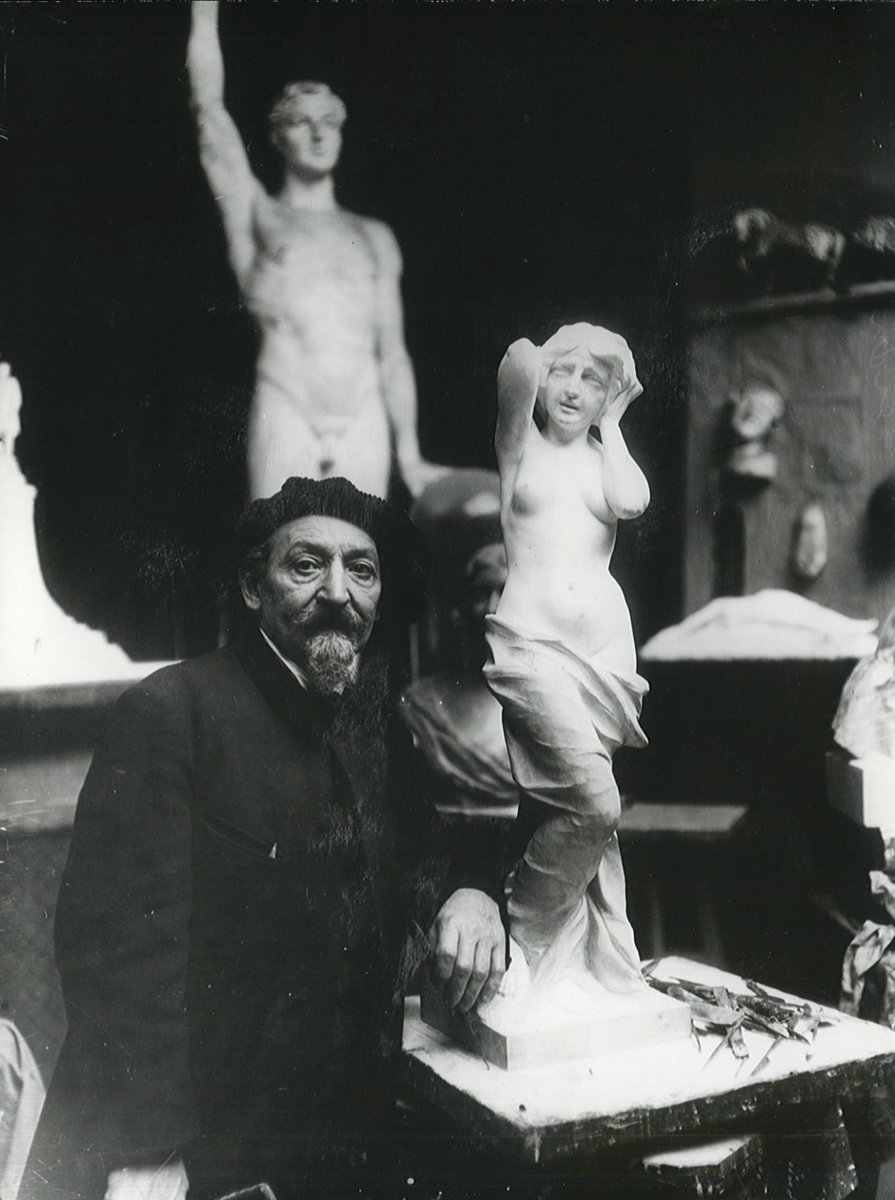
Late portrait (probably 1930s). Behind him, a large male sculpture with a raised arm; on the table in front of him, a draped female statuette — sensitive modelling of the folds and of the twist of the body.
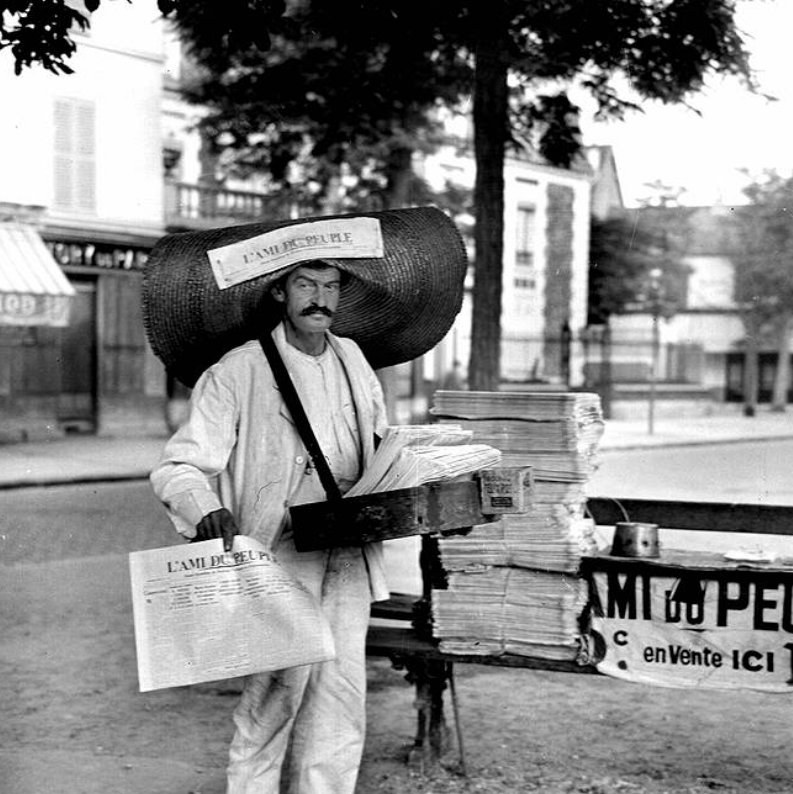
An unusual shot: the Breton sculptor plays along and takes on the role of a street vendor, an enormous sombrero on his head serving as an advertising banner for François Coty's daily (launched in 1928). The photograph is the work of Albert Harlingue, a Parisian photographer established from 1905 in rue Sevestre in the 18th arrondissement. A reporter for the illustrated agency bearing his name, he documented Parisian political, military and artistic life for six decades — from the trenches of 1914-18 to artists' studios. On his death in 1964, his 70,000 or so negatives entered the Roger-Viollet collection.
Continuity of the studio vocation
His presence at no. 34 extends the building's vocation as a place of studios, already attested for Pottier, Dargaud and later Hella Guth. Over more than a century, no. 34 has thus kept its discreet but constant reputation as an artists' enclave. On his arrival Feitu probably shared the premises with Henri Marre (studio 4) and with Petit Georges (the music-hall singer, resident around 1914), before being followed, at a distance, by Hella Guth (1951-1992).
Sources & resources
- sculpteur-feitu.fr — official website of the Feitu family (Yves Feitu): biography, gallery of works, explicit mention of the studio at 34 bd Clichy
- Official Facebook page "Pierre Feitu – Pierre-Luc Feitu, sculpteur"
- INHA — Agorha, authority record "Feitu, Pierre, 16/04/1868 - 01/02/1937, sculpteur"
- INHA library, Jacques Doucet collections — Feitu/Germain correspondence to Jean-Émile Laboureur (1914-1926), shelfmark Autographes 185, 84
- e-monumen.net — catalogue of French public commemorative monuments
- Bénézit dictionary · Lamy dictionary
- Pierre Kjellberg, Les bronzes du XIXᵉ siècle, 1996; Yves Devaux, L'univers des bronzes, 1978; Jean-Claude Renard, L'âge de la fonte, 1985; Louis Tenars, monograph (cited by sculpteur-feitu.fr)
- Musée du Petit Palais · Musée de Brest · Musées de Reims — works held