Opening: Ciné-Vox-Pigalle (1938)
The hall opened on 8 February 1938 under the name Ciné-Vox-Pigalle. The company Cinévox Cinéma is still registered at the address, under the APE code for cinema operations — an administrative relic of that period of activity, almost ninety years later.
The opening coincides with the end of the Cabaret du Néant (which had occupied the ground floor since 1895) and with the great period of cinema construction in the Pigalle district, which would host several dozen cinemas between the wars and the 1960s.
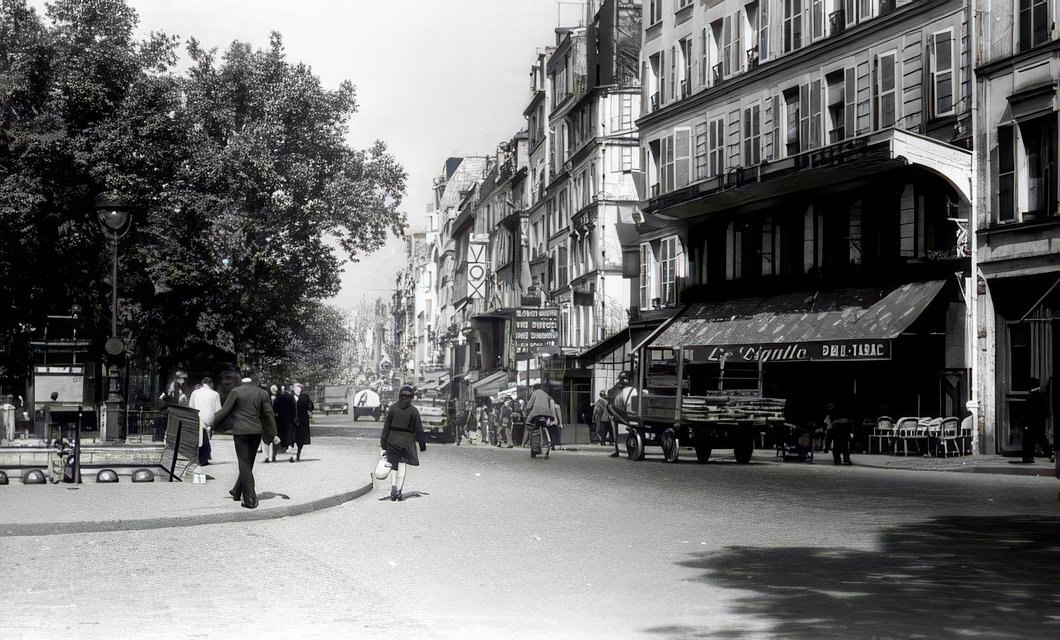
View of a Pigalle boulevard in the late 1930s or early 1940s. On the right, a large café-tabac with the sign "La Cigale · TABAC", its dark canopy, terrace chairs and corner door. In the middle and further away, vertical signs on the façades indicate several shops — a lively, working-class neighbourhood, a string of cinemas, cafés, and food shops. In the foreground: tree-lined median of the boulevard, newspaper kiosk, passers-by in overcoats, a man with a bucket, a delivery man on his flatbed cart. This is the ordinary atmosphere of Pigalle in which no. 34 opened its cinema on 8 February 1938 — a boulevard where popular cinema took the natural succession of the cabarets of the turn of the century.
The architect — Julien Hirsch (E.P.Z.)
The hall was designed by architect Julien Hirsch, trained at the Zurich Polytechnic School (E.P.Z.), who practised in Paris in the 1930s. In 1935 he published a collection entitled Quelques réalisations de Julien Hirsch, architecte E.P.Z. (Paris-Strasbourg, S.N., 1935), one copy of which is held at the Cabinet des estampes of the Bibliothèque nationale de France and is catalogued by the Atlas of Architecture and Heritage of Seine-Saint-Denis.
Hirsch was an architect specialised in cinema halls in the late 1930s. Besides the Ciné-Vox-Pigalle, he designed the Cinevog Latin (Latin Quarter), which also opened in 1938: a newsreel theatre installed in a former restaurant, where Hirsch managed, as Cinema Treasures notes, to fit "a single-screen auditorium with a deep balcony, a lobby, and a large façade, with a curved stage that gave the feeling of a bigger place than it actually was" into a constrained volume. No. 34 boulevard de Clichy falls within the same typology: conversion of a cabaret space into a projection hall, on two levels (orchestra + balcony), with careful work on the façade and the signage.
Stylistically, his writing belongs to Streamline Moderne — the late variant of Art Deco characterised by horizontal lines, aerodynamic curves, simple volumes, indirect lighting. This is the aesthetic of French popular cinema of the late 1930s, halfway between interwar Modernism and post-war functionalism. Hirsch belongs to the second wave of cinema equipment in the Pigalle district, where several dozen halls would open between 1925 and 1960.
His signature at no. 34 remains discreet: as far as we know, no plaque mentions him on the spot, and his name does not appear in any heritage guide to the neighbourhood. This entry modestly restores him to the history of the place.
Intermediate phases: Le Clichy, Agora (1946-1951)
According to the specialised database Cinema Treasures, two intermediate operational names appear between 1946 and 1951: Le Clichy and Agora. This phase corresponds to the post-war revival of the hall, following the definitive closure of the Cabaret du Néant.
Interesting detail: during this intermediate phase, no. 34 shared the name "Agora" with another cinema on the same boulevard located at 64 boulevard de Clichy / 2 rue Coustou — the Cinéma Agora opened in 1932 in a 300-seat basement hall, taken over in 1934 by one of the Fratellini brothers (from the neighbouring Cirque Médrano), and which would operate until 1995 (according to the entry compiled by Ciné-Façades by Philippe Célérier). For five years, two Agora cinemas thus coexisted thirty metres from one another on the same boulevard de Clichy — a curious homonymy, probably linked to the success of the Cinéma Agora at no. 64 that the no. 34 hall tried to capitalise on during its identity-seeking phase, before finding its definitive name in 1951 with the rebranding in tribute to Gone with the Wind.
Renaming: the Scarlett (1951)
On 19 December 1951, the hall was renamed Scarlett. According to local oral tradition, the name is a direct tribute to Victor Fleming's Gone with the Wind (1939) — Scarlett O'Hara being the heroine of the film, who had become a mythic figure of popular cinema at the turn of the 1950s. The hall specialised in B and Z movies: horror cinema, neighbourhood crime films, low-budget adventure films, second-tier Italian and American exploitation productions. This is the golden age of boulevard cinemas where programming rotated quickly and one could enter at any time — hence the mention "PERMANENT" visible on the woodwork of the hall.
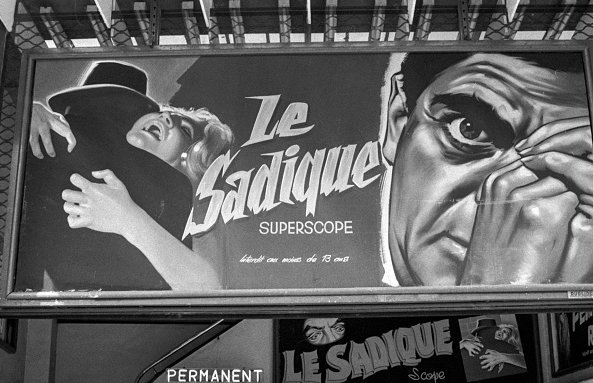
Mention "PERMANENT" on the lower woodwork, mention "No admittance for under-13s" beneath the title. Superscope is a 1950s widescreen projection format — a typical choice of B and Z movies which played on the technical argument to attract audiences.
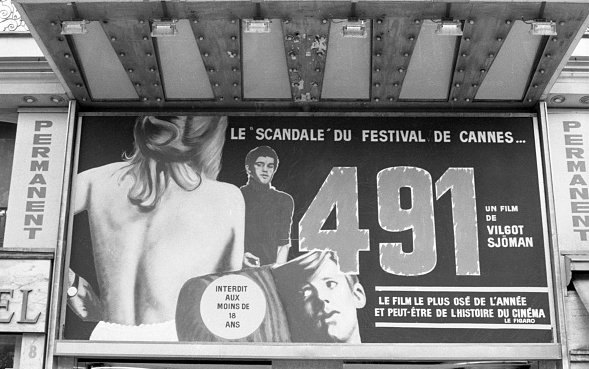
The advertising tagline announces "The scandal of the Cannes Festival" and, according to Le Figaro as quoted on the poster, "The boldest film of the year and perhaps in the history of cinema". The film, released in 1964, is adapted from the novel of the same name by Lars Görling and caused a scandal from its premiere at the 1964 Cannes Festival. It was banned in Sweden then re-released with cuts, banned in Norway until 1971, refused by the British BBFC in 1968, and seized by US customs. This poster is therefore a precious chronological marker: it places the Scarlett's erotic programming as early as the mid-1960s — and not, as is often said, from 1968-1969 onwards. Mention "No admittance for under-18s".
The shift to erotic cinema: Bénazéraf, Pécas, Franco
Through the 1960s and especially after 1968, like most cinemas on the boulevard, the Scarlett shifted to erotic film. The programming transformed: "sex loops", soft-erotic films, risqué comedies, then soft pornography from the mid-1970s onwards. The headliners of the Scarlett at this period are the three major figures of European erotic cinema:
José Bénazéraf (1922-2012), born in Casablanca, friend of Jean-Luc Godard — appears in Breathless. Nicknamed "the Godard of X", "the Antonioni of Pigalle", sometimes "the Buñuel of eroticism", he blended politics and eroticism and defied the censors from the early 1960s. Henri Langlois said of his films that they were "like rivers carrying stones and diamonds". Emblematic films: L'Éternité pour nous (1960), Le Concerto de la peur (1963), Joe Caligula (1965), Le Désirable et le Sublime (1969), Frustration (1971), Black Love (1973). In 2022, his daughters donated all his archives to the CNC.
Max Pécas (1925-2003), born in Lyon, is according to the Cinémathèque française the "French pioneer of the Z style, also called nanard cinema". He stood alongside Bénazéraf as one of the masters of the French erotic genre, capable of exporting well, with Le Cercle vicieux (1959), La Baie du désir, I am a Nymphomaniac (1970), Claude et Greta, Sexually Yours (1974), before shifting in the late 1970s to the Saint-Tropez comedies that would become the very archetype of French B-movies.
Jesús Franco (1930-2013), born in Madrid, signs hundreds of films at a frantic pace under some twenty pseudonyms ("Clifford Brown", "Jess Franck"…) — up to three films at once with the same crews. He shot all over Europe, escaping Francoist censorship by working in French co-production. Notable works: The Awful Dr. Orlof (1961), Necronomicon (1967), Eugénie de Sade (1970), A Virgin Among the Living Dead (1971), Les Gloutonnes (1975) — precisely the one whose colourful poster sits on the Scarlett below.
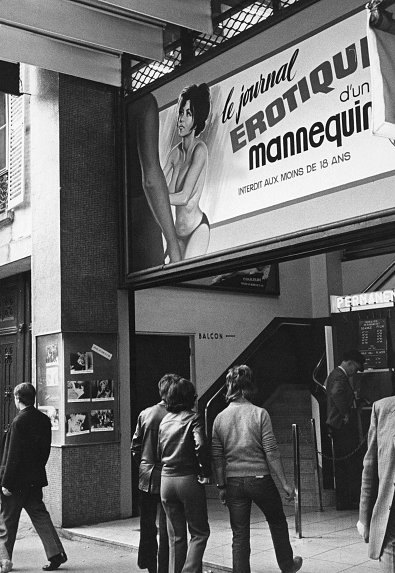
At the foot of the marquee, the word "BALCON" can be read — the hall keeps its original neighbourhood-cinema configuration with stalls and balcony. On the right, the glazed ticket booth, the front of the Reichshofen just visible at the left edge of the frame. Late-afternoon Pigalle atmosphere, audience of men in jackets, queue hesitating to enter. The film belongs to the vein of the "erotic diaries" directed in the early 1970s by Jean-Marie Pallardy (1940-2024), a former model turned soft-porn director, who notably shot The Erotic Diary of a Lumberjack (1973). Mention "No admittance for under-18s".
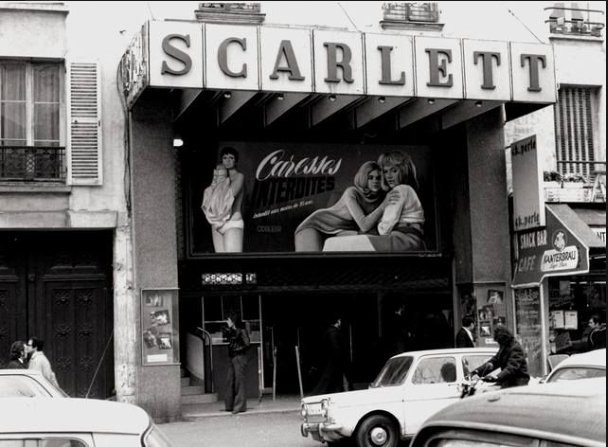
Frontal view of the entire façade with the SCARLETT illuminated sign in large capitals on light bulbs, the painted poster above the door depicting two women in colour (red, ochre, brown on a beige background), and the mention "No admittance for under-18s". On the left, the staircase of the building of no. 34; on the right, the corner of the street with the neighbouring snack bar and the corner towards no. 36 (the building that housed the La Lune Rousse cabaret until 1914). Cars and passers-by in jackets: late-afternoon Pigalle atmosphere of the 1970s, when the Scarlett held its place in the ordinary life of the boulevard, without particular fuss or scandalisation.
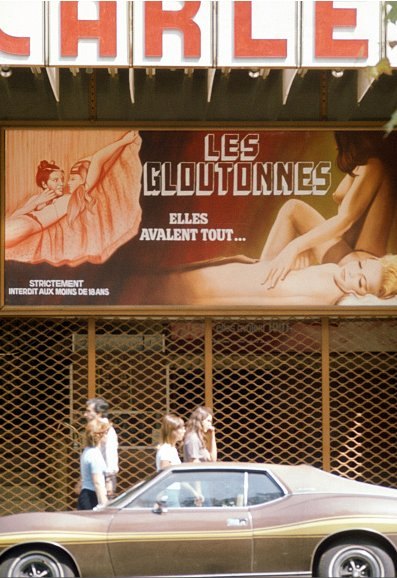
Under the illuminated SCARLETT banner can be seen the polychrome painted poster (red, yellow, ochre) of the film. Mention "strictly forbidden to under-18s". In the foreground, a long American convertible, and three small girls playing in front of the lowered metal shutter of the Scarlett — a striking contrast between the hall's programming and the ordinary childhood of the neighbourhood, which coexisted on the same boulevard pavement. Precise dating: Les Gloutonnes was directed by Jesús Franco (under the pseudonym "Clifford Brown"), the third major figure of European erotic cinema of the time; the film, also titled Les Exploits érotiques de Maciste dans l'Atlantide, was produced by Comptoir Français du Film Production (Paris) and released in France on 6 August 1975. The photograph therefore cannot predate this date — a precious chronological marker.
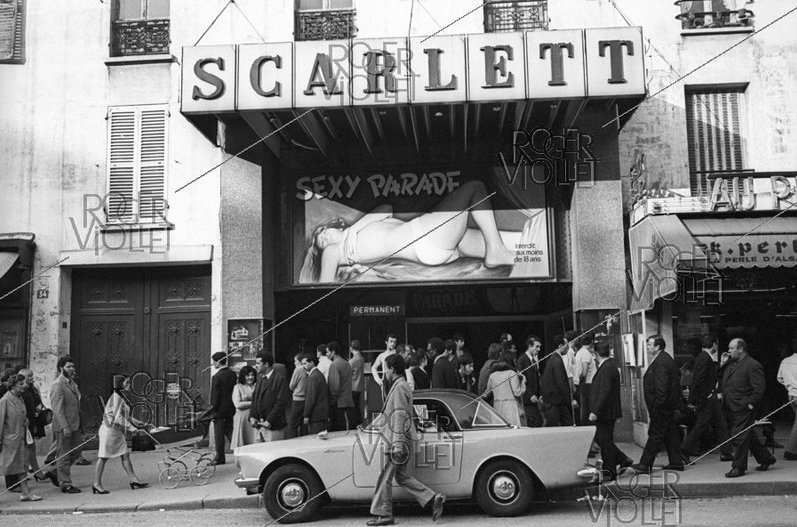
Illuminated sign SCARLETT in large white capitals on light bulbs, banner "SEXY PARADE" above a painted poster of a reclining nude. Mentions "PERMANENT" and "No admittance for under-18s". Compact male crowd in front of the entrance, a 1960s car parked along the pavement, neighbouring Pigalle façades (wig shop, snack "Perle d'Alsace"). This is the iconic image of the Scarlett at its peak as a popular erotic-cinema venue.
What the posters tell
Set side by side, these photographic archives draw the complete trajectory of a popular Pigalle cinema over nearly thirty years — and make it possible to date them with unprecedented precision. 491 by Vilgot Sjöman (1964) places the Scarlett's erotic programming as early as the mid-1960s, well before the official liberalisation of 1968-1969. Le Sadique in Superscope belongs to the B and Z movies of the 1950s-1960s. Le Journal érotique d'un mannequin, in the vein of Jean-Marie Pallardy, places the photograph in the early 1970s. Les Gloutonnes by Jesús Franco, released in France on 6 August 1975, gives an even more precise marker: the photograph where three small girls play in front of the lowered metal shutter of the Scarlett cannot predate this date. Finally, the photograph of the Sexy Parade façade documents the peak of popular erotic cinema of the mid-1970s, just before the shift to soft pornography then hard. For anyone interested in the cultural history of Pigalle, these images constitute a first-rate document: they show a boulevard cinema that never ceased to embrace the evolutions of the gaze-market, from Hollywood to the peep show.
Closure and reconversion (1981)
The Scarlett ceased its activity as a traditional cinema on 22 December 1981. The premises were then converted into a large sex shop with video screenings, presented at the time as a "little brother of the Sexodrome" nearby. This is the moment when Pigalle massively switched, all over the boulevard, from X-rated cinemas to direct sales of video cassettes — a change of economic model brought about by the spread of the VCR and VHS cassettes in households.
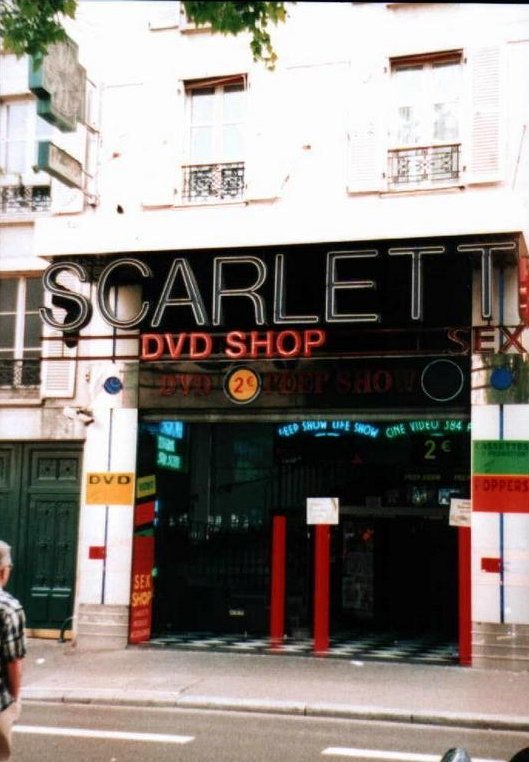
The former cinema has turned into SCARLETT DVD SHOP and PEEP SHOW. The illuminated SCARLETT sign in white capitals survives, as if loyal to the place — only the commercial content has changed. Mentions "PEEP SHOW LIVE SHOW · CINE VIDEO · 2 €". To the right and below can be seen the standardised sex-shop graphic codes that have progressively colonised the boulevard since the 1980s. On the left, no. 34 is just visible with the entrance door of 34 boulevard de Clichy and its artists' studios deep in the courtyard — the maximum gap between the street and the inside.
Current use: Moon City and Pharmacie Pigalle
The site today houses two establishments which share the ground floor:
- The Moon City sauna, occupying the walls that successively housed Café Reichshoffen, Brasserie Riester, Brasserie du Coq d'Or, ephemeral cafés-concerts, the Cabaret de l'Enfer, the Cabaret du Néant, the Ciné-Vox-Pigalle and the Scarlett. Over more than 1,200 m², the establishment presents itself as one of the largest in Europe.
- A Pharmacie Pigalle, occupying part of the façade.
An enduring cinematographic memory
No. 34 has kept its cinematographic vocation well beyond the closure of the Scarlett, but shifted towards production. Several film and television production companies are today registered at no. 34: Frédéric Tellier (director of SK1, Sauver ou périr, Goliath), Artisan 14, Christiane Leherissey (institutional and advertising films), Martine Jamaux Production (technical services), and director Fabrice Minier. No. 34 remains, almost a century after the opening of the Ciné-Vox-Pigalle, one of the small audiovisual hubs of lower Montmartre.
Sources & resources
- Cinema Treasures — Scarlett entry (theater #36830, Paris): confirms "Architects: Julien Hirsch" and the Streamline Moderne style
- On the architect Julien Hirsch:
- Atlas of Architecture and Heritage of Seine-Saint-Denis — entry "Hirsch, Julien, architect"
- Hirsch, Julien, Quelques réalisations de Julien Hirsch, architecte E.P.Z., S.N., Paris-Strasbourg, 1935 — architect's monograph, held at the Cabinet des estampes of the Bibliothèque nationale de France
- Cinema Treasures — Cinema Latin (Cinevog Latin): another hall designed by Julien Hirsch in 1938, in the Latin Quarter, same typological constraints (conversion into a two-level cinema)
- Montmartre Secret — "The old cinemas of boulevard de Clichy" (April 2024): confirms the sequence Vox Pigalle 1938 → Scarlett 1951 → closure 1989
- Cairn / 1895 review — interview with Simone Lancelot, who herself rebranded the Cinévox Pigalle as Scarlett (450 seats, opened on 8 February 1938)
- Paris-bise-art — article of 26 February 2021: confirms the opening of 8 February 1938 and the renaming of 19 December 1951
- Paris-Louxor — Cinemas of Paris, interactive map
- Paris-Louxor — Cinemas of the 9th, 10th and 18th arrondissements: "Ciné Vox Pigalle – Scarlett, 34 boulevard de Clichy"
- Boulevard de Clichy — Wikipedia
- Frédéric Tellier — Wikipédia (director registered at no. 34)
- Cinévox Cinéma company — administrative remnant registered at no. 34 (APE code for cinema operations), trace of the 8 February 1938 opening
- Ciné-Façades — Cinéma Agora entry (Paris 18th) by Philippe Célérier: confirmation of the existence of the Cinéma Agora at 64 boulevard de Clichy from 1932 to 1995, distinct from the Scarlett at no. 34, with details on its takeover by the Fratellini brothers in 1934
- On the Scarlett's erotic programming:
- José Bénazéraf — Wikipedia: king of French erotic film of the 1960s-70s, friend of Godard, archives at the CNC since 2022
- La Rochelle Festival — José Bénazéraf entry: confirms the correct spelling of the name (with accents) and his stature at the Cinémathèque française
- Max Pécas — Wikipedia: "stood alongside José Bénazéraf as one of the masters of the genre"
- Cinémathèque française — Max Pécas entry: explicit, "French pioneer of the 'Z' style, also called 'nanard' cinema"
- On the films identifiable on the posters:
- Vilgot Sjöman — Wikipedia: Swedish director (1924-2006) of 491 (1964), I Am Curious (1967-68), major figures of the sexual liberation in cinema
- 491 (film) — Wikipedia: controversy, censorship and bans, presentation at Cannes 1964
- Le Film du jour — Jean-Marie Pallardy (1940-2024): former model, director of the "Erotic Diaries" series (lumberjack, model) in the early 1970s
- Les Gloutonnes — Wikipedia: French erotic film by Jesús Franco (under the pseudonym "Clifford Brown"), produced by C.F.F.P. Paris, released in France on 6 August 1975
- Cinémathèque française — Les Gloutonnes entry: official production entry, confirms the date and the director's identity
- CinéDweller — biography of Jesús Franco: Spanish filmmaker (Madrid 1930-2013), prolific, signs hundreds of films under some twenty pseudonyms