A recent discovery, drawn from an autobiographical account by photographer Gilles Walusinski published in 2018 in the online cultural review délibéré, sheds light on a little-known chapter in the history of 34 boulevard de Clichy: the occupation of studio 5 by a collective of young photographers fresh out of May 1968, and the presence in the building of a tenant related by marriage to the symbolist painter Eugène Carrière.
The Vaugirard school collective at studio 5 (June 1969)
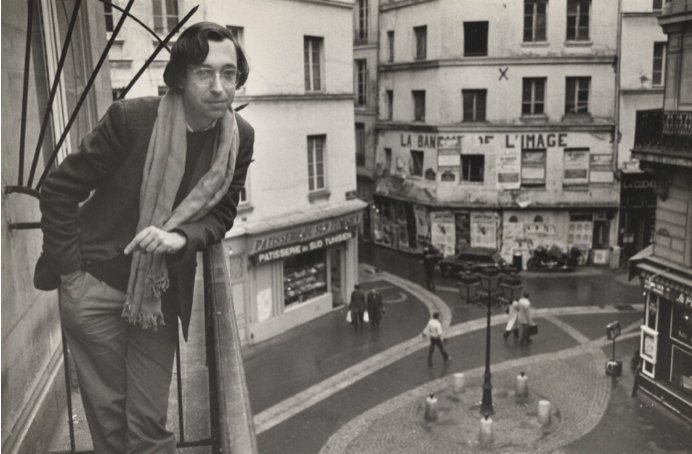
The documentary photographer with his gaze tilted toward the street he knows so well — in the background, the sign « La banque de l'image » and the « Pâtisserie du Sud-Tunisien ». Walusinski, born 1948, has spent his entire professional life as a photographer in Paris: May 68, atelier 5 at 34 boulevard de Clichy in 1969, the Rapho agency, Hopikat, the À la rue investigation on Parisian homelessness (with Juliette Keating, 2014), the magazine délibéré.
Gilles Walusinski (born 1948) is a French documentary photographer, contributor to the review délibéré, former member of the Rapho agency and of Hopikat, long committed to social issues (Roma, homeless people, the Paris tramway). With Juliette Keating, he notably published the investigation À la rue (Éditions L'Ire des marges, 2017), devoted to the eviction of thirteen Roma families in Montreuil in 2016.
In 1968, Walusinski was a student at the school known as “Vaugirard” (today the École nationale supérieure Louis-Lumière). During the États généraux du cinéma et de la photographie held in May–June 1968, the school turned into a place of political debate. Upon graduating in June 1969, five classmates decided to pool their means of production — that is to say “their lack of means” — and rented a studio together at 34 boulevard de Clichy: studio 5.
« Belle petite impasse au pied de Montmartre, des arbres et des ateliers d'artistes d'un côté de l'allée, un immeuble de l'autre côté. L'atelier avait été aménagé pour la photographie par un précédent occupant. Il y avait un petit laboratoire installé et une mezzanine, studio lumière du jour, qui devait à l'époque lui servir à faire les photos lestes des jeunes femmes travaillant dans le quartier de Pigalle ; nous avons retrouvé des tirages laissés dans un coin du labo. »
— Gilles Walusinski, « Eugène », délibéré, 25 juillet 2018.
This description provides several valuable details about the material organisation of the studio-courtyard at no. 34 in the late 1960s: a photographic darkroom in place, a mezzanine set up as a daylight studio, equipment left by a previous occupant who apparently practised the “risqué” neighbourhood photography typical of Pigalle's sociology since the early 20th century. The owner of no. 34 sold the studio in 1970–1971 for 30,000 francs (around €35,000 in 2025 terms) — a sum out of reach for the collective of five photographers, who had to leave the premises.
Nane, neighbour from the 3rd floor, and the Nadar-Carrière legacy
During the year the collective occupied studio 5, a tenant of the building at no. 34 came into Walusinski's life: “Nane, a charming lady, lived in the building, on the third floor, would offer us tea and talk to us about photography because she worked for our landlord.” This Nane is the first documented tenant of no. 34 for the period following the 1936 census records.
Plusieurs éléments biographiques émergent du récit :
- Nane lived on the 3rd floor of the street-front building at 34 boulevard de Clichy in the late 1960s.
- She worked for the owner of no. 34, who “proved as skilled at flogging fake originals to the publishing trade as at collecting our rent to plug his deficit” — which suggests a trade in art editions or photographic prints.
- When the owner sold studio 5, Nane found better-paid employment at the Rapho agency — a photographic cooperative founded in Paris in 1933 by Charles Rado, which welcomed Doisneau, Willy Ronis, Brassaï and Sabine Weiss.
- Nane lived with a certain “Monsieur Carrière” and their daughter. The couple separated in the years that followed.
- According to the neighbourhood's oral tradition, Nane kept in her flat a Picasso and a painting by Eugène Carrière — reinforcing the family connection with the symbolist painter and the circulation of rare works in the building at that time.
One day, Nane — bereaved and alone after Monsieur Carrière's departure, and after having witnessed from her window a sparrow seized by a falcon — invited Walusinski for tea and gave him a box she had kept in her bedroom. The box contained three precious items:
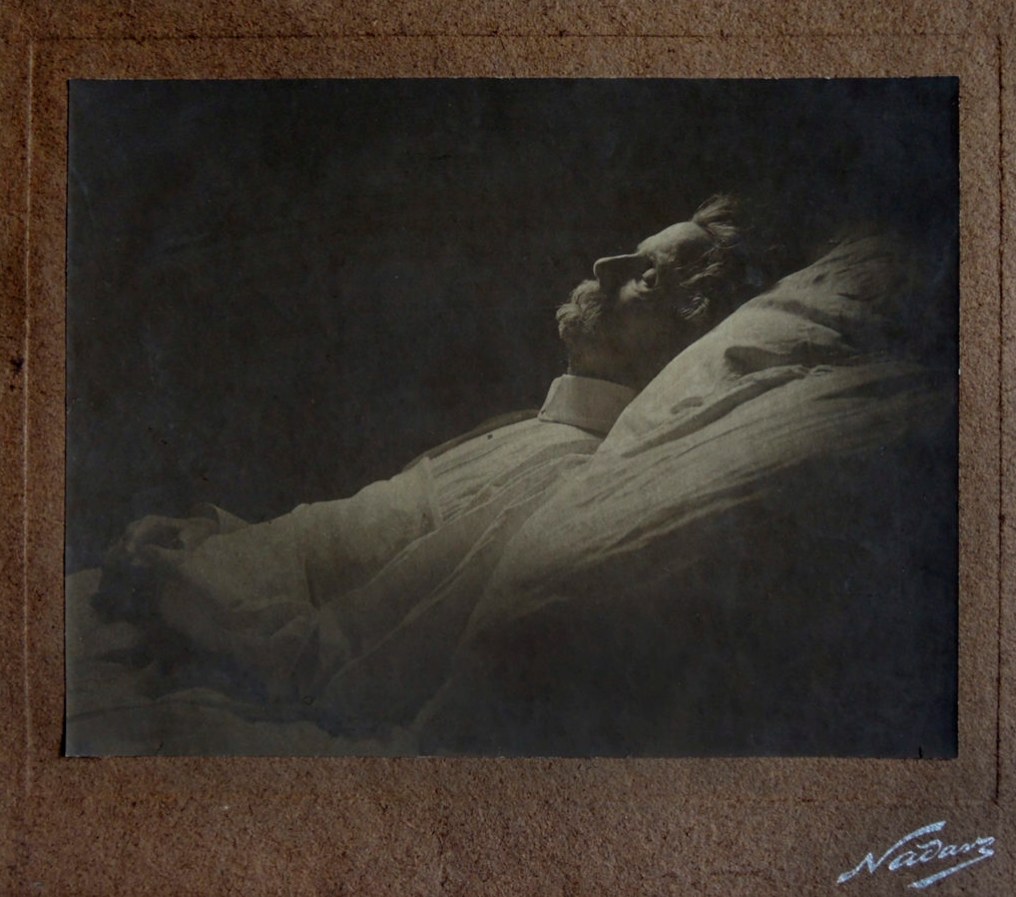
Original print mounted on brown embossed card, signed in silver “Nadar” — a signature specific to the studio of Paul Nadar (son of Félix). Walusinski later identified it by cross-referencing the photograph reproduced on page 202 of the second volume of the Hubschmid edition of Nadar (1979). The framing of the gifted print differs from Hubschmid's: Nadar would take several views during a single funerary session “to be on the safe side”. The photograph kept by Nane thus very likely belongs to a different state of the same negative, or to a sister negative.
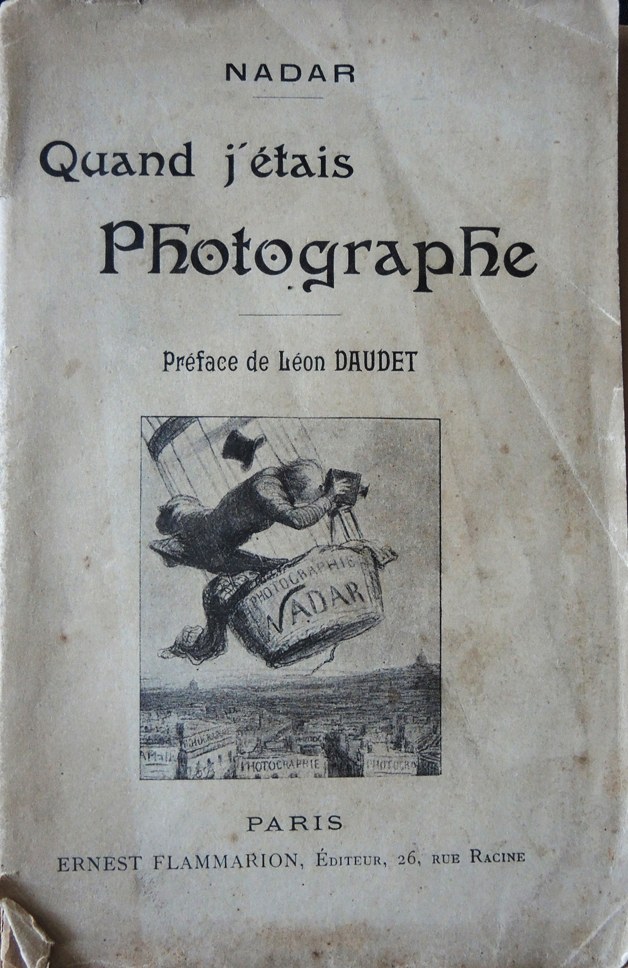
The copy given to Walusinski bore a handwritten dedication from Nadar to Eugène Carrière:
“qui sait peindre mieux que les yeux, les regards…” (“who can paint better than the eyes themselves — gazes…”) followed by this flourish: “refrain d'une vieille chanson, le plus vilain Nadar ne peut donner que ce qu'il a !…” (“refrain of an old song: the ugliest Nadar can only give what he has!…”).
Evidence of the genuine friendship between the two men in 1905, the year before Carrière's death. A handwritten letter of condolence signed “P. Nadar” — that is, Paul Nadar (1856–1939), son and continuator of the studio — addressed to Eugène Carrière's widow, was folded inside the book.
Hypothesis — Nane, Eugène Carrière's daughter-in-law or relative
Nane's exact identity remains to be documented, but several elements strongly converge towards a direct kinship with the painter's family:
- Nane's partner bore the surname Carrière, and the couple had a daughter (“their little girl” in the 1969–70 account).
- Nane held, as a privately preserved family inheritance, documents of direct provenance from Eugène Carrière: a post-mortem photograph originally intended for the close family, a letter of condolence sent by Paul Nadar to the Carrière widow (Sophie-Marie Adam, known as Sophie). Taken together, they show the profile of a family archive passed down through the painter's lineage.
- Eugène Carrière had seven children with his wife Sophie Desmousseaux: Léon (painter), René (painter), Nelly, Marguerite, Jean-René and Élise. Direct transmission is compatible with descent through one of the sons or grandsons — in particular René Carrière (1888–1982), painter, or Jean-René Carrière (1887–1982), painter and sculptor.
- The Montmartre / Pigalle district is biographically consistent with the Carrière family: Eugène Carrière ran a painting academy on rue de Rennes (“Académie Carrière”, 1898–1903), counting Henri Matisse, André Derain and Jean Puy among his pupils; his son René had his Paris residence nearby.
Nane Carrière's presence at 34 boulevard de Clichy would thus make this address the ultimate repository, during the 1960s, of a fragment of the painter's personal archive — an archive that has only survived, outside museum collections, through discreet family transmissions, now very often lost. This hypothesis would deserve to be confirmed by cross-referencing with the Carrière family archives (in particular those kept by the heirs of René and Jean-René) and with the Paris civil-status records of the 1920s–1940s.
Eugène Carrière and Félix Nadar — a fin-de-siècle friendship
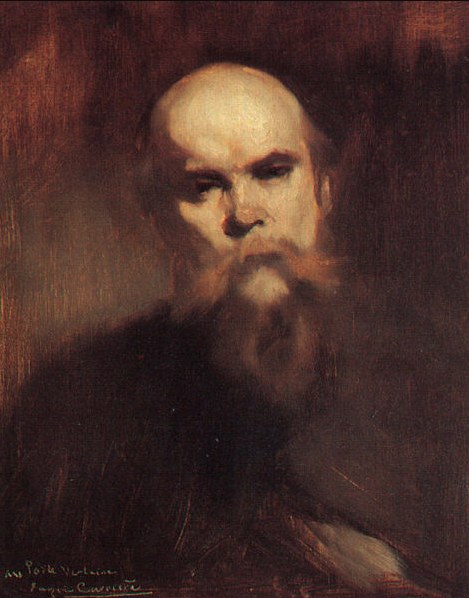
Carrière (1849–1906), trained in Alexandre Cabanel's studio at the École des Beaux-Arts, is known for his sfumato painting with brown or even black backgrounds and for his intimate portraits — Verlaine, Edmond de Goncourt on his deathbed (Musée d'Orsay), Maurice Rollinat, Alphonse Daudet. Rejected by the Impressionists for his “crepuscular” tone, he nevertheless exerted an influence on nascent Fauvism through his academy.
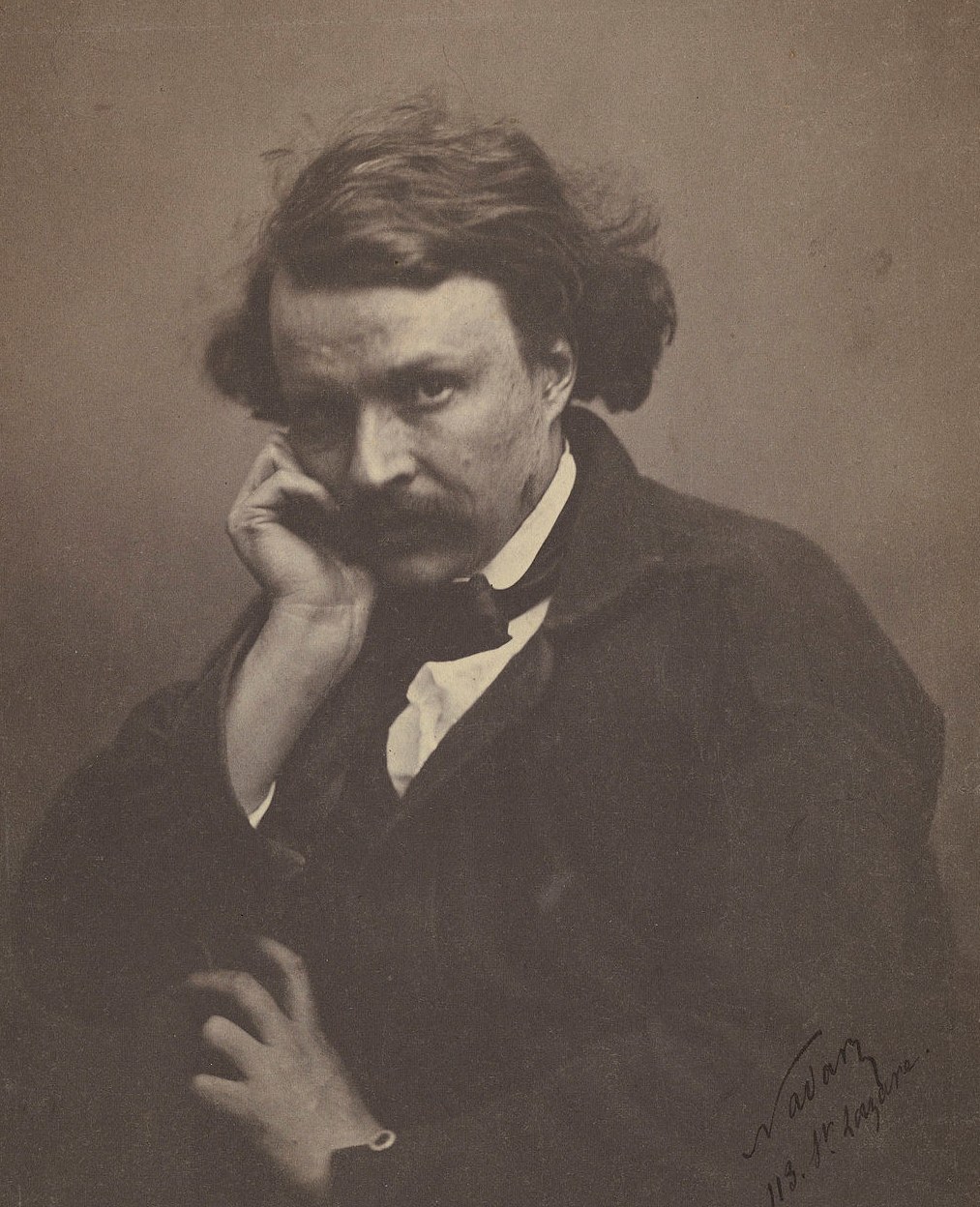
Félix Nadar (Gaspard-Félix Tournachon, 1820–1910), the most famous photographer of 19th-century France, set up his studio at 113 rue Saint-Lazare and then, from 1860, at 35 boulevard des Capucines — the studio that hosted the first Impressionist exhibition in April 1874. Around 1895, ruined, he passed the studio on to his son Paul Nadar (1856–1939), hence the specific signature on the print given to Walusinski. The friendship between Carrière and Félix Nadar, attested by the 1905 handwritten dedication, was part of the extraordinary social network Nadar maintained with Paris artists — from the Panthéon Nadar (1854) to the last portraits of Sarah Bernhardt, via Baudelaire, Hugo, Manet, Berlioz.
Why this page?
Eugène Carrière never lived at 34 boulevard de Clichy. But Walusinski's account makes no. 34, for a few months around 1970, the chance repository of a fragment of family memory — that of a friendship between a crepuscular symbolist painter and the most famous Parisian photographer of the 19th century. Nane's gesture — offering these three relics to a young, unknown photographer, while she herself was bereaved and alone — partakes both of transmission by happenstance and of the studio logic that has flowed through no. 34 since Manet: a place where works and memories circulate between neighbours, apprentices, descendants and strangers.
Sources & resources
- Gilles Walusinski, “Eugène”, review délibéré, 25 July 2018 — original autobiographical account
- Agence Rapho (1933, fondée par Charles Rado) — où Nane fut employée après le 34
- ENS Louis-Lumière — successor to the “Vaugirard” school attended by Walusinski in 1968
- Gallica / BnF — original edition of Nadar, Quand j'étais photographe (Ernest Flammarion, 1899); Hubschmid edition of Nadar (1979)
- Musée d'Orsay · Musée du Louvre — works by Eugène Carrière (Portrait of Verlaine, Edmond de Goncourt on his Deathbed)
- Notice Eugène Carrière · Notice Félix Nadar · Notice Paul Nadar