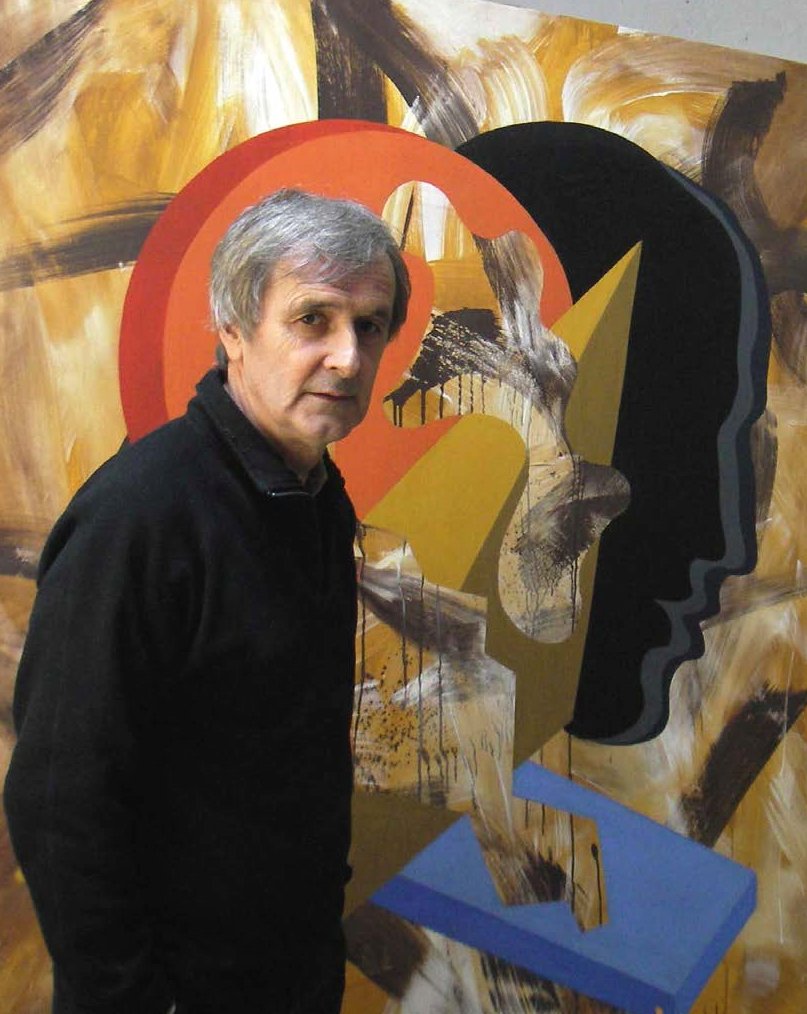
Two facing profiles stand out against an ochre background worked in broad flat areas — a composition characteristic of the recurring dialogue in Batlle's work between figure and sign.
The Toulouse lineage of studio 4
Studio 4 of 34 boulevard de Clichy, in the first courtyard, has hosted since the early 20th century a remarkable South-West artists' lineage: first Henri Marre (1858-1927), post-impressionist painter of the Toulouse School and friend of Bourdelle; then his daughter Sébastienne Marre; and more recently Michel Batlle. Three Toulouse artists thus succeeded one another in the same Parisian room over nearly a century — like a Montmartre window onto the South-West, each generation having extended the singular way of looking at the world.
A trajectory at the margins
Michel Batlle was born on 3 April 1946 in Toulouse, into a family marked by art and exile: his father is a Catalan political refugee of the Spanish Civil War (1936-1939); several family members are painters or musicians. Self-taught, he held his first exhibition at age 17 in 1963, and the following year presented his first abstract paintings in the spirit of the École de Paris and American abstract expressionism, with an affinity for Lettrism that would lastingly mark his relationship to the sign.
From around 1965 to 1973, his studio "Le Cratère", on rue Saint-Michel in Toulouse, was the underground and avant-garde meeting point of the city — a laboratory where painting, experimental and concrete music (which he practised from 1966 after his rock period), poetry and performance came together. From 1968 to 1973, he wrote the art column for the Sud-Ouest newspaper.
The invention of "Psychophysiographie" (1966)
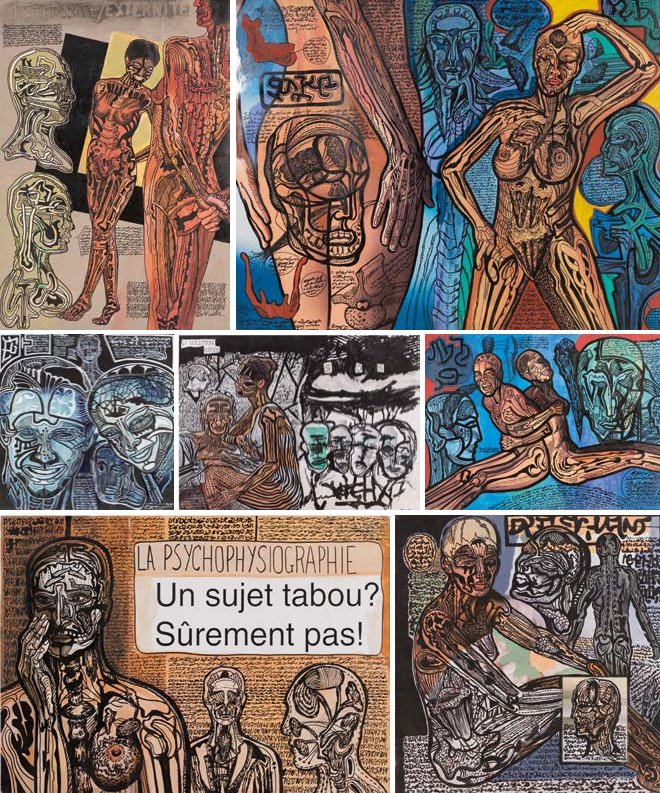
In 1966, Michel Batlle invented a practice he named Psychophysiographie: "relations between body and mind translated through any graphic means, a kind of scientific simulacrum producing imaginary anatomies". Concretely, he engraves with sterile vaccinostyle on X-rays recovered from the medical world, paints over photographs, multiplies unexpected supports. It is one of the major plastic inventions of French Body Art, alongside the works of Gina Pane, Michel Journiac, ORLAN. Batlle blends, as he would later say, "art and the body" — close to the spirit of Fluxus, Body Art and the Japanese movement Gutai, yet at the same time deeply rooted in a Catalan and Mediterranean materiality that distinguishes him from his Parisian contemporaries.
Anatomical figures treated as superimposed signs, handwritten texts in the background, imaginary anatomies: the practice founded in 1966 blends medical plate, graffiti, automatic writing and painting. The phrase taken up at the centre of the plate — "La psychophysiographie. Un sujet tabou ? Sûrement pas !" ("Psychophysiography. A taboo subject? Certainly not!") — sums up the spirit of the approach.
The "Cultural Wars" and humanist commitment
After a period of expressionist figuration starting in 1970, performance-painting and Land Art actions conceived as "critical parody of the international art market" (1971-1975), Michel Batlle developed from the 1980s his major series: the "Cultural Wars". The critic Maurice Benhamou gave it this reading that has become famous:
"Michel Batlle is an important artist because his painting brings something other than formal and decorative itching. He is the only painter I know whose art lances the abscess of today's cultural debate. In his canvases, he superimposes the deep signs of different cultural memories: the Romanesque, the Gothic, Lascaux and perspective… In Michel Batlle's works, there are like raised, clenched fists of resistance."
In 1989, Michel Batlle was the first living artist to exhibit in the former USSR, in Kiev; chance had it that the opening coincided with the fall of the Berlin Wall. In the 1980s, he created the magazine Axe Sud, took part in the founding of the Midi-Pyrénées FRAC (regional contemporary art collection), and organised the first exhibitions outside Spain of Miquel Barceló and Jaume Plensa.
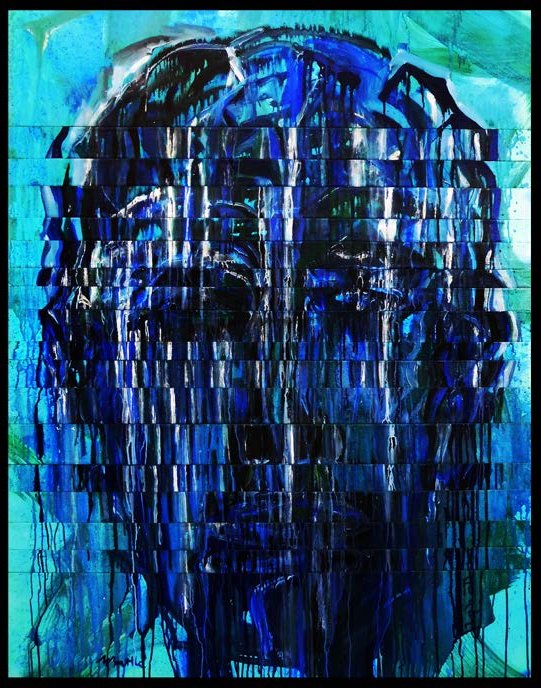
Face striped with horizontal bands, treated in a range of deep blues and turquoises, traversed by vertical ink drips — a recurring device in Batlle's work, where the figure is at once asserted and fragmented by the medium.
Monumental metal sculpture (since 2010)
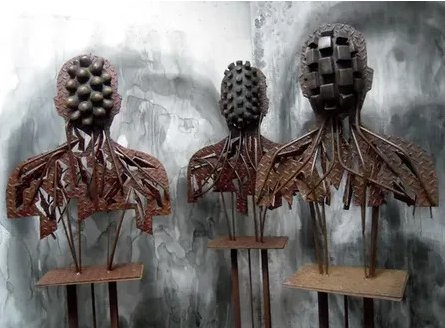
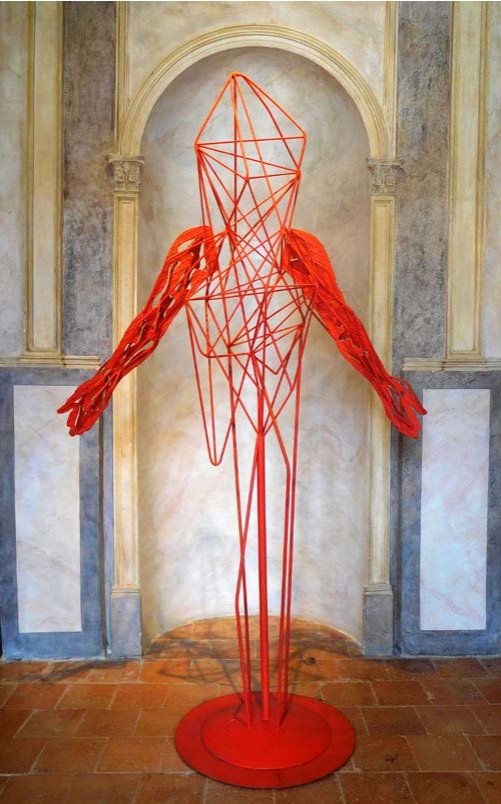
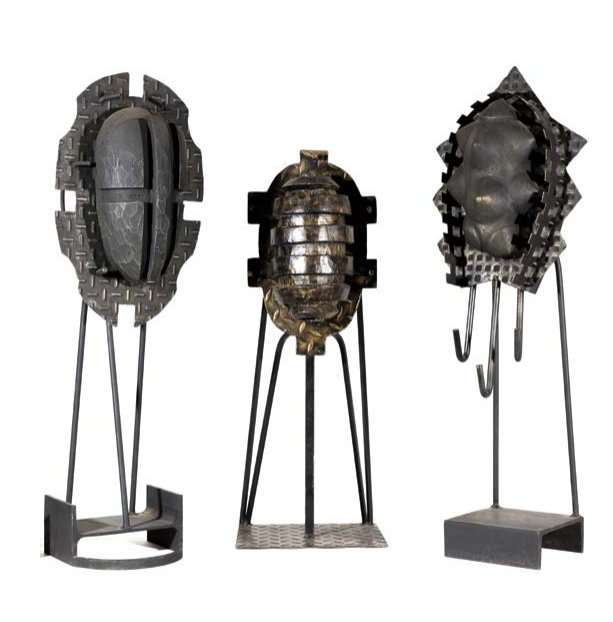
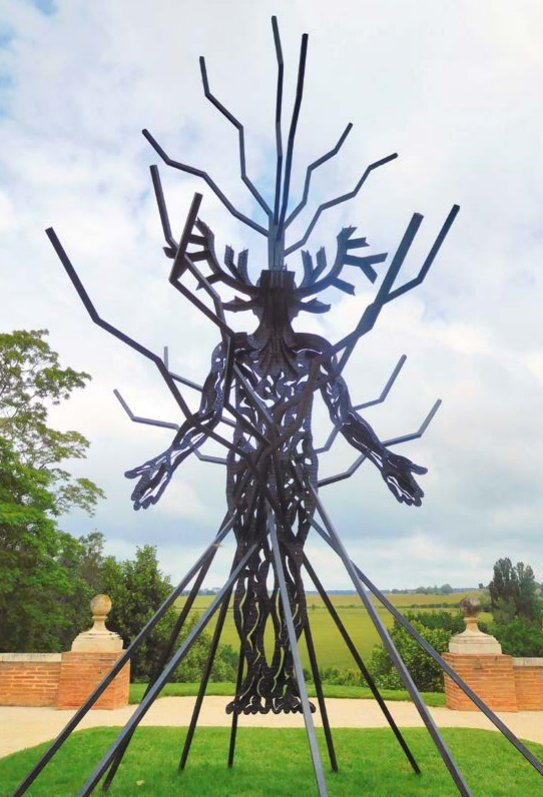
From 2010 onwards, Michel Batlle has worked intensively on metal sculpture, producing sometimes monumental works. These are the filiform sculptures one could glimpse in his studio 4 at no. 34: human silhouettes in black metal pierced through with sticks, bars, rods. For the artist, the subject is explicitly political: contemporary dehumanisation, information saturation and the silent oppression of modern life. "I don't make ornamental work, decoration like Jeff Koons for instance — I make something more human."
Human silhouette opening into branches that reach for the sky — figure both vegetal and anthropomorphic, outdoor installation.
Human silhouette broken down into geometric lines, painted bright red, presented in a classical architectural niche. The structure lets light through and turns the figure into an open cage.
Heads in dark metal worked as textured surfaces (alveoli, scales, riveted plates), borne by tripods that give them an almost ritual, tribal presence.
Variation on the same series: skulls treated as networks of alveoli or grids, like beehives or cellular structures — the human reduced to its frame, exposed.
Current event — exhibition at the Périgord Museum in 2026
From 12 March to 21 September 2026, the Museum of Art and Archaeology of the Périgord in Périgueux is dedicating to Michel Batlle a major retrospective entitled "Geography of the body" — bringing together his Anatomies from the 1970s through to his most recent works. The Breuil hall of the museum presents the triptych of Anatomies, a counter-writing close to surrealist automatic writing, on which the contours of a mute anatomy emerge in transparency. Further along, the series of faces painted on wood — where lapidary phrases such as "Trop de tout tue tout" ("Too much of everything kills everything") or "J'ai fait un rêve, une révolution" ("I had a dream, a revolution") appear — crystallises "Batlle's refusal to subscribe to the doxa of contemporary art".
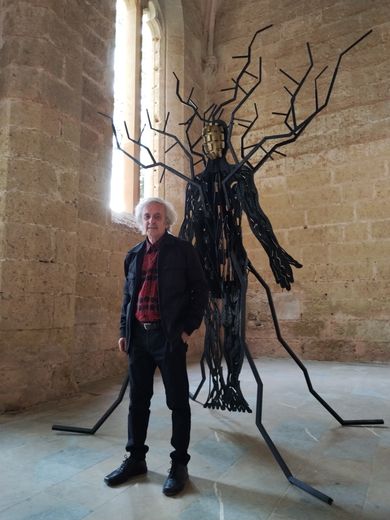
A dialogue between the work and the ancient architecture — the silhouette in black metal, half tree half human figure, takes on an almost liturgical dimension under the stone vaults.
Public collections
Michel Batlle's works are held in some twenty international institutions:
- France: Musée des Augustins (Toulouse), Fonds régional Midi-Pyrénées (FRAC), Fonds national d'art contemporain (FNAC, Paris), Musée des Beaux-Arts (Rodez), Galerie photo du Château d'eau (Toulouse), Town of Sérignan, Town of Montauban
- International: Museum of Modern Art (Belgrade, Serbia), Museum of Kiev (Ukraine), Philbrook Museum (Tulsa, Oklahoma, USA), Museum of Sarajevo (Bosnia and Herzegovina), Pinacoteca di Capo d'Orlando (Sicily), French Institute of Kyushu (Fukuoka, Japan), Museum of Olot (Girona, Spain)
Quotes
"I want to remain free, even if it is uncomfortable. Art is not made to reassure. To create is also to resist what shapes us." — Michel Batlle
Sources & resources
- Michel Batlle — Wikipedia (English) · Wikipédia (French) · Wikidata
- Galerie Françoise Livinec — biographical entry on Michel Batlle (representing gallery, Paris/Brittany)
- Galerie Man Ray — Michel Batlle (representing gallery)
- Museum of Art and Archaeology of the Périgord — exhibition Geography of the body, 12 March-21 September 2026
- Esprits nomades — "Michel Batlle, beyond the rigid extension of life" — critical analysis with citation by Maurice Benhamou.
- Palais Idéal du Facteur Cheval — work Portrait of Facteur Cheval by Michel Batlle
- See also the entries Henri Marre, Sébastienne Marre and Studios in pictures for the Toulouse lineage of studio 4.