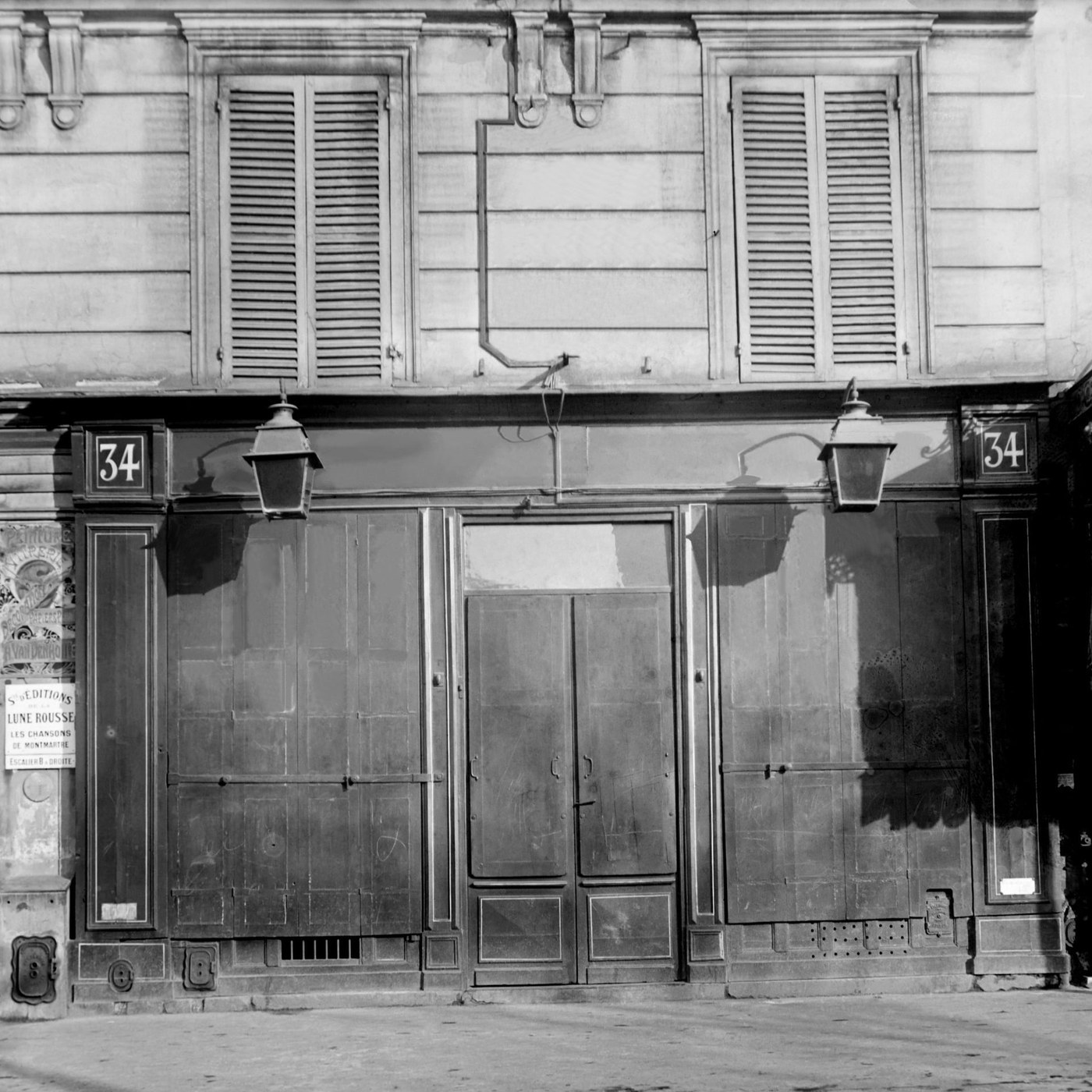
La Lune Rousse — an iconic Pigalle cabaret
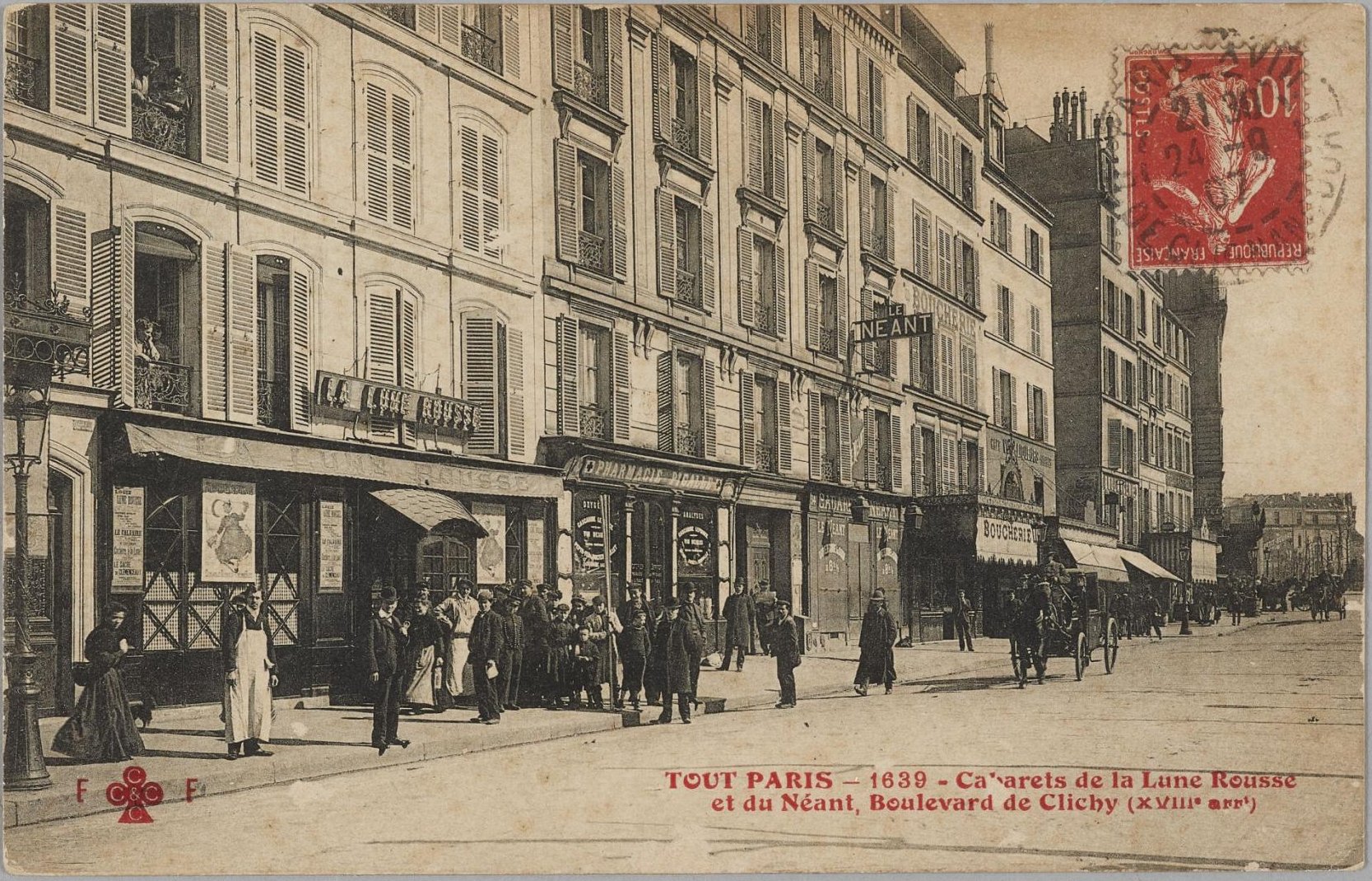
La Lune Rousse is one of the great Parisian cabarets of the Belle Époque, founded by the chansonniers Numa Blès and Dominique Bonnaud in November 1904 in the building next to no. 34 — at 36 boulevard de Clichy (where the Théâtre des Dix Heures stands today). The cabaret specialised in revue and song recitals, and the Guide des Plaisirs de Paris cited it as one of the "freest and funniest places in the capital", blending the most caustic songs about politicians with the lightest pieces. The hall was decorated with works by Faivre, Willette and Léandre; the posters were signed Daniel de Losques.
Numa Blès created there a parodic distinction, "la Grande Chansonnerie de la Lune Rousse", a kind of legion of honour for satirical poets. Among the chansonniers who performed there, the most famous was Lucien Boyer (1876-1942) — author, among others, of Mistinguett's great hits "Ça, c'est Paris" and "Valencia", and of the iconic Montmartre song "Tu verras Montmartre". The cabaret moved in 1914 to 58 rue Pigalle, then to rue Victor-Massé, before closing definitively in 1964.
The publishing house at no. 34, staircase B right
In parallel with the cabaret, a music publishing house of La Lune Rousse published the lyrics and sheet music of the songs under the "Les Chansons de Montmartre" collection — four-page booklets, illustrated on the front cover, containing the piano-vocal score and lyrics. A bookseller's notice on AbeBooks, when assembling a collection of booklets from this period, confirms: "7 booklets are published by the Société d'éditions de la 'Lune Rousse'", the rest of the collection being published by Herpin editions.
It is this publishing house — distinct from the cabaret in commercial terms, but commercially linked — that had its offices at 34 boulevard de Clichy, staircase B right. The precision "staircase B right" on the plaque indicates with precision the interior location of the publishing house, which probably occupied an office-apartment above the Café-Brasserie Reichshofen. This is an important discovery for the history of no. 34: the building did not house only the brasserie painted by Manet and the lineage of artists in the courtyard, but also a head office for Montmartre popular song publishing — a stone's throw from the source-cabaret at no. 36.
Chansonniers who passed through the no. 34 publishing house
The "Chansons de Montmartre" booklets published by La Lune Rousse contain works from a whole pantheon of chansonniers from the first half of the 20th century:
- Dominique Bonnaud (1864-1943) — co-founder of the cabaret, chansonnier of the Auberge du Clou and then the Chat Noir
- Numa Blès (1871-1917) — co-founder, former chansonnier of the Quat'z'Arts
- Lucien Boyer (1876-1942) — author of Mistinguett's great hits, who died in the cheerful squandering of several fortunes
- Vincent Hyspa (1865-1938) — major chansonnier of the Chat Noir and La Lune Rousse
- Marcel Legay (1851-1915), Xavier Privas (1863-1927)
- Hugues Delorme, Jacques Ferny, Paul Delmet, Gabriel Montoya
- Later: Noël-Noël, Jean Rieux, Pierre Dac, Raymond Souplex, René Dorin and many others
Why this page?
This enamelled plaque — discreet, little-known, still visible on the façade — is one of the last visual relics of the moment when 34 boulevard de Clichy was simultaneously an Alsatian brasserie (the Café-Brasserie Reichshofen painted by Manet), a popular-song publishing office (Lune Rousse), an artists' courtyard (Pottier, Dargaud, Marre…), and right next to the iconic cabaret at no. 36. That is, the densest possible concentration, over a few metres of façade, of what Pigalle could produce around 1904-1914 — restaurant, music publishing, cabaret and painting. The plaque, by its mere material survival, preserves the memory of this ecosystem.
Sources & resources
- La Lune Rousse — Wikipédia entry: complete history of the cabaret, founded by Numa Blès and Dominique Bonnaud in Marseilles in 1891 then in Paris at 36 bd Clichy in November 1904, successive moves, closure in 1964.
- Montmartre Secret — La Lune Rousse: detailed investigation into the cabaret, its chansonniers, its poster artists and its decoration.
- Le blog de Lepic-Abbesses — "Tu verras Montmartre" (Lucien Boyer): on Lucien Boyer, leading chansonnier of La Lune Rousse.
- Paris-Libris — Montmartre a chanté, Les Bibliophiles de Montmartre, 1938: collection of cabaret songs including La Lune Rousse, illustrated by Georges Villa.
- André Warnod, "Dominique Bonnaud et la Lune Rousse", chapter VII of L'esprit montmartrois, Laboratoires Carlier, 1938 — reference study by a witness of the period.
- Michel Herbert, La chanson à Montmartre, La Table Ronde, 1967 — history of Montmartre song.
- BnF / Gallica catalogues: search for booklets and sheet music from Société d'éditions de la Lune Rousse under the "Les Chansons de Montmartre" collection.
- See also the entry Édouard Manet and the Brasserie Reichshofen at no. 34, on the same façade, just to the right of this plaque.