The address documented by the Bibliothèque de Genève
The "Jean Ségalat" authority record of the Iconography Department of the Bibliothèque de Genève describes the figure as "iconographer, photographer" and gives as historical address: "Paris, 34, boulevard de Clichy". The record bears the dates 1961-1998, which most likely correspond to the coverage of the documentary collection held at the BGE — not to the biographical dates of the man, which are 1934-2010.
The identification rests on three converging strands: (1) the BGE record, which cites the address of no. 34; (2) the published biography of Roger-Jean Ségalat, which confirms a long Parisian residence, from 1960 to 1969, in art publishing circles (Gallimard, Pauvert); (3) the consistency of the occupations — the BGE describes him as iconographer and photographer, two activities precisely documented in Roger-Jean Ségalat's biography (Pléiade iconography; photographic feature published in Bizarre magazine in 1963 under the title "L'objectif de Ségalat").
Itinerary of a Cévenol in Parisian transit
Born on 12 July 1934 in Tudeils, Corrèze, into a family of Cévenol origin, Roger-Jean Ségalat first followed the path of teaching — a small farmer turned schoolteacher, as the back cover of the biography written by his son Laurent in 2015 soberly puts it. He became a French teacher, then turned to the book trade. His arrival in Paris — around 1960 — coincides with his entry at Gallimard, the publishing house where he would remain for ten years.
It was during this Parisian decade that Ségalat lived at 34 boulevard de Clichy. The address is consistent, geographically and sociologically, with his profession and his milieu: Pigalle, in the 1960s, was still populated with publishers, iconographers, typographers, photographers and antiquarian booksellers — a discreet economy of book and image that paralleled the artists' studios of the neighbourhood. He was at the same time a neighbour of other figures linked to the image documented at no. 34 in the same period: the Vaugirard photo collective that took over studio 5 in June 1969, including the photographer Gilles Walusinski.
Pléiade iconographer (1962-1969)
Between 1962 and 1969, Roger-Jean Ségalat produced the iconography of several albums of the Bibliothèque de la Pléiade, published in non-commercial editions for the Quinzaine de la Pléiade. The most famous is the Album Éluard, the seventh album of the collection, published in 1968: a 323-page work illustrated with 467 commented reproductions, "iconography compiled and annotated by Roger-Jean Ségalat". In this capacity he had visited André Breton at his rue Fontaine apartment for the reissue of Le Surréalisme et la peinture (1965), of which he was also the iconographer; he recalled there Man Ray, whom he had met.
Beyond the Album Éluard, Ségalat worked in the same decade on the Album Proust, completing some texts after the death of one of the authors — though he refused to have his name credited on it. He also signed the iconography of historical and literary works for the Edito-Service / Cercle du Bibliophile editions in Geneva (collection Les grandes heures de l'histoire) and for the Éditions Jean-Jacques Pauvert, whose Paris offices he frequented. It was at Pauvert that he published his first novel in 1968, Le Pont d'Orémon.
The photographer — "L'objectif de Ségalat"
Alongside his work as an iconographer, Ségalat was also active as a photographer. Issue 31 of Bizarre magazine (July 1963), edited by Michel Laclos at Pauvert, devoted a feature to him entitled "L'objectif de Ségalat", accompanied by texts by André Frédérique. Bizarre magazine was, in the 1960s, one of the high places of late Surrealist spirit in Paris: Ségalat entered it as a photographer at the very moment when he began to work for Gallimard. In 1962, he had already provided the photographic illustrations for Dominique Jourier's novel La Robe, published by the Cercle du livre précieux.
The draughtsman — pen figures and urban scenes
Alongside iconography and photography, Roger-Jean Ségalat also practised pen-and-ink drawing. Several signed works have appeared at auction, attesting to a regular graphic output: figure scenes treated as elongated, stretched silhouettes, urban views with bridges, compositions with several grouped figures. The line is nervous, fragmented, close to the sketch, with hatching and ink stains that recall the sensibility of the illustrators of the 1960s-1970s.
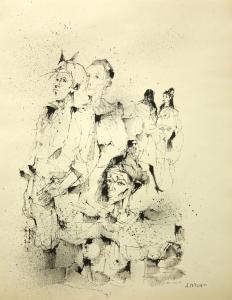
Composition with several standing figures, nervous and stretched lines, ink stains. Signed work that has passed at auction.
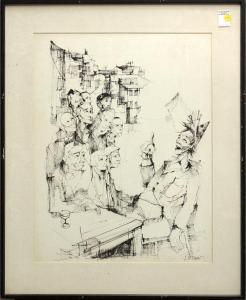
Urban view with architecture in the background and a group of figures in the foreground, ink on paper.
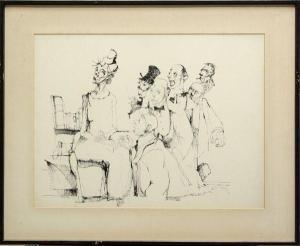
Scene with several figures, seated female figures and standing silhouettes, ink on paper.
Lausanne and the Melisa bookshop-gallery (1969-2010)
In 1969, Ségalat left Paris and 34 boulevard de Clichy to settle in Lausanne, where he would remain until the end of his life. In 1974 he took over the Melisa bookshop-gallery, then opened a bookshop under his own name on the Pontaise — devoting the rest of his life to old and rare books. His bookshop became, in the words of his publisher Infolio, "a high place of the literary and artistic life of French-speaking Switzerland". It was during this second life that he published his second book, Monument à F. B. (Hachette, 1978), and assembled the collection now held at the BGE.
Roger-Jean Ségalat died on 15 April 2010 in Lonay (canton of Vaud). In 2015, his son Laurent Ségalat — a biologist — devoted a biography to him for Infolio: Roger Ségalat et l'aventure de la librairie Melisa à Lausanne, to which we owe the bulk of the biographical information gathered here.
An ambiguity to clear up — not the Aveyron painter
The "Jean Ségalat" of 34 boulevard de Clichy must not be confused with his exact namesake, the figurative painter Jean Ségalat (1926-1987), born and died in Decazeville (Aveyron) — whose work, deeply rooted in the rural and mining Rouergue, never crossed Pigalle. The Aveyron painter Jean Ségalat did indeed attend the École des Beaux-Arts in Paris in 1945-1947, but he left the capital as soon as he was disappointed by the academic teaching. No source links him to boulevard de Clichy. The confusion is easy: a common first name, a rare surname, two contemporaries, two visual-arts activities. The distinction rests on three points:
- The Jean Ségalat of no. 34 is the Cévenol Roger-Jean Ségalat (1934-2010), iconographer and photographer;
- The Aveyron painter Jean Ségalat (1926-1987) is figurative, of the post-Buffet expressionist school, with no lasting Parisian connection;
- The BGE Geneva authority record explicitly links the address of no. 34 with the profession of iconographer-photographer, which rules out the Aveyron painter.
Why no. 34? Pigalle, editorial memory
Ségalat's installation at no. 34 in the 1960s confirms the vocation of no. 34 as a building of images that the courtyard-studio has maintained continuously since Manet. Where the 19th century had hosted painting (Manet, Dargaud, Lebourgeois) and then textile design (Pottier), the first half of the 20th century sculpture (Feitu) and Toulouse painting (Marre), the second half of the 20th century saw the cohabitation at no. 34 of:
- post-war École de Paris painting with Hella Guth (1951-1992);
- documentary and collective photography with the Vaugirard collective at studio 5 (June 1969);
- art iconography at Gallimard with Jean Ségalat (c. 1960-1969);
- later, film production and architectural memory (Tellier, Lehérissey, Minier).
The chronological sequence is itself eloquent: Hella Guth arrived in 1951, Ségalat in the 1960s, the Vaugirard collective in 1969 — at ten-year intervals an ecosystem of the still and reproduced image sedimented in the same building, extending without rupture the earlier visual traditions of the address, but on the supports proper to the second half of the 20th century: the illustrated book, the silver-gelatin print, the photomechanical reproduction.
Main works and publications
- Iconography of Album Éluard, 7th album of the Bibliothèque de la Pléiade, NRF Gallimard, Paris, 1968 — 323 pages, 467 illustrations; non-commercial first edition.
- Iconography of Album Proust, Bibliothèque de la Pléiade, Gallimard (texts completed by Ségalat after the death of a co-author, with no nominal credit).
- Iconography of André Breton, Le Surréalisme et la peinture, Gallimard reprint 1965 — iconographic preparation done with Breton at his rue Fontaine residence.
- Iconography of historical works for the Edito-Service / Cercle du Bibliophile editions (Geneva, 1970s).
- "L'objectif de Ségalat", photographic feature with texts by André Frédérique, in Bizarre no. 31, July 1963.
- Photographic illustration of the novel La Robe by Dominique Jourier, Cercle du livre précieux, 1962.
- Le Pont d'Orémon, novel, Jean-Jacques Pauvert, Paris, 1968.
- Monument à F. B., narrative, Hachette, Paris, 1978.
- La Réserve précieuse de la Bibliothèque du Musée Olympique Lausanne, Olympic Museum, Lausanne, 2003 — bilingual French-English catalogue.
Sources & resources
- Bibliothèque de Genève — Iconography, "Jean Ségalat" person record: iconographer, photographer, French nationality, historical address "Paris, 34, boulevard de Clichy", dates 1961-1998 (collection coverage).
- Wikipédia — Roger-Jean Ségalat: reference biography, occupations, dates, Gallimard years.
- Laurent Ségalat, Roger Ségalat et l'aventure de la librairie Melisa à Lausanne, Infolio editions, Lausanne, 2015 — biography written by his son, first-hand testimony on the Parisian decade.
- Bibliothèque cantonale et universitaire de Lausanne — Patrinum database of Vaudois personalities, "Roger-Jean Ségalat" entry.
- For the distinction with the Aveyron namesake: Wikipédia — Jean Ségalat (1926-1987), figurative painter born and died in Decazeville (Aveyron), with no documented connection to boulevard de Clichy.
- On the Album Éluard and the Pléiade editorial chain: publisher's notices, specialist antiquarian booksellers (Librairie Vignes, Bouquinerie Aurore SLAM-ILAB), and AbeBooks listings.