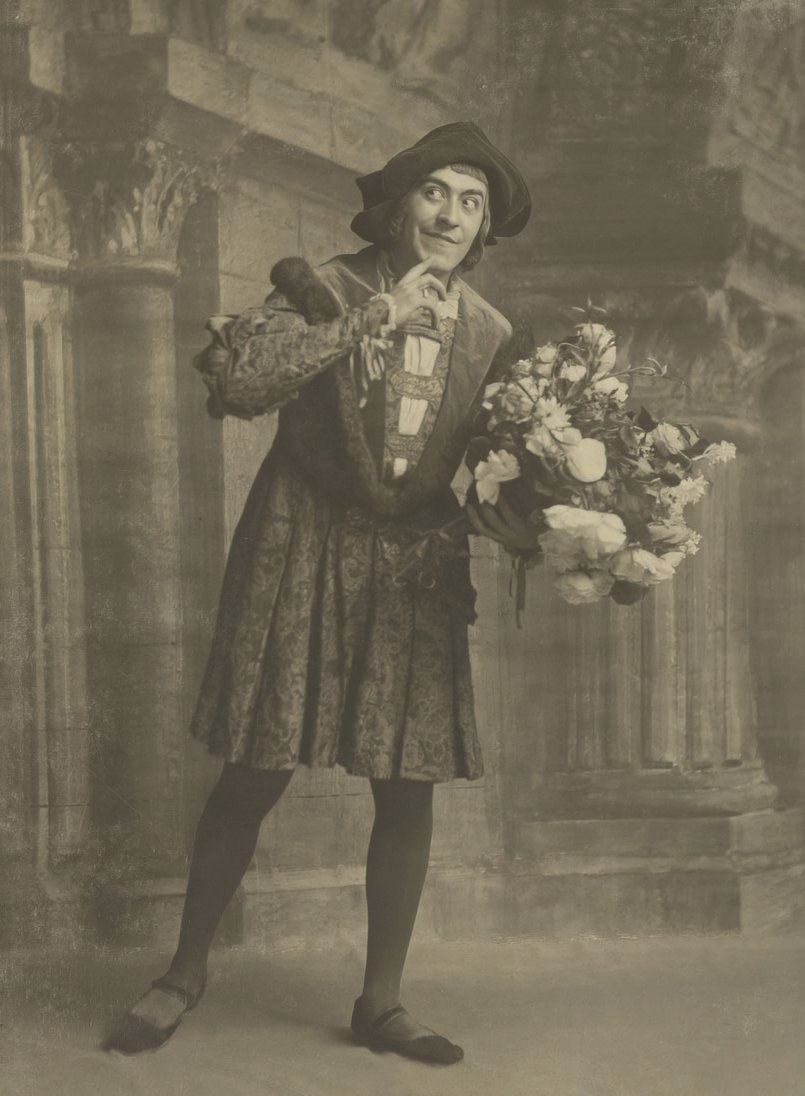
Photograph by the Atelier Nadar (Paul Nadar). The role of Fieramosca was created by Petit at the inauguration of the TCE on 31 March 1913, conducted by Felix Weingartner. The year Petit was thus photographed in stage costume is also the year he lived at 34 boulevard de Clichy.
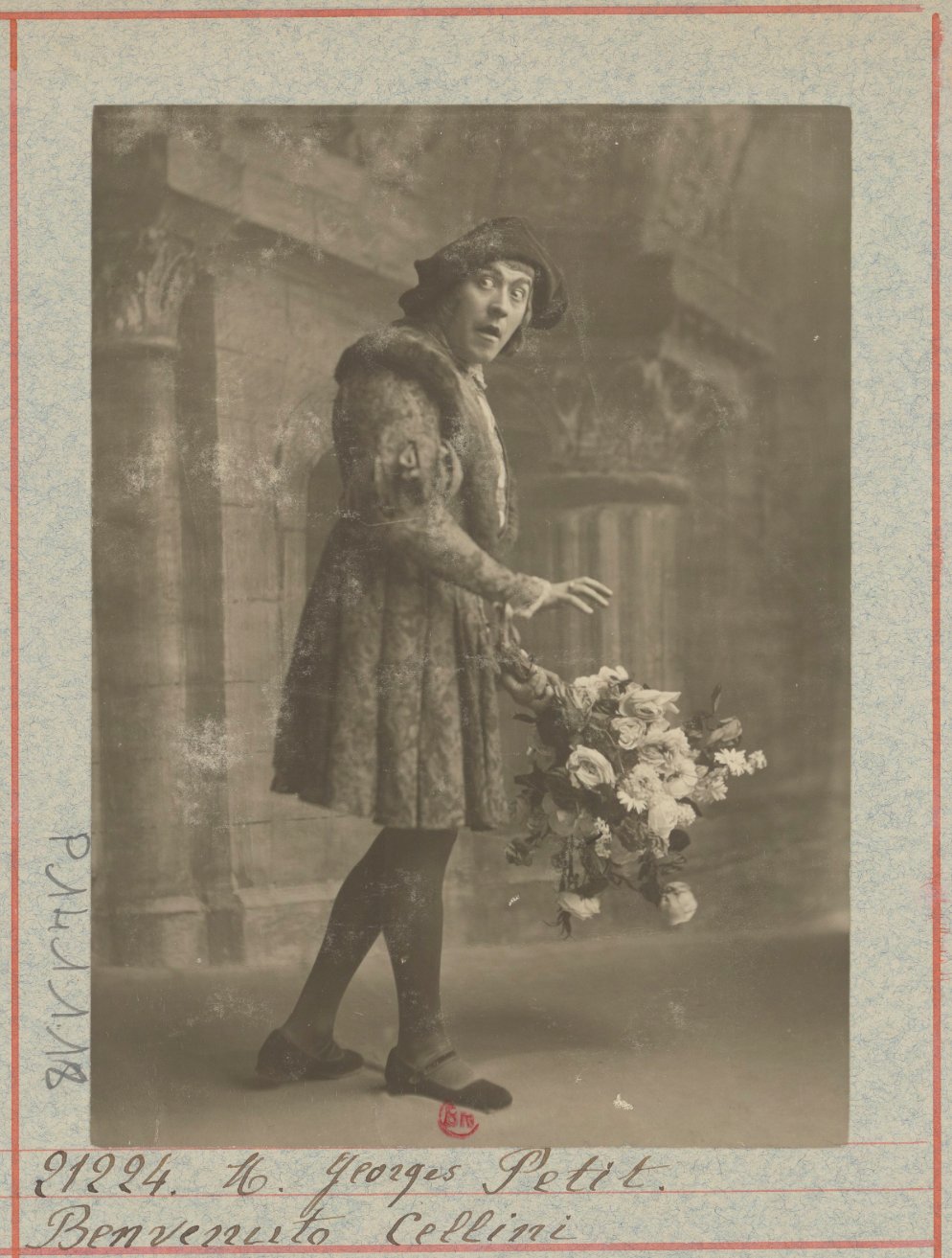
Petit in the costume of Fieramosca holding a bouquet of flowers, in a set with columns and arcades. The handwritten caption reads "21224. M. Georges Petit. Benvenuto Cellini". From the same series of stage portraits Petit had taken around the time of the work's première at the Théâtre des Champs-Élysées.
Georges Michel Petit, known as Georges Petit, was born in Bordeaux (74 rue du Loup, 2nd section) on 8 August 1883, son of François Albert Petit, an employee, and of Marie Gary. He completed his first musical studies at the Bordeaux Conservatoire from 1893 to 1898, where he obtained a first prize in piano and harmony; during the same period, from 1897 to 1900, he played the organ at Saint-Nicolas Church in Bordeaux. He moved to Paris in 1901 and entered the Paris Conservatoire in 1902 in the classes of Dubulle (singing), Isnardon (opéra-comique) and Lhérie (opera), while attending the harmony and composition classes of Xavier Leroux.
At the Conservatoire, he won every distinction: first runner-up in singing in 1904; second prize in singing and first prize in opera in 1905; first prizes in singing and opéra-comique in 1906. With a baritone voice "superb and remarkably timbred" according to Comœdia illustré in 1910, he was immediately engaged for the 1906-1907 season by MM. Kufferath and Guidé at the Théâtre Royal de la Monnaie in Brussels.
Lyric career — major creations
Georges Petit made his Brussels debut in 1907 in Pelléas et Mélisande by Debussy, where he created the role of Pelléas at La Monnaie "to lively success". He also created there the role of Iokanaan in Richard Strauss's Salomé (first French-language performance), Chorèbe in Berlioz's La Prise de Troie, Frédéric in Lakmé, Valentin in Faust, Wolfram in Tannhäuser.
Back in Paris, he was engaged by the Isola brothers at the Gaîté-Lyrique, where he created Antoine Mariotte's Salomé, played Chilon (Quo Vadis?), created Bielsky-Skousatoff in Ivan the Terrible and Lyspariano in Carmosine. At Covent Garden in London, he sang Pelléas et Mélisande again.
1913 was a pivotal year: on 31 March 1913, he created the role of Fieramosca in Berlioz's Benvenuto Cellini at the inauguration of the Théâtre des Champs-Élysées, conducted by Felix Weingartner. He also performed there Der Freischütz and Fauré's Pénélope. On 15 November 1913, he made his debut at the Paris Opera (Palais Garnier) in Les Joyaux de la Madone by Ermanno Wolf-Ferrari (role of Raphaël). On 24 April 1924, he created at the Théâtre des Champs-Élysées Lord Berners's Le Carrosse du Saint-Sacrement (role of the Viceroy).
In 1926, he triumphed in Mussorgsky's Boris Godunov at the Grand Théâtre d'Alger (Audisio season) — critics noted that he "rendered in a masterly manner the complex role of this bloodthirsty tsar". He was also a temporary professor of a lyric declamation class at the Paris Conservatoire in 1911.
Composer
Alongside his career as a singer, Georges Petit published a corpus of melodies and pieces for piano with several publishers: Hamelle (Paris), Lemoine (Paris), J. M. Vieu and Otto Junne (Brussels). His collection Romances du souvenir is documented by Gallica/BnF. The subtitle Odette Legendre chose for her 1992 monograph — "a half-century of French vocal art" — sums up well the dual dimension of his work: transmitting the French lyric tradition both through the stage and through composition.
Private life
Georges Petit first married Elsa Sophie Geneviève Pétry, known as Léda Ginelly (1899-1959), a choreographic artist born in Barcelona. The couple later divorced. The press of February 1926 (Lyrica) reports the couple together on tour in Algiers: Petit in Boris Godunov, Léda Ginelly an "exquisite dancer" in La Tragédie de Salomé by Florent Schmitt and in Golliwog's Cake Walk by Debussy. Petit then married, in Paris 17th on 13 July 1935, Marie Alphonsine Alexandrine Hébert (1882 — before 1960).
Presence at 34 boulevard de Clichy
In 1914, Georges Petit lived at 34 boulevard de Clichy in Paris 18th — address confirmed by biographical sources (artlyrique.fr, cross-checked with his correspondence and press files). He was then 30-31 years old and had just experienced the pivotal year of 1913 (creation of Benvenuto Cellini at the TCE and debut at the Paris Opera); his residence at no. 34 therefore corresponds to the most brilliant period of his career as a baritone. He was one of the lyric artists who populated the artists' buildings near Pigalle, in the immediate vicinity of the theatres, cafés-concerts and cabarets of the neighbourhood.
Petit does not appear in the consolidated Paris census records of 34 boulevard de Clichy (1926-1936), which suggests that he had left the address before 1926 — consistent with his later move to 26 avenue de Villiers (Paris 17th) attested in 1935, then to 10 rue Théophraste-Renaudot (Paris 15th) at the end of his life.
His presence at no. 34 traces, alongside that of Eugène Pottier (textile-design studio, 1880-1887, author of The Internationale), the dual musical and literary dimension of no. 34: a building that has not only sheltered the visual arts, but also artists of song and composition — consistent with the immediate vicinity of the cafés-concerts, cabarets and lyric theatres of Pigalle in the same period.
Main works
- Collection Romances du souvenir — documented by BnF-Gallica.
- Melodies and pieces for piano published by Hamelle, Lemoine, J. M. Vieu, Otto Junne (Brussels).
Notable created or starring roles
- Pelléas in Debussy's Pelléas et Mélisande — premiered at La Monnaie in Brussels, 1907; revived at the Gaîté-Lyrique in 1911 and at Covent Garden in London.
- Iokanaan in Richard Strauss's Salomé — first French-language performance at La Monnaie.
- Fieramosca in Berlioz's Benvenuto Cellini — premiered at the Théâtre des Champs-Élysées, 31 March 1913, cond. Felix Weingartner.
- Raphaël in Wolf-Ferrari's The Jewels of the Madonna — Paris Opera debut, 15 November 1913.
- The Viceroy in Lord Berners's The Triumph of Neptune / Le Carrosse du Saint-Sacrement — premiered at the TCE, 24 April 1924.
- Antoine Mariotte's Salomé (premiered at Gaîté-Lyrique); Chilon in Quo Vadis?; Bielsky-Skousatoff in Ivan the Terrible; Lyspariano in Carmosine; Chorèbe in Berlioz's La Prise de Troie; Frédéric in Lakmé; Valentin in Faust; Wolfram in Tannhäuser; Mussorgsky's Boris Godunov (Algiers, 1926); Fauré's Pénélope.
Sources & resources
- artlyrique.fr — Georges Petit entry: complete biography with civil status dates, genealogy, created roles, press citations (Comœdia illustré 1910, Henri Focké Célébrités de l'art lyrique 1914, Lyrica 1926). Cites and reproduces the Atelier Nadar portraits held at the BnF.
- Odette Legendre, Georges Petit: 1883-1960 — un demi-siècle d'art vocal français, 1992, 46 pp.
ISBN-10:2-89276-105-0· ISBN-13:978-2-89276-105-4 - Revue d'Histoire littéraire de la France, 98th year, no. 5, September-October 1998, pp. 709-1031 — special issue Bibliographie de la littérature française (XVIᵉ-XXᵉ siècles), année 1997, PUF (JSTOR · Cairn.info).
- APPL — Père-Lachaise Cemetery (Petit Georges 1883-1960 entry) — burial location (division 87, columbarium, recess 1195)
- BnF data — Georges Petit authority record (ark:/12148/cb124701585)
- Gallica / BnF — for consultation of any digitised scores and romances (in particular Romances du souvenir and the pieces published by Hamelle, Lemoine).