34 boulevard de Clichy housed, for more than half a century, one of the most famous and most macabre cabarets of the Parisian Belle Époque.
Origin and foundation
The concept was born in 1892 in Brussels, under the name Café de la Mort, created by the illusionist Antonin Dorville. After a few months in Brussels, Dorville transferred his establishment to 53 boulevard de Clichy in Paris, renaming it the Cabaret du Néant. In June 1895, he moved to the 34, where he added several extra darkened rooms. The address would remain that of the Néant until its definitive closure around 1946-1950.
Between 1892 and 1895, the 34 was also the first address of the Cabaret de l'Enfer, founded by Antonin Alexander, before its transfer to no. 53. The Néant took its place at the 34 in 1895.
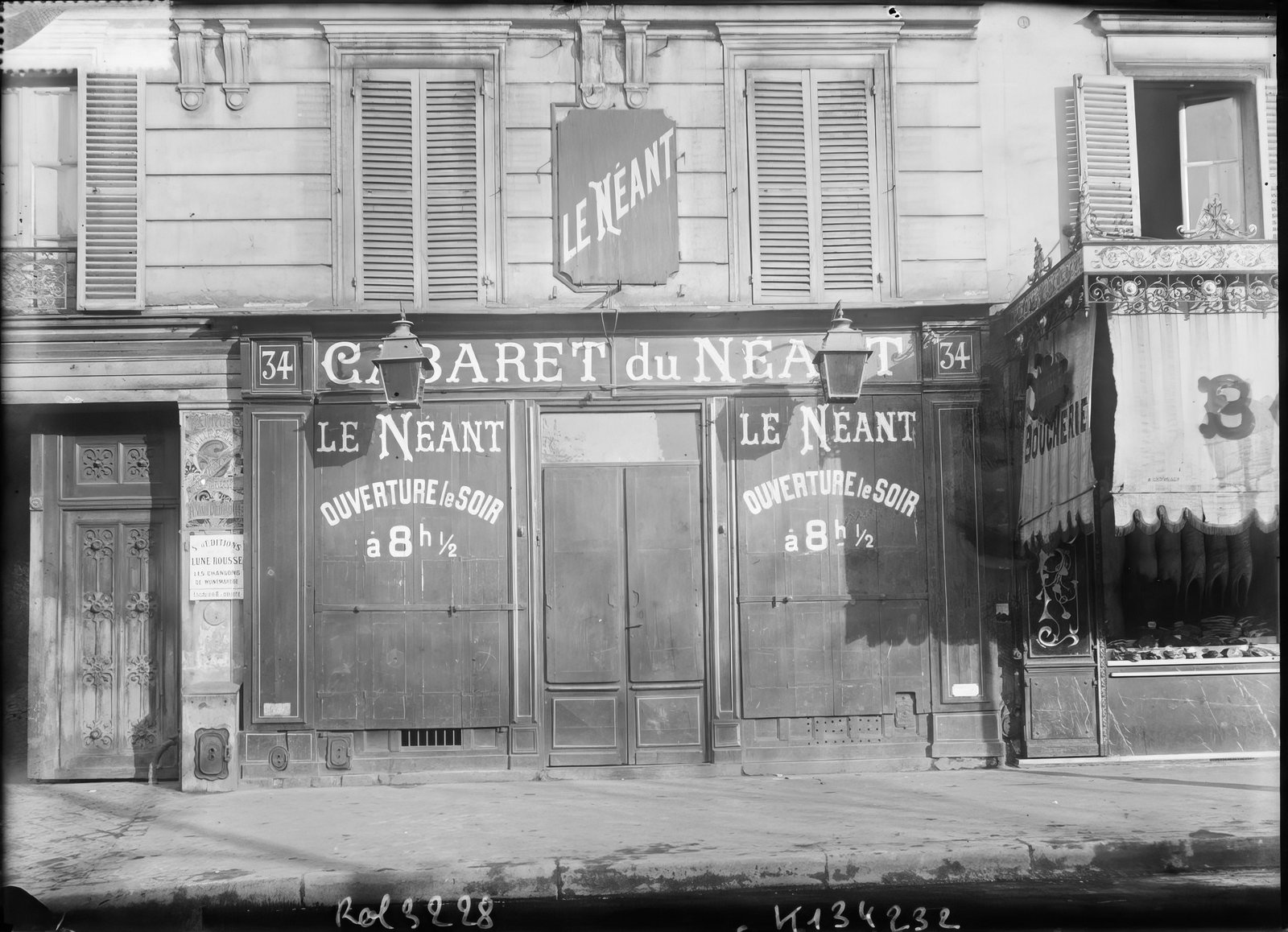
Frontal view of the dark-painted shopfront: the sign “LE NÉANT” appears three times — above the first-floor windows, and on each panel of the ground-floor shutters —, the banner “CABARET du NÉANT” under two funereal lanterns, and the mention “OUVERTURE le SOIR à 8h ½” (“opens evenings at 8.30 p.m.”). The two enamelled “34” street plates frame the shopfront. On the left, on the still-extant entrance door to the building, an advertising poster for the Éditions Lune Rousse — Les Chansons de Montmartre; on the right, the neighbouring butcher's shop. Glass-plate negative held at the BnF, Department of Prints and Photography (shelfmark EI-13 (30)). Source: Gallica / BnF, ark:/12148/btv1b53109559k — public domain.
Atmosphere and decor
The Cabaret du Néant was conceived as a funeral vault: green lanterns at the entrance gave passers-by the livid look of corpses, darkened rooms, candelabras made of human bones, tables in the shape of coffins, waiters dressed as undertakers.
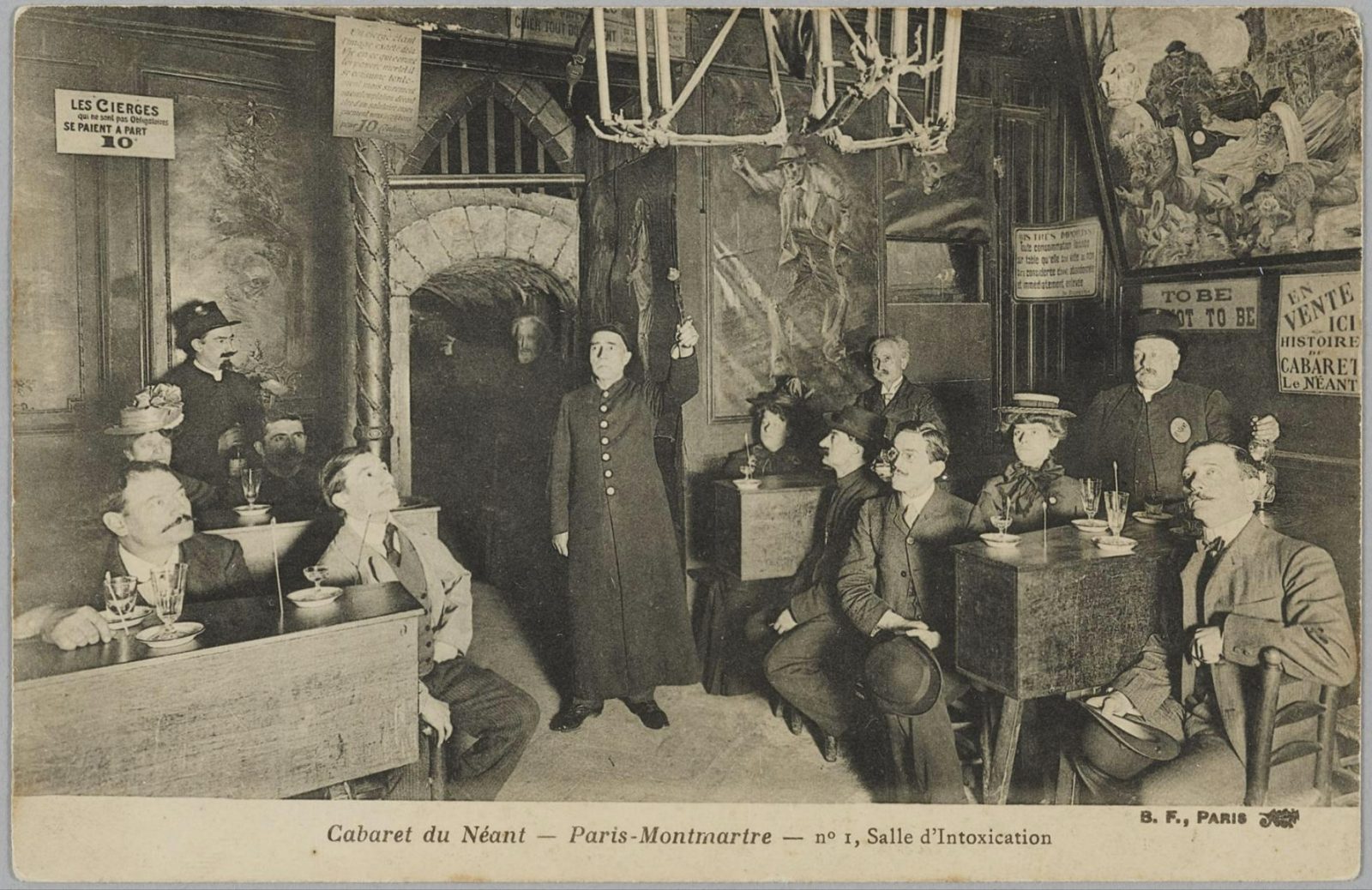
Postcard, early 20th century. A presenter animating a show in front of fascinated customers; in the background, an unsettling figure in the shadows, the famous coffin-tables, a chandelier in the shape of a skeleton.
The visit included several themed rooms: the Salle d'Intoxication (Intoxication Room), the Salle de l'Incinération (Cremation Room — where the attraction consisted in being placed in a coffin, the customer holding a candle), and the Caveau des Spectres tristes (Vault of the Sad Spectres) in the basement, where conjuring tricks based on the principle of Pepper's Ghost simulated the customer's decomposition into a skeleton.
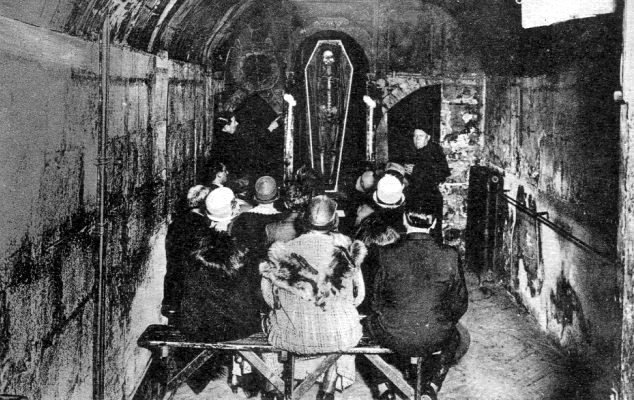
Vertically standing coffin with visible skeleton, customers seated in rows as at a funeral service. Sober decor, cellar walls: at the exact opposite of its neighbour's demonic iconography (the Cabaret de l'Enfer), the Néant plays the austere crypto-funereal vault.
Several material traces of the establishment are preserved at the Carnavalet Museum in Paris: a promotional ashtray and an illustrated postcard entitled "Cabaret du Néant — Salle d'Intoxication, 34 boulevard de Clichy, Montmartre".
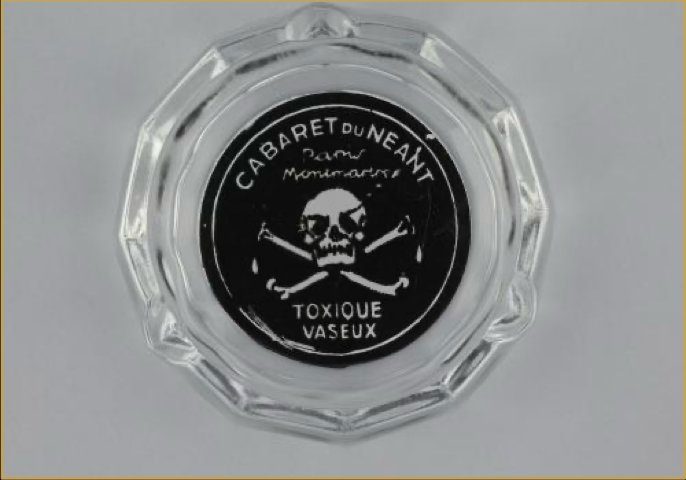
Moulded glass, c. 1945-1950. Carnavalet Museum — History of Paris, inventory n° 2018.5.483. Visible on Paris Musées Collections.
The "Skeletons' Dinner"
Another remarkable piece of visual propaganda from the Néant is a menu-invitation entitled Dîner des Squelettes (Skeletons' Dinner), printed between the two World Wars (the mention "Château la Pompe Funèbre 1924" in the list of drinks provides a temporal marker). The document combines a lithograph of a vanity-skeleton dancing on the terrestrial globe, in the great medieval macabre tradition, with a menu entirely composed of funereal puns that conveys the cabaret's tone.
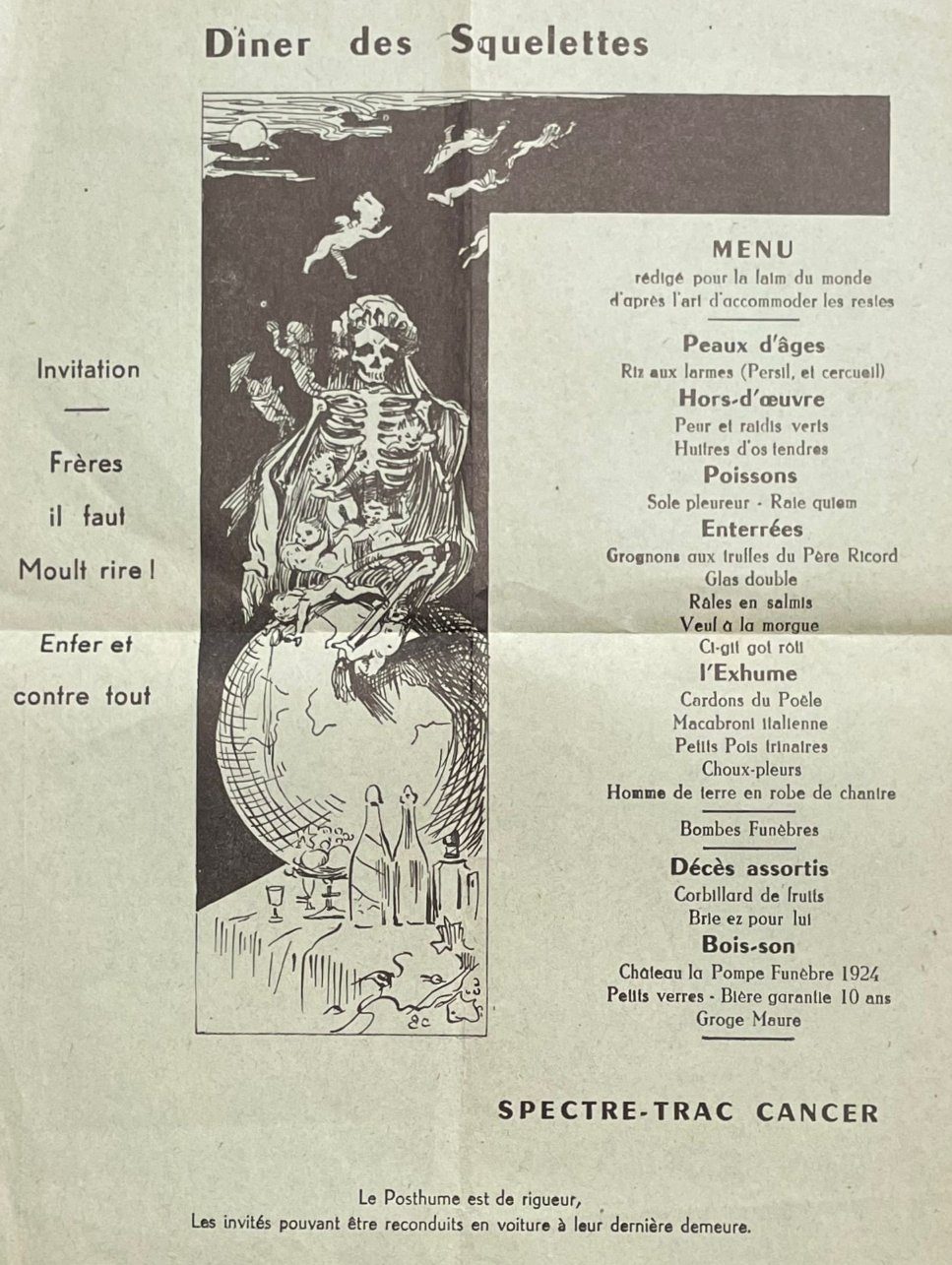
On the back, a promise: guests can be driven home by car to their last resting place. The menu plays entirely on macabre puns. The motto of the place — "Frères il faut Moult rire!" and "Enfer et contre tout" — frame a lithograph signed "ac".
Critical reception
The cabaret is classified among the "Artistic Cabarets" in the guide Baedeker's Paris and Its Environs (1904 edition). Scientific American published an illustrated exposé of the optical tricks of the Néant in 1896. Unlike its neighbours Le Ciel and L'Enfer, the Néant is described by the critic Georges Renault as a place "frequented by hysterics and neurotics". The Surrealists around André Breton conducted experiments with mediumistic sleep there in the 1920s.
Export and posterity
In 1896, the Cabaret du Néant inspired an imitation in New York, at the Casino Chambers (Thirty-ninth Street and Broadway). This New York version included the first public exhibition of an X-ray machine in North America. The modernist poet Mina Loy devoted a poem to it, "Café du Néant", published in August 1914.
When the establishment closed for good, its morbid sets were bought by a certain Piquemal and reused at the Historial-Musée de cire de Montmartre (Montmartre Wax Museum), open between 1954 and 1990. The Cabaret du Néant is documented exhaustively in Cabarets of Death by Mel Gordon, and illustrated in Bohemian Paris of To-day by W. C. Morrow (1899).
More recently, the Frac Île-de-France and the Communauté d'agglomération de Marne-et-Gondoire paid tribute to the cabaret by presenting, from 18 September to 15 December 2020 at the Rentilly castle, an exhibition entitled Le Cabaret du Néant.
The Cabaret de l'Enfer — neighbour and precursor
Before the Néant, the 34 housed, between 1892 and 1895, the first address of the Cabaret de l'Enfer founded by Antonin Alexander. In its early years, the Enfer did not stand alone: it shared a common façade with its luminous twin, Le Ciel, in a dual stage-set that turned the front of the 34 into a permanent eschatological theatre — on one side the Gothic arcatures, angels and balconies of paradise, on the other the grimacing maw swallowing passers-by and the stucco flow imitating the eternal torments. Several historical photographs document this arrangement at the 34 from different angles. After its transfer to no. 53, the Enfer continued to operate for decades only a few metres away, but without its celestial counterpart: the façade was reconstructed on the damned iconography alone, which became its solitary trademark.
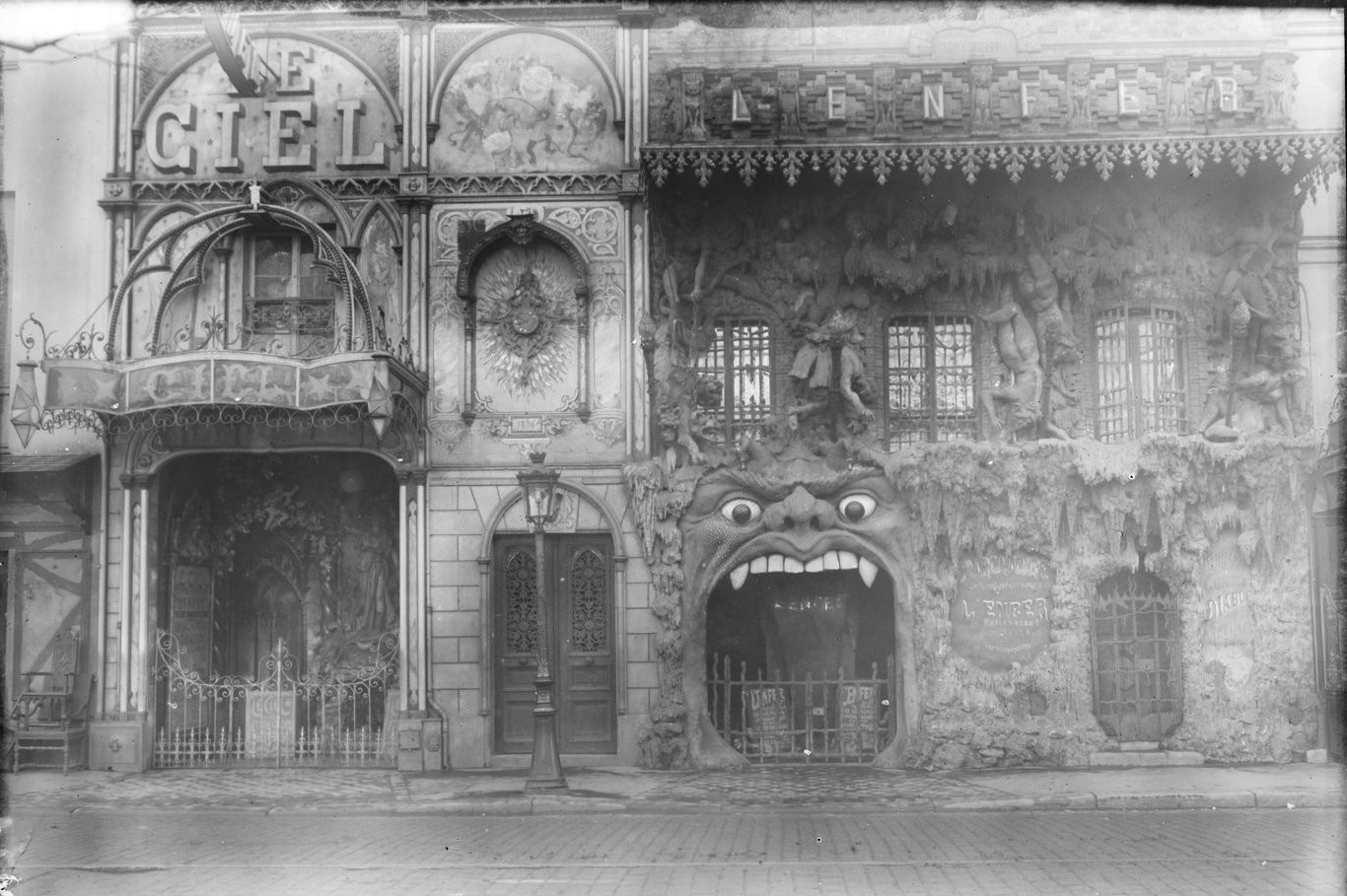
The twin façade of the Ciel (left, Gothic arcatures, ornate balcony, "LE CIEL" sign) and of L'Enfer (right, monstrous maw, stucco flows, "L'ENFER" sign). This dual stage-set, signature of Antonin Alexander, plays the salvation/damnation contrast on an architectural scale.
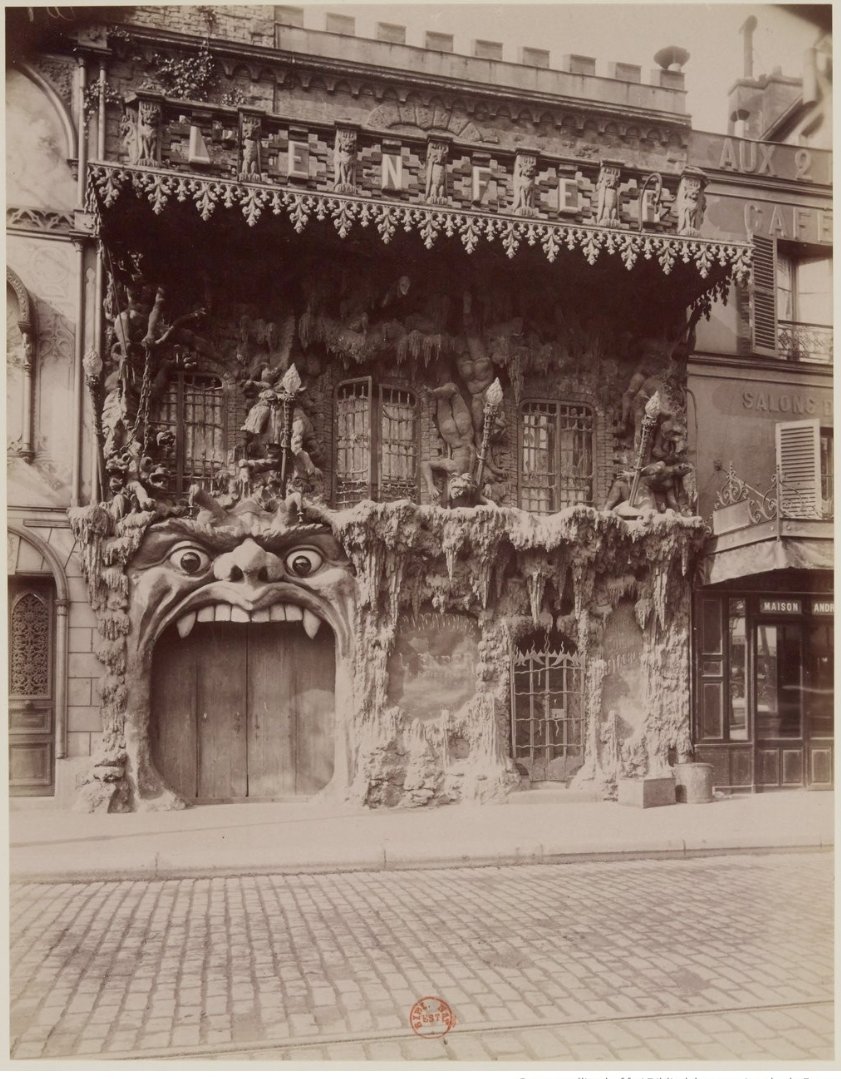
Tight framing on the monstrous maw, the sculpted damned souls, the stucco stalactites and the raised lances. On the left, the Gothic carriage entrance of no. 34 (the same as on the overall view); on the right, the "MAISON ANDR[É]" and the "SALONS" of an adjoining café ("AUX 9"). The ornate frieze bears the letters of "L'ENFER" sculpted in the lintel.
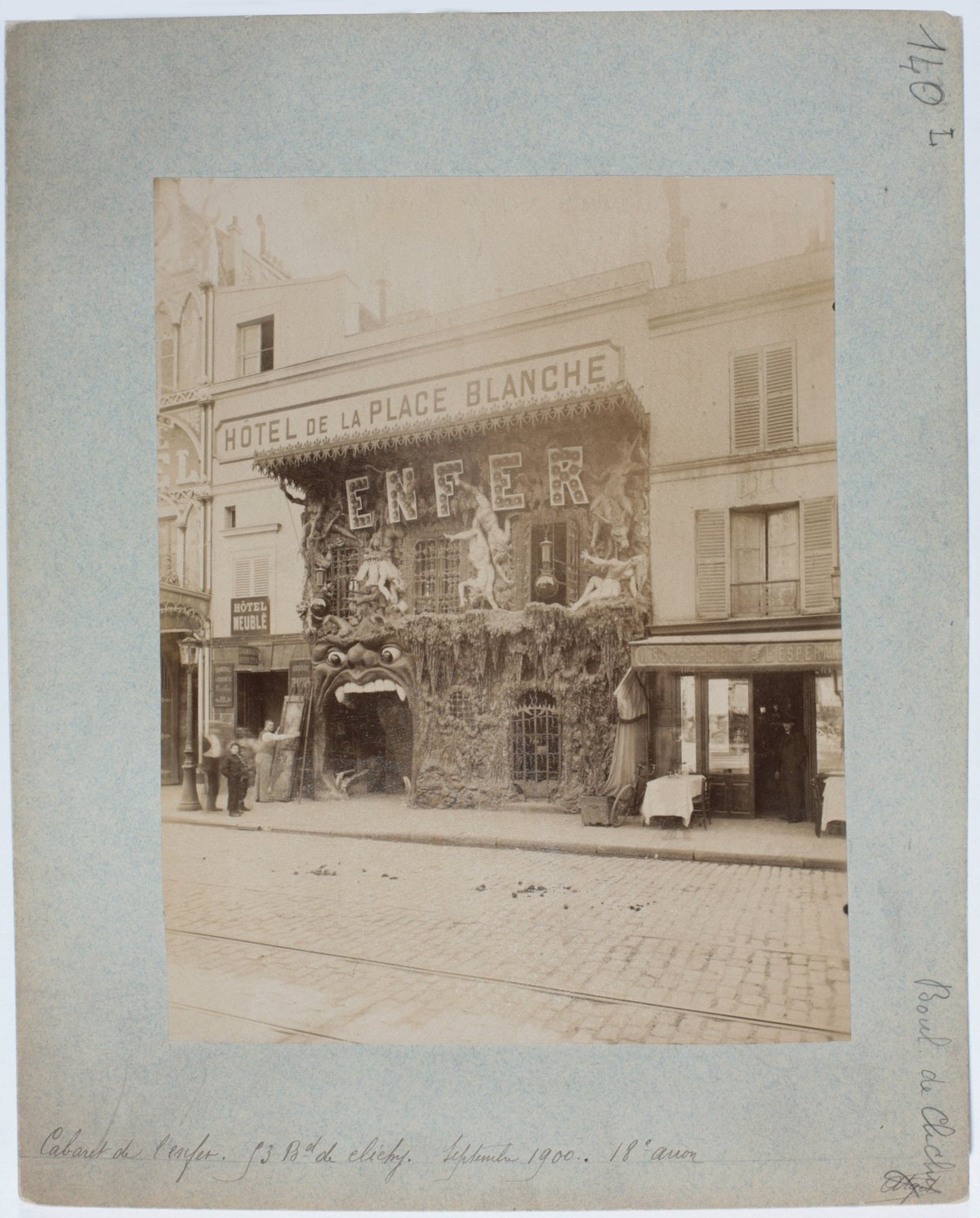
View taken from the opposite pavement. The maw of the Enfer now occupies the centre of the composition, surmounted by the illuminated sign "ENFER" in bulb letters. In the background, the Hôtel de la Place Blanche dominates; on the right, the terrace of a café ("L'Espér[ance]") with its draped tables and awning; on the left, an "HÔTEL MEUBLÉ". The Ciel has disappeared, the urban context has entirely changed. Handwritten caption: "Cabaret de l'Enfer. 53 Bd de Clichy. Septembre 1900. 18ᵉ arrᵗ".
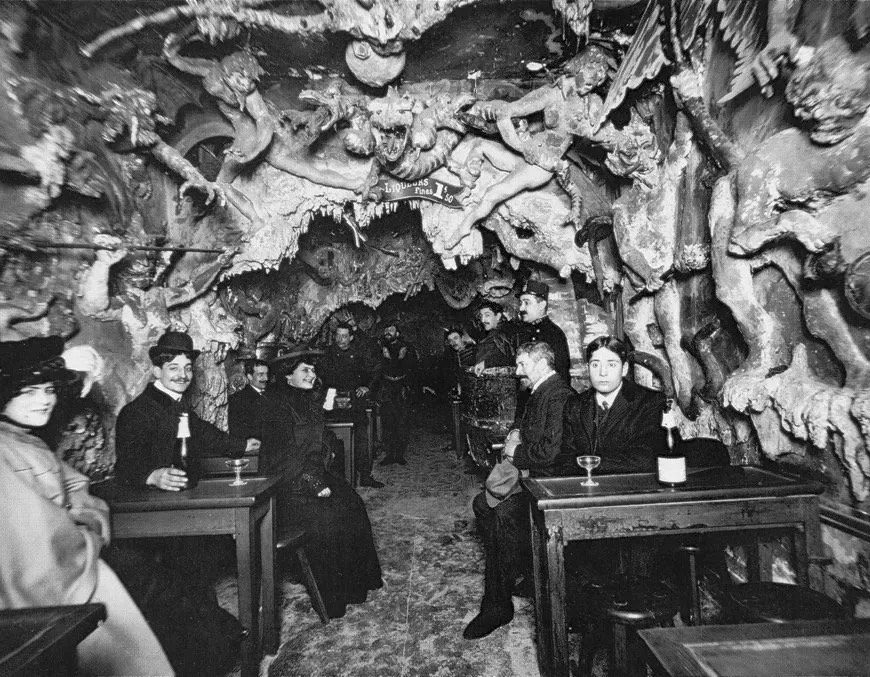
The decor reproduces the infernal cavern: stucco stalactites, walls sculpted with writhing damned souls, demons with bulging eyes, creatures with clawed feet. At the centre, a sign reads "LIQUEURS FINES 1.50"; at the back, one of the famous servers dressed as devils can be seen. Ordinary café tables, customers posing for the photographer — the contrast with the demonic iconography enveloping them is the whole point of the device.
The forgotten brasseries of no. 34 (1885-1892) — Riester, Coq d'Or, Lisbonne?
Between the closure of the Brasserie Reichshoffen — around 1885, after the pictorial cycle by Édouard Manet which ends in 1879 — and the arrival of the Cabaret de l'Enfer in 1892, the ground floor of 34 boulevard de Clichy went through a period of about seven years until now totally absent from the accounts of the address. This heritage investigation has established that at least two successive brasserie operations occupied the premises during that grey area: the Brasserie Riester and then the Brasserie du Coq d'Or. Nathaniel Greene's scholarly article on the Cabaret du Néant (review 1895, no. 96, 2022) further suggests a "Lisbonne" stage in the commercial history of the place, whose location at no. 34 remains to be formally verified.
Brasserie Riester — Georges Riester, brewer in Puteaux
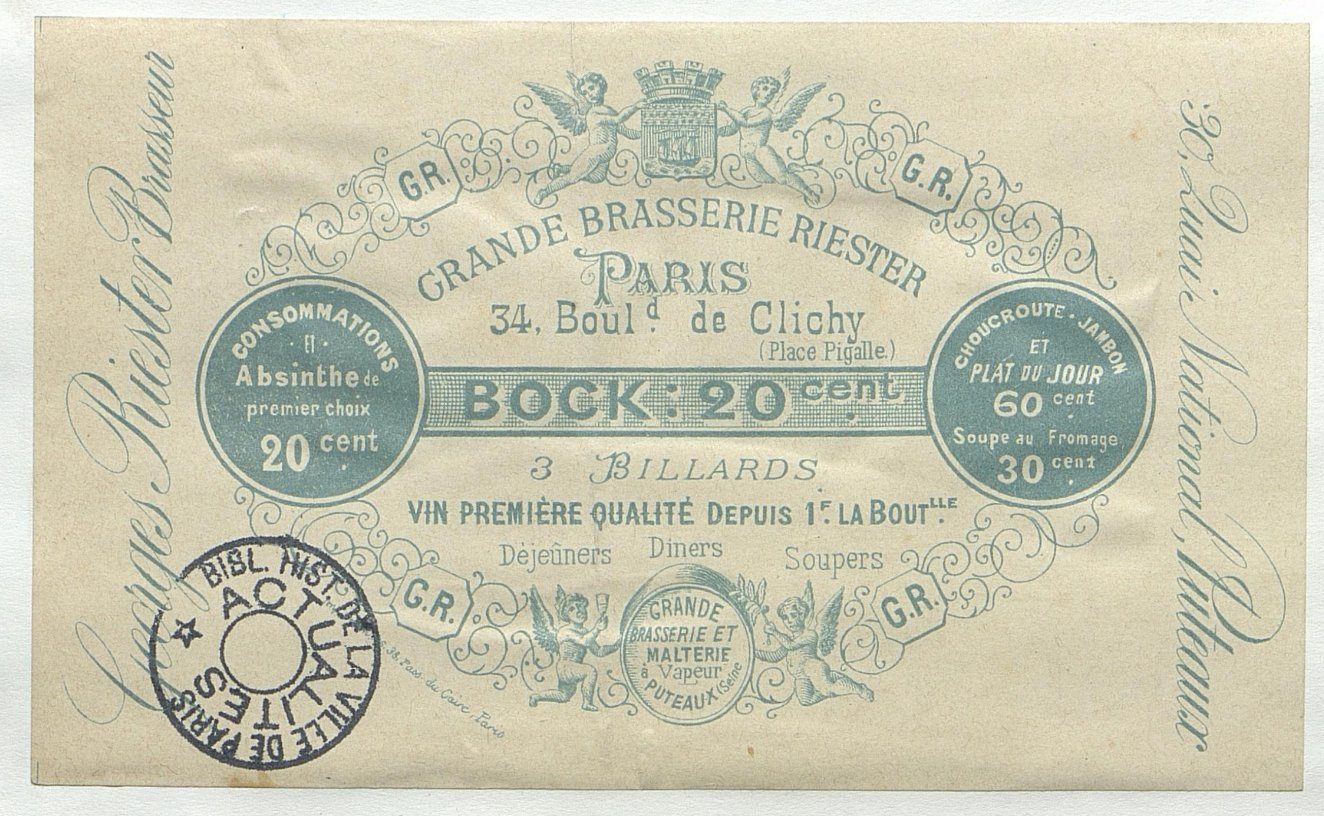
Printed in blue-grey with Belle Époque motifs, frame of putti holding the coat of arms of the City of Paris. Initials G. R. (Georges Riester) in four cartouches. In the margin: "Georges Riester, Brasseur — rue National, Puteaux". At the foot: "Grande Brasserie et Malterie à vapeur, Puteaux (Seine)". The card bears the stamp "Bibliothèque Historique de la Ville de Paris — Actualités", attesting its provenance. Held in the Actualités collection of the BHVP (22 rue Malher, 75004 Paris).
The promotional card lists a popular Pigalle brasserie menu: "BOCK: 20 cent.", "Absinthe de premier choix 20 cent.", "Choucroute-Jambon et Plat du jour 60 cent.", "Soupe au Fromage 30 cent.", with the mention "Déjeuners — Diners — Soupers" and "Vin première qualité depuis 1 fr. la bouteille". A revealing detail of an ambitious establishment: the mention "3 Billiard tables", costly equipment that implies a large room and a regular clientele. Riester is not just a Pigalle operator: he is an industrial brewer, owner of the Grande Brasserie et Malterie à vapeur in Puteaux (Seine) — he supplies the beer sold at no. 34 himself. No. 34 here functions as the Parisian shop window of an industrial-suburb brewery, on a brewer-publican vertical-integration model typical of the late 19th century.
Brasserie du Coq d'Or — Eugène Becker
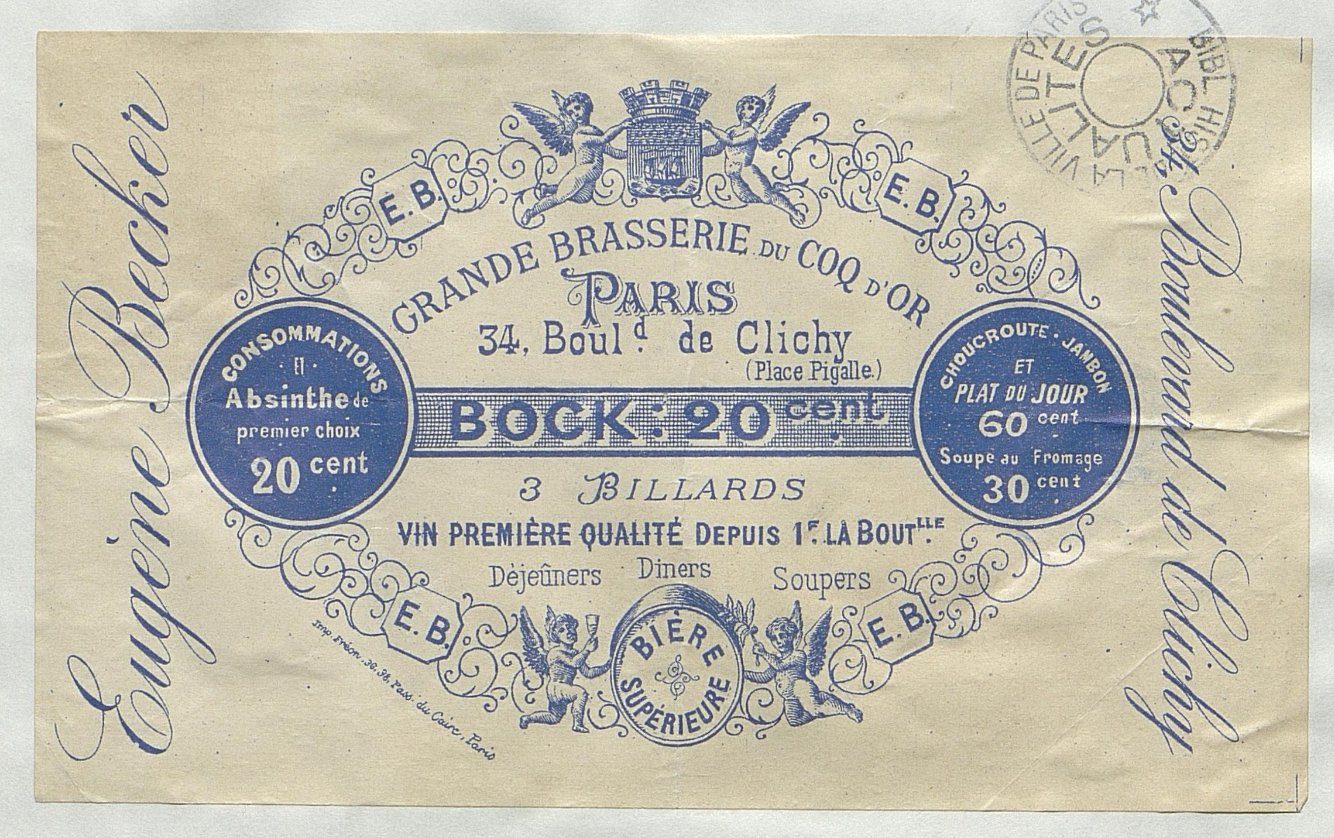
Printed in vivid blue, layout rigorously identical to the Riester card (same putti, same coat of arms, same tariff, same "3 Billiard tables"); only the initials and the brewer's identity change: E. B. (Eugène Becker) in four cartouches, in the margin "Eugène Becker — Boulevard de Clichy", and at the foot "Bière Supérieure". Mention of the printer: "Imp. Gréon, 36-38 Faub. du Caire, Paris". Stamp "Bibliothèque Historique de la Ville de Paris — Actualités".
The near-identical graphic design between the two cards is itself a precious heritage clue: same printer (Gréon, faubourg du Caire), same plate reused with a simple change of name and initials, same advertised equipment ("3 Billiard tables"), same prices to the centime. Becker manifestly took over Riester's establishment, keeping its installations and operating model, and had his own card printed at the same workshop, which simply replaced the identifying elements. This material continuity suggests a direct succession with no interruption of business. The name "Coq d'Or" belongs to an Alsatian-Germanic imaginary then very fashionable in Pigalle, perhaps echoing the Reichshoffen brasserie that occupied the same walls a few years earlier.
The "Lisbonne" stage — a lead to be verified
In his article "Autour du Néant: Dorville et l'invention du cabaret macabre" (review 1895, no. 96, 2022), Nathaniel Greene mentions, within the commercial context of late-19th-century Pigalle, a "Lisbonne" stage — likely a café-concert or a brasserie of that name — which he would situate between Coq d'Or and the arrival of the Cabaret de l'Enfer in 1892. This mention, however, remains to be formally verified: at this stage of the inquiry we have not been able to confirm through an independent material source (promotional card, press notice, trademark filing, business-tax register) that the Lisbonne actually occupied the ground floor of 34 boulevard de Clichy. It might be either a transitional establishment whose material trace has been lost, or a confusion with a homonymous establishment in the neighbourhood. The lead is signalled here for further archival work.
The 34, theatre of a commercial mutation
Over the decade 1885-1895, the ground floor of the 34 went through the entire commercial mutation of Pigalle under the Third Republic. From the traditional Alsatian brasserie (Reichshoffen) to the industrial Île-de-France brasserie (Riester), then to the modern Alsatian brasserie (Coq d'Or) — perhaps followed by a Lisbonne stage to be confirmed —, then to ephemeral cafés-concerts, and finally to thematic macabre cabarets (Enfer then Néant). This density of uses, on a few square metres and in less than a decade, makes the ground floor of the 34 a veritable case study for anyone wishing to understand the invention of modern Pigalle.
Current status of the premises
Today, the historic ground floor of the Cabaret du Néant is occupied by the Moon City sauna (over more than 1,200 m²), which presents itself as one of the largest in Europe. The inner courtyard and the rear-courtyard artists' studios, for their part, have kept their creative vocation since the end of the 19th century.
Sources & resources
- Cabaret du Néant — Wikipedia
- Paris Musées Collections — promotional ashtray "Cabaret du Néant" (Carnavalet Museum, inv. n° 2018.5.483)
- Frac Île-de-France & Parc culturel de Rentilly — exhibition Le Cabaret du Néant, Rentilly castle, 18 September — 15 December 2020
- Revue 1895 — Nathaniel Greene, "Around the Néant: Dorville and the invention of the macabre cabaret", no. 96, 2022
- Mel Gordon, Theatre of Fear & Horror: Expanded Edition: The Grisly Spectacle of the Grand Guignol of Paris, 1897-1962 (chapters devoted to Parisian macabre cabarets)
- W. C. Morrow, Bohemian Paris of To-day, 1899 — Internet Archive
- Baedeker's Paris and Its Environs, 1904 edition
- Scientific American, 1896 — exposé of the optical tricks of the Néant
- Mina Loy, "Café du Néant", poem, August 1914