A capital discovery of the investigation: the Czech painter Hella Guth, a figure of post-war abstraction associated with the École de Paris, lived and worked at 34 boulevard de Clichy from 1951 to 1992 — for 41 consecutive years, which makes her one of the longest continuous artistic presences in the entire history of the building.
From Bohemia to Prague
Helena Guthová, known as Hella Guth, was born on 16 February 1908 at Kirchenbirk (today Církvice) in western Bohemia, in the Austro-Hungarian Empire. She was the second of three children of Jewish parents converted to Protestantism.
A pupil of Trude Sandmann in Vienna during her secondary-school years, she then studied at the School of Arts and Crafts of the Austrian Museum of Art and Industry in Vienna (1926-1929) under the direction of Joseph Hofmann. She moved to Prague in 1930, joined the avant-garde group Mánes — where she was labelled "Trotskyist" — and studied from 1930 to 1932 with Willi Nowak at the Academy of Arts of Prague. During this Prague period, she earned her living as an advertising designer.
Anti-fascist commitment
From 1933, after the Nazi seizure of power in Germany, Hella Guth committed actively to defending German artists who had taken refuge in Prague. She organised support demonstrations, published a series of postcards of protest and contributed to the anti-fascist satirical newspaper Simplikus. The same year, she produced a series of woodcuts for Brecht's Threepenny Opera, published at her own expense and noticed. She joined the German theatre troupe in exile Studio 34, for which she designed posters and sets, and did not hesitate to step on stage herself.
London, then Paris
With the Nazi occupation of Czechoslovakia in 1939, Hella Guth fled to London, where she lived during the war. She had her first solo exhibition there in 1943 at the Czech Institute; her painting, still figurative, already showed a Surrealist tendency. There she married Frank Popper, an art theorist, critic and exhibition curator specialised in kinetic art, also originally from Czechoslovakia.
The studio at 34 boulevard de Clichy (1951-1992)
Three concurring sources attest to Hella Guth's installation at 34 boulevard de Clichy in 1951: the Wikipedia entry devoted to the artist, the Galerie Ballesteros, and Bertrand Cayeux's website. All three indicate that she settled that year in a small studio at the 34, where she would live until her death.
The installation at the 34 coincided with a biographical break: Hella Guth separated from Frank Popper after their arrival in Paris. She then lived alone in her studio, leading an austere and concentrated life. A testimony reported by the Galerie Champetier describes her as a discreet woman, of small stature, her hair always pulled back, doing nothing to draw attention to herself — always dressed simply, concentrating all her energy on her art.
Parisian abstraction and the great period 1953-1965
In Paris, Hella Guth gradually abandoned figuration to join post-war lyrical abstraction, in the wake of the Réalités Nouvelles. Her career experienced a particularly active decade:
- 1953: solo exhibition at the Galerie Arnaud, Paris.
- 1954-1959: she exhibited every year at the Salon des Réalités Nouvelles in Paris — the great institution of French abstraction.
- 1955: solo exhibition at the Galerie Colette Allendy, Paris — one of the most important galleries of Parisian abstract avant-garde (Allendy exhibited Soulages, Hartung, Schneider, Mathieu).
- 1958: Hella Guth took part, with other painters and writers, in the founding of the Salon d'Art et Jeunesse de Crest (Drôme).
- 1960: group exhibition Peintres abstraits de Paris at the Galerie Günar in Düsseldorf, alongside Élie Borgrave, Georges Breuil and Jean Miotte.
She was appreciated by the Scottish poet Edwin Muir, the art critic Herbert Read and the theorist of abstraction Michel Seuphor. She formed bonds with many Parisian artists — Sonia Delaunay, Marcelle Cahn, Nicolas Schöffer — and frequented the Surrealist milieu. Her painting at the time was characterised by pleasingly arranged planes of warm colour, accentuated with straight linear traces.
The studio as a place of continuity
Guth's studio at the 34 illustrates the long-term vocation of the building's rear-courtyard studios. Whereas the commercial ground floors changed rapidly (Reichshoffen → Riester → Coq d'Or → cabarets → cinema), the artists' studios in the inner courtyard kept their occupants for decades. Hella Guth illustrates this stability, like Henri Marre and Sébastienne Marre before her in the neighbouring studio 4, and after her Michel Batlle, the Leherpeur lineage, and a whole generation of contemporary artists.
This exceptional artistic continuity — from great Impressionism to contemporary art, passing through every avant-garde of the 20th century — makes 34 boulevard de Clichy one of the discreet but unmissable high places of modern Parisian creation.
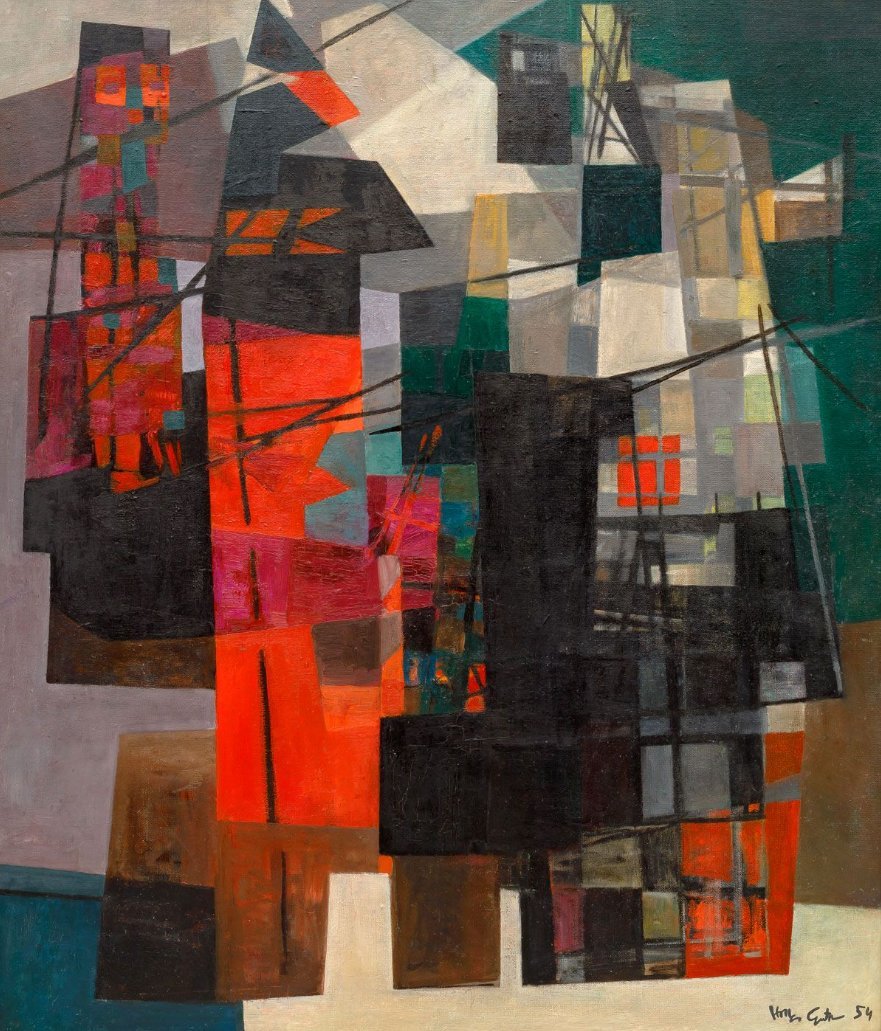
Architecture of vertical planes, contrasts of reds and blacks; ropes stretched across the canvas. Work signed and dated lower right, characteristic of the great Parisian period (Galerie Arnaud, Galerie Colette Allendy, Salon des Réalités Nouvelles).
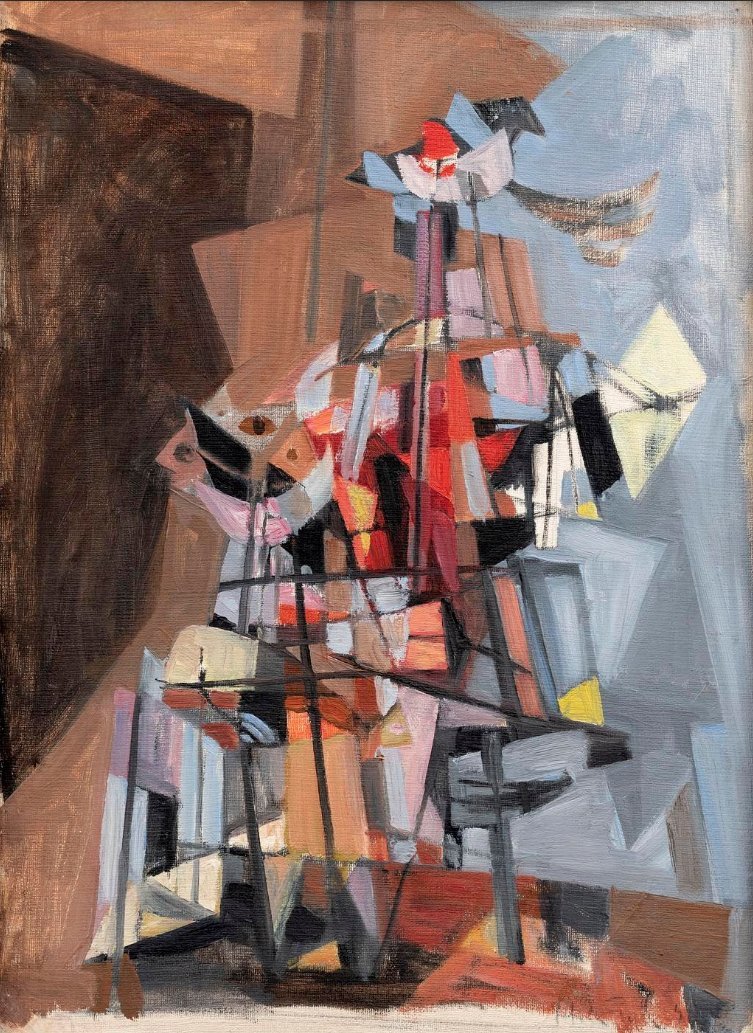
Transition from late figuration to lyrical abstraction: the silhouette becomes geometric in cubist planes — a legacy of the Prague and London years — while the palette lightens into fauvist and Parisian blue-grey tones.
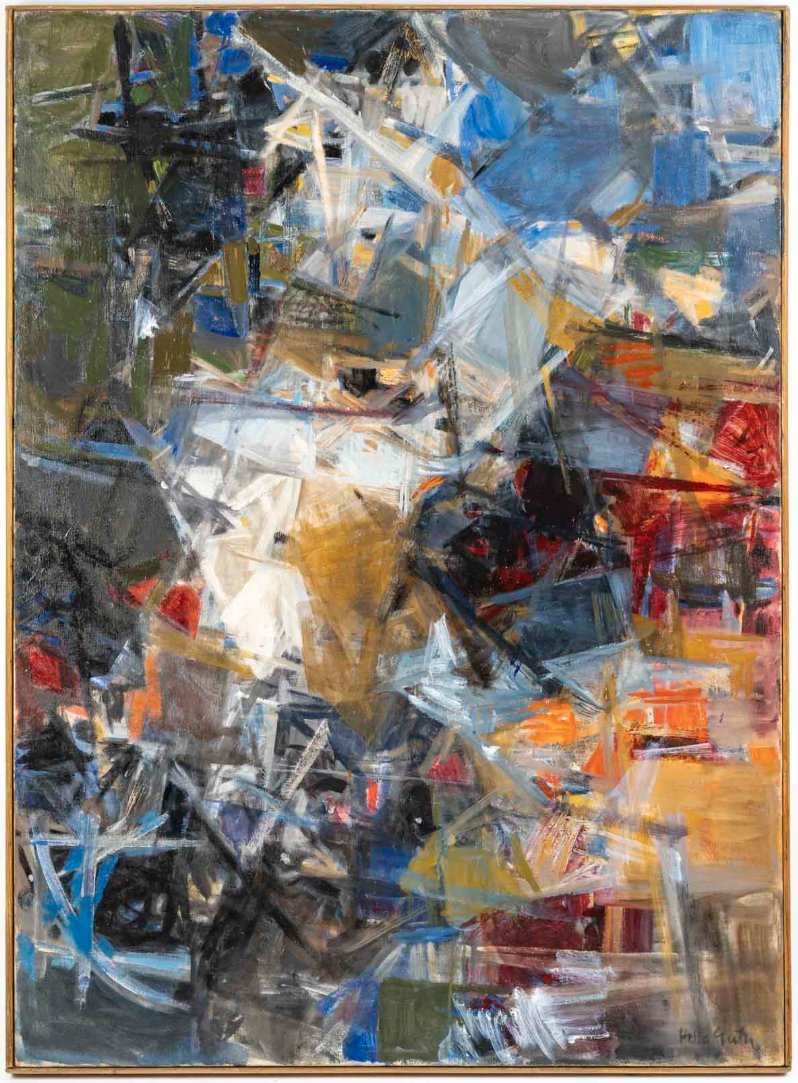
A bundle of white, ochre, blue and red lines crossing a dense material — the gestural signature of the artist's most liberated period, in the lineage of the Réalités Nouvelles and the dialogue forged with Sonia Delaunay and Nicolas Schöffer.
Sources & resources
- Hella Guth — Wikipédia (FR) (FR) · Wikidata Q1601927
- Galerie Ballesteros — biography and works of Hella Guth
- Bertrand Cayeux website — detailed biography
- Galerie Champetier — testimony and presentation
- Salon des Réalités Nouvelles — Hella Guth exhibited there every year from 1954 to 1959
- Frank Popper — Wikipedia (art theorist, husband of Hella Guth)
- Sonia Delaunay · Nicolas Schöffer · Michel Seuphor — Wikipedia (Hella Guth's Parisian circle)