A family of Polish Jewish tailors in Pigalle
Motel Cwejbak, a Jewish tailor from Poland, married Chaja (sometimes spelled Chaya) Rochman, born in 1900 in Garwolin, a small Polish town located 67 kilometres south-east of Warsaw. Both worked as tailors — one of the most common trades within the Central European Jewish immigration that settled in Paris between the wars, particularly in the neighbourhoods of the Pletzl (4th), Belleville (20th), and Pigalle (9th and 18th).
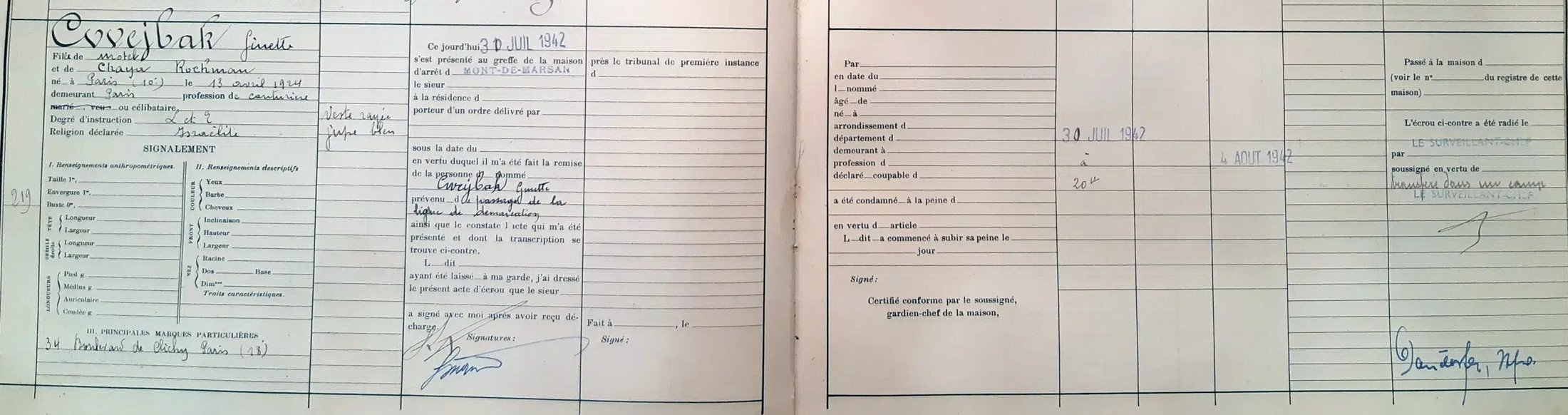
The couple settled at 34 boulevard de Clichy, in the 18th arrondissement of Paris. Their two children were born there: Ginette, on 13 April 1924 in Paris 10th — she also bore the first name Blanche (likely a French version of a Hebrew/Yiddish name, possibly Bluma or Blume) — and Albert, on 12 May 1926 in Paris 12th. Ginette followed her parents' path: she became a seamstress. Albert was educated at the Boys' School at 5 rue Pierre-Budin (Paris 18th), then became an apprentice tailor under his father. On the prison register of the Mont-de-Marsan house of detention (30 July 1942), Ginette is described as "israelite" (Jewish), single, seamstress, level of education "L. et É." (reads and writes), residing at "34 Boulevard de Clichy Paris (18th)" — the handwritten mention is placed under the heading "distinguishing marks", in the place usually occupied by the defendant's address.
This presence of a Polish Jewish family at no. 34 in the 1920s-1930s is consistent with what the consolidated Paris census records (1926-1936) show: a mixed bourgeois-working-class building, where several families of foreign origin — Kordick, Marus, Heirvegh, Rohde, Peyer — came from Central and Eastern Europe. See the page dedicated to census records and tenant registers.
1942 — the year of catastrophe
The Vél' d'Hiv' Roundup (16-17 July 1942)
On 16 and 17 July 1942, on orders from the German authorities and with the full collaboration of the French police and the Vichy government, the "Vél' d'Hiv' Roundup" was carried out — the largest anti-Jewish round-up ever conducted in France. 13,152 foreign Jews were arrested in Paris and its suburbs, including 3,031 men, 5,802 women and 4,051 children. Single adults and childless couples were sent to Drancy, while families were corralled at the Vélodrome d'Hiver (rue Nélaton, 15th) under appalling sanitary conditions, then transferred to the transit camps of Pithiviers and Beaune-la-Rolande, in the Loiret.
Motel and Chaja Cwejbak were among those arrested. They were deported to Auschwitz on Convoy no. 10 of 24 July 1942. On their arrival on 27 July, all the deportees from this convoy were selected for forced labour — the systematic selection towards the gas chambers would become widespread on subsequent convoys. No trace of their survival beyond arrival has been found.
The flight and arrest of the children
Ginette (18) and Albert (16), spared by the Vél' d'Hiv' Roundup — perhaps absent from the apartment on the morning of 16 July, perhaps hidden by neighbours or friends in the hours that followed —, fled to the South-West in the hope of crossing into the unoccupied zone (the demarcation line then divided France in two until 11 November 1942).
They were arrested around 30 July 1942 by the Mont-de-Marsan Feldgendarmerie (Landes département) for "crossing the demarcation line" — they had therefore crossed the internal border but were intercepted in the occupied zone, in the coastal strip along the Atlantic that the Wehrmacht closely watched. Ginette was registered at the Mont-de-Marsan house of detention on 30 July 1942; the prison register describes her as daughter of Motel and Chaya Rochman, born in Paris (10th) on 13 April 1924, residing in Paris, profession seamstress, single, declared religion Jewish. Albert went through the same administrative path.
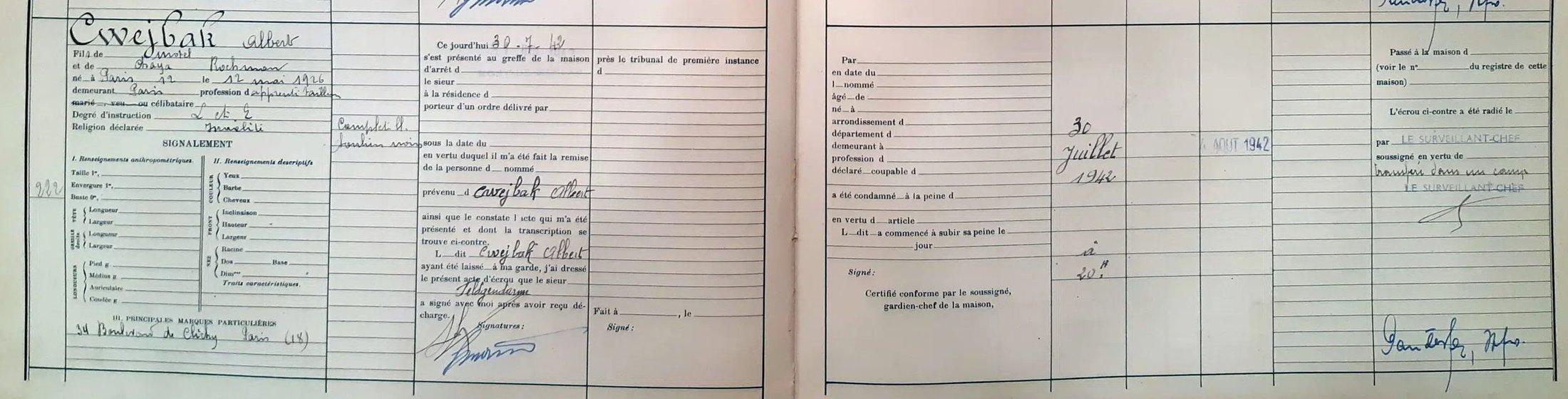
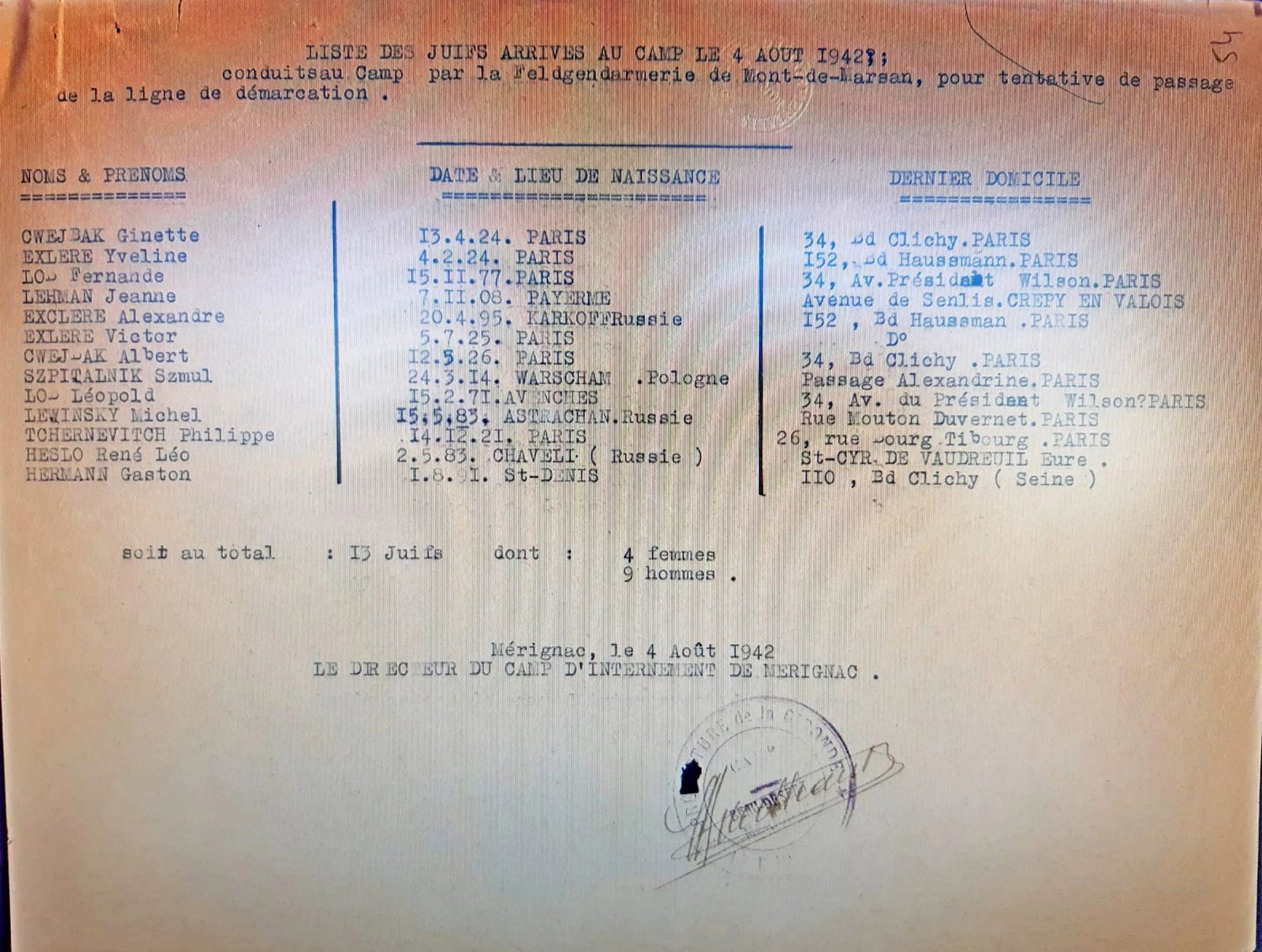
On 4 August 1942, they were transferred to the Mérignac internment camp (Gironde), with eleven other Jews arrested under the same circumstances. The typed list, signed by the camp director and stamped by the Gironde Prefecture, lists: "CWEJBAK Ginette, 13.4.24, Paris, 34 Bd Clichy. PARIS" and "CWEJBAK Albert, 12.5.26, Paris, 34 Bd Clichy. PARIS". They are thirteen in all — nine men and four women — of whom six were resident in Paris and three others on boulevard Haussmann or boulevard de Clichy as well (Yveline and Alexandre Exlere from 152 bd Haussmann, Gaston Hermann from 110 bd de Clichy).
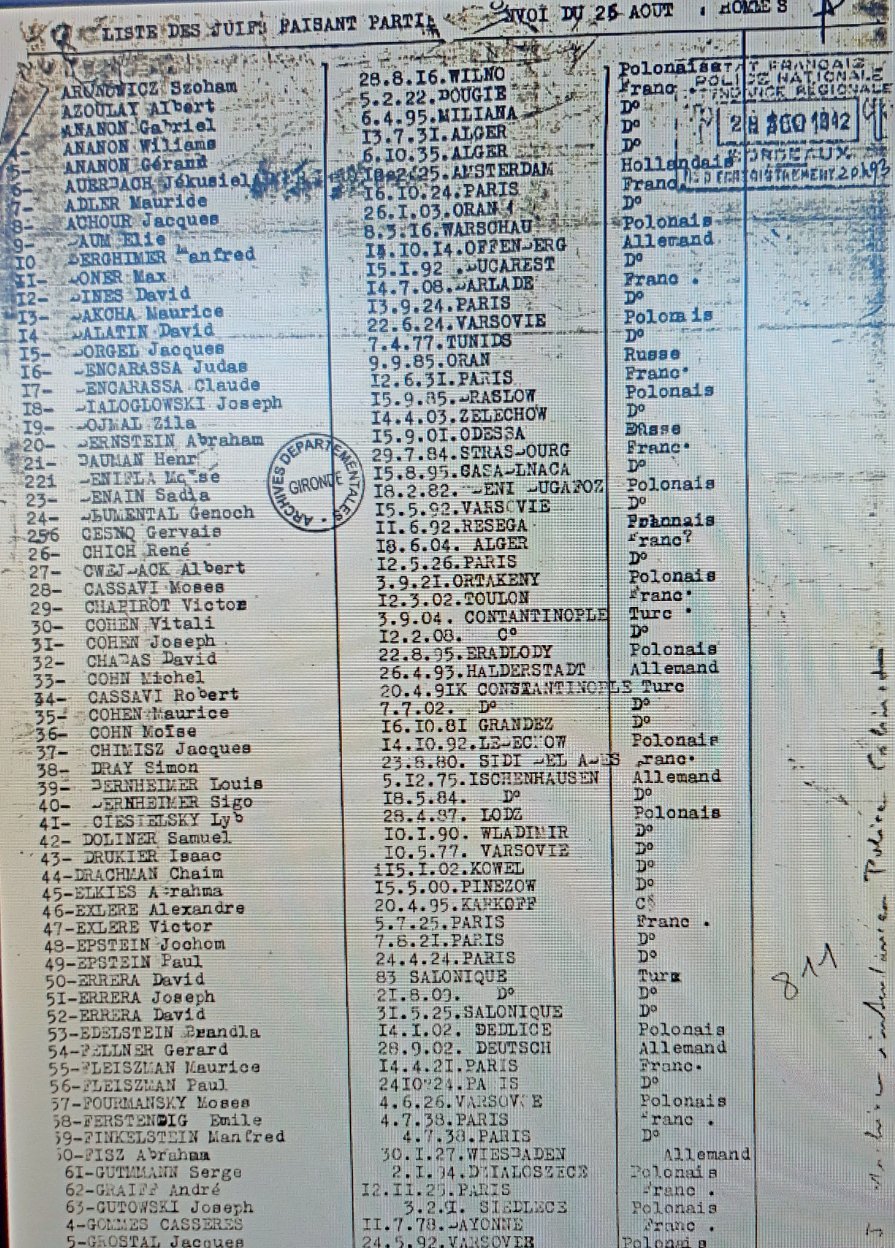
Albert then appears, at no. 27, on the "List of Jews on the convoy of 26 August" — convoy departed from Bordeaux: "CWEJ-ACK Albert, 12.5.26, PARIS, Polish" (the spelling varies through the documents: Cwejbak, Cwejback, Cwej-ack). This convoy reached Drancy and then Auschwitz.
At Auschwitz — the selection
Ginette Cwejbak
Born 13 April 1924 in Paris 10th — Died 26 September 1942 at Auschwitz
At 18, Ginette was selected for death on arrival. Her date of death — 26 September 1942 — was officialised by the Journal Officiel de la République française of 30 October 2011, after archival reconstitution. She survived only a few days after her arrival at the camp.
Albert Cwejbak
Born 12 May 1926 in Paris 12th — Died October 1993 at Ivry-sur-Seine
At 16, Albert was selected for forced labour. He survived the appalling conditions of Auschwitz for over two years. With the Red Army's advance westwards, he was transferred to Buchenwald (registration number 125367), camp located in Thuringia, then on 10 February 1945 to Gross-Rosen (Silesia).
Albert survived deportation. Liberated in 1945, he returned to France. He is the only survivor of the Cwejbak family of 34 boulevard de Clichy. He died in October 1993 at Ivry-sur-Seine (Val-de-Marne), aged 67.
A 1948 inquiry from the American family
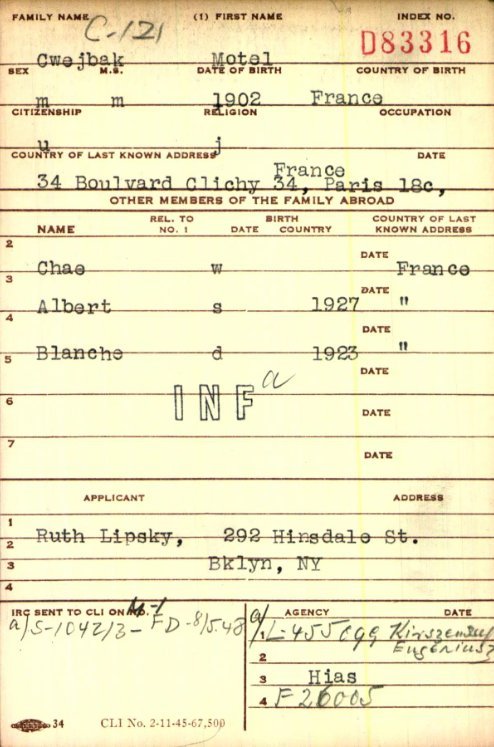
On 5 August 1948, Ruth Lipsky, residing at 292 Hinsdale Street, Brooklyn (NY), made a request to the Central Location Index (C.L.I.) — an inter-agency service set up after the Liberation to help dispersed Jewish families reconnect — to learn the fate of the Cwejbak family. Her record, identified as D83316, routed through the IRC, HIAS and Kirszencweig (Eugeniusz) agencies, lists the four family members sought at the address "34 Boulvard Clichy 34, Paris 18c" (original spelling, the "v" and "18c" are typos for "boulevard" and "18th"):
- Cwejbak Motel, born 1902 in France (approximate civil-status date — Motel's French civil registration remains to be confirmed)
- Cwejbak Chae (wife)
- Cwejbak Albert (son), born 1927 in France
- Cwejbak Blanche (daughter), born 1923 in France
The dates and the first name Blanche match the approximate information available to the American cousin — Ginette is here sought under her civilian first name Blanche, which confirms the family's use of both names. The mention "INFa" stamped on the record probably means "information" or "informant" — the American family probably never received a complete reply: Motel and Chaja had already been deported six years earlier, Ginette had survived only one month after her deportation, and only Albert could still be contacted at that date.
Why this page?
The other figures recorded by this investigation — painters, sculptors, singers, photographers, cabaret owners — left behind works, images, identifiable graves. The Cwejbak family left only administrative records: birth dates, convoy numbers, a Buchenwald registration number, an entry in the Journal Officiel of 2011. These are the only documents that remain of them — with, for Albert, the silence of a survivor who was able to resume a life in France until 1993.
Inscribing their names in this heritage investigation means recalling that the history of 34 boulevard de Clichy is not reduced to artists and figures of Parisian modernity. It is also the history of an ordinary Paris street where the Shoah struck, as it struck the entire neighbourhood — Pigalle/Montmartre had one of the highest concentrations of Jewish population in the capital between the wars. The names of Ginette, Motel and Chaja Cwejbak are engraved on the Wall of Names at the Mémorial de la Shoah, allée des Justes, Paris 4th — among the 76,000 Jews deported from France between 1942 and 1944.
Living memory
The Memorial of the Deportation of the Jews of France by Serge Klarsfeld (1st edition 1978, new edition 2012, 812 p., Sons and Daughters of Jewish Deportees from France Association) lists the 74,182 Jews deported from France by convoy, with their names, first names, dates and places of birth, Paris or provincial addresses. It is the reference work for reconstructing the trajectory of the Cwejbak family. The Educational Centre for the Resistance and Deportation of the Landes (CPRD-Landes) has compiled a detailed biographical entry from these sources.
Sources & resources
- Primary documents consulted (departmental and institutional archives):
- Prison register of the Mont-de-Marsan house of detention, 30 July 1942 — record no. 219, Cwejbak Ginette (Departmental Archives of the Landes).
- List of Jews who arrived at the Mérignac internment camp, 4 August 1942 — 13 Jews (4 women, 9 men) brought by the Mont-de-Marsan Feldgendarmerie for attempting to cross the demarcation line. Document signed by the camp director, stamped by the Gironde Prefecture (Departmental Archives of the Gironde).
- List of Jews on the convoy of 26 August [1942], "Police Régionale, Bordeaux, 28 August 1942" stamp — entry no. 27: Cwej-ack Albert (Departmental Archives of the Gironde).
- Central Location Index record no. D83316 (CLI), request from Ruth Lipsky, Brooklyn (NY), sent on 5 August 1948; IRC, HIAS, Kirszencweig agencies — collection of post-war Jewish search organisations.
- CPRD-Landes — Educational Centre for the Resistance and Deportation, biographical entry "Ginette et Albert Cwejbak": synthesis from the Departmental Archives of the Landes, detailing family composition, occupations, address, convoys and respective fates.
- Mémorial de la Shoah, Paris — Wall of Names (76,000 engraved names of Jews deported from France 1942-1944) and database of the Centre for Contemporary Jewish Documentation (CDJC). Direct search by surname is possible.
- Serge Klarsfeld, Memorial of the Deportation of the Jews of France, 1st edition 1978, new edition 2012, 812 p., 48×30 cm, 7 kg, Sons and Daughters of Jewish Deportees from France Association (FFDJF). Print edition out of print — interactive CD-Rom available.
- Serge Klarsfeld, Vichy-Auschwitz. The role of Vichy in the Final Solution of the Jewish Question in France, 1983, and The calendar of the persecution of the Jews of France, 1993.
- Yad Vashem — record of convoy 35 from Pithiviers to Auschwitz, 21 September 1942 (note: according to the new primary sources, Albert was deported on the convoy of 26 August 1942 from Bordeaux, not on convoy 35; Ginette's trajectory after Mérignac remains to be specified).
- Mérignac (Beau-Désert) camp, Gironde — administrative internment camp under the Occupation (1940-1944), transit point to Drancy then Auschwitz for many Jews arrested in the occupied zone of the South-West.
- Cercil — Memorial Museum of the Children of the Vél' d'Hiv', Orléans, and Sons and Daughters of Jewish Deportees from France Association.
- See also the Journal Officiel de la République française of 30 October 2011, which officialises Ginette Cwejbak's date of death (26 September 1942 at Auschwitz).
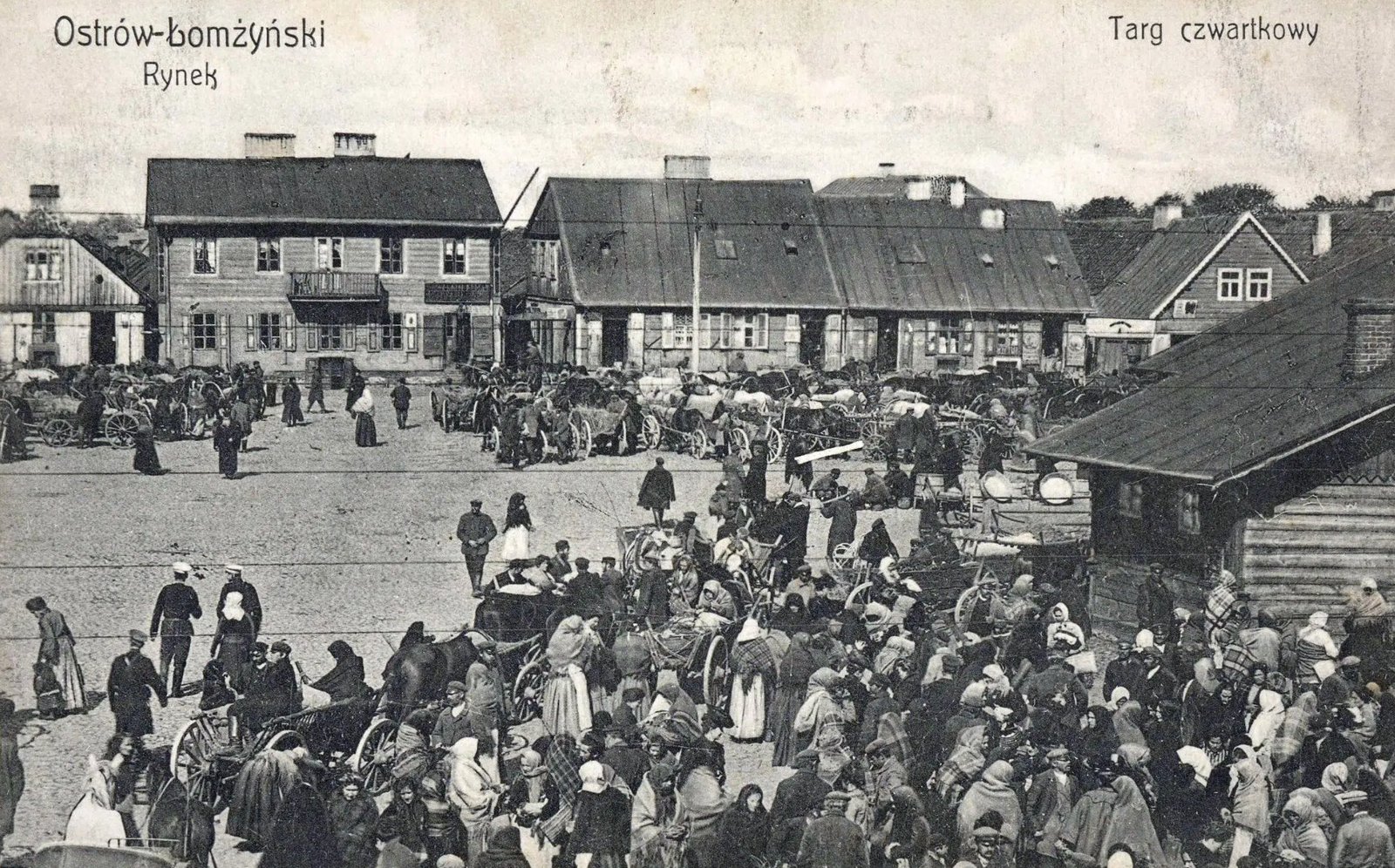
- For the genealogical context of the surname: Ostrów Mazowiecka (in Yiddish Ostrov-Lomzhe, in Polish Ostrów-Łomżyński) and the region of Garwolin, where Chaja Rochman was born, are among the principal centres of Polish Jewish migration to France between the wars.