A capital discovery in the investigation into n°34: during the last years of his life, the building housed the studio of Eugène Pottier, poet, revolutionary songwriter, textile-pattern designer, former member of the Commune and author of the lyrics of The Internationale, the universal anthem of the workers' and socialist movements.
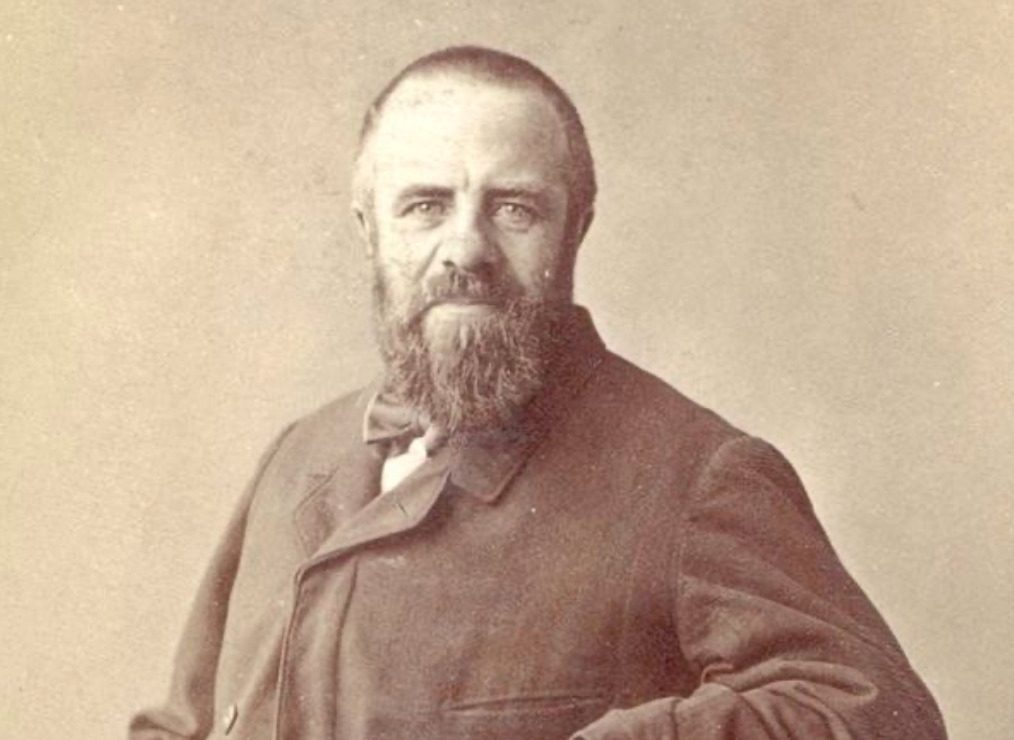
Portrait of the poet shortly before his death, at the time when he occupied his studio at 34 boulevard de Clichy.
This information is attested by the reference database Paris révolutionnaire (parisrevolutionnaire.org), which devotes a specific entry to 34 boulevard de Clichy classified under the headings "Song" and "Member of the Commune".
A life of struggle
Pottier was born at 60 rue Sainte-Anne (Paris 2nd), the son of a Bonapartist packing-worker. An apprentice from the age of 13, he became a textile-pattern designer — printed motifs for fabrics, wallpapers, embroideries, tapestries — and at 15 published his first collection La Jeune Muse (1832), dedicated to Béranger.
A republican militant from 1832, a socialist from 1840 onwards, he took part in the 1848 Revolutions, where he narrowly escaped being shot on the barricades. In 1864, he founded the Trade Union Chamber of textile-pattern designers, which joined the First International. During the siege of Paris, he fought at Champigny in the 181st battalion of the National Guard.
Elected mayor of the 2nd arrondissement and then a member of the Paris Commune (March-May 1871), he sat on the Federation of Artists chaired by Gustave Courbet and drafted the manifesto-programme published in the Commune's Journal officiel on 15 April 1871. He fought during the Semaine sanglante, then went into hiding at the end of May 1871 with his sister Joséphine, in the Clignancourt-Château Rouge district, 800 metres from n°34. It was there, on 28 May 1871, that he wrote the poem The Internationale.
Sentenced to death in absentia, Pottier went into exile in England and then in the United States (Boston, New York), where he campaigned with the Socialist Labour Party and the International Labour Union, worked as a designer and teacher, and joined Freemasonry.
The studio at n°34 (1880-1887)
Benefiting from the 1880 amnesty, Pottier returned to Paris ill and penniless. He lived in Levallois-Perret and took up his trade as a textile-pattern designer again in order to survive. The Paris révolutionnaire database specifies that the studio rented at n°34 was located in the Grandes-Carrières district, and that the occupation dates from the Third Republic, after Pottier's return from exile.
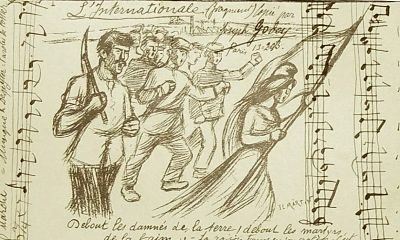
The poem, written on 28 May 1871 in his hiding-place at Clignancourt, was published for the first time in 1887 in the Chants révolutionnaires that Pottier was preparing from his studio at n°34.
In 1883, he won the silver medal at the Lice chansonnière competition, which allowed him to be reunited with the songwriter Gustave Nadaud. Thanks to Nadaud, some fifty of his songs appeared in 1884. In 1887, shortly before his death, his Chants révolutionnaires were published with a preface by Henri Rochefort — it was in this volume that the text of The Internationale appeared for the first time.
Pierre Degeyter, a Belgian wood-turner from Lille, would set the poem to music the following year, in 1888. The studio at 34 boulevard de Clichy is therefore the place where Pottier finalised and saw to the publication of the work that would become one of the most-sung songs in the world.
An exceptional chronological coincidence
Over the very years 1880-1887, the 34 simultaneously housed:
- On the ground floor — the end of the Brasserie Reichshoffen (until c. 1885), painted by Manet, who died on 30 April 1883;
- In the courtyard or on the upper floors — the studio of Paul-Joseph-Victor Dargaud, painter of the construction sites of the Sacré-Cœur;
- The studio of Eugène Pottier, who was preparing his Chants révolutionnaires.
Manet and Pottier most probably crossed paths with Dargaud in the courtyard or on the boulevard between 1880 and 1883. At that time the 34 combined the painting of bourgeois modernity (Manet), documentary heritage painting (Dargaud) and revolutionary working-class creation (Pottier).
Sources & resources
- Eugène Pottier — Wikipedia · Wikidata Q316327
- Paris révolutionnaire — entry 34 boulevard de Clichy (CACP reference p. 441)
- Le Maitron — Biographical Dictionary of the French Workers' Movement, Pottier entry
- BnF Gallica — works by Pottier online (digitised original editions)
- Eugène Pottier, Chants révolutionnaires, preface by Henri Rochefort, 1887
- Pierre Brochon, Eugène Pottier et la chanson sociale, Éditions sociales, 1949
- Père-Lachaise cemetery — Pottier's tomb (95th division), monument by Émile Derré