Charles Gir, real name Charles Félix Girard, was one of the most prominent French illustrators and caricaturists of the Belle Époque and the Roaring Twenties. Painter, illustrator, poster designer, sculptor — a polymorphous artist whose contemporaries summed him up thus: "An original artist who treated every subject with mocking indulgence — war, theatre, fashion, politics." With his wife, the actress Jeanne Fusier-Gir, he lived at 34 boulevard de Clichy, in Building C to the left — while their son François Gir, a film director, occupied the ground floor of the same building.
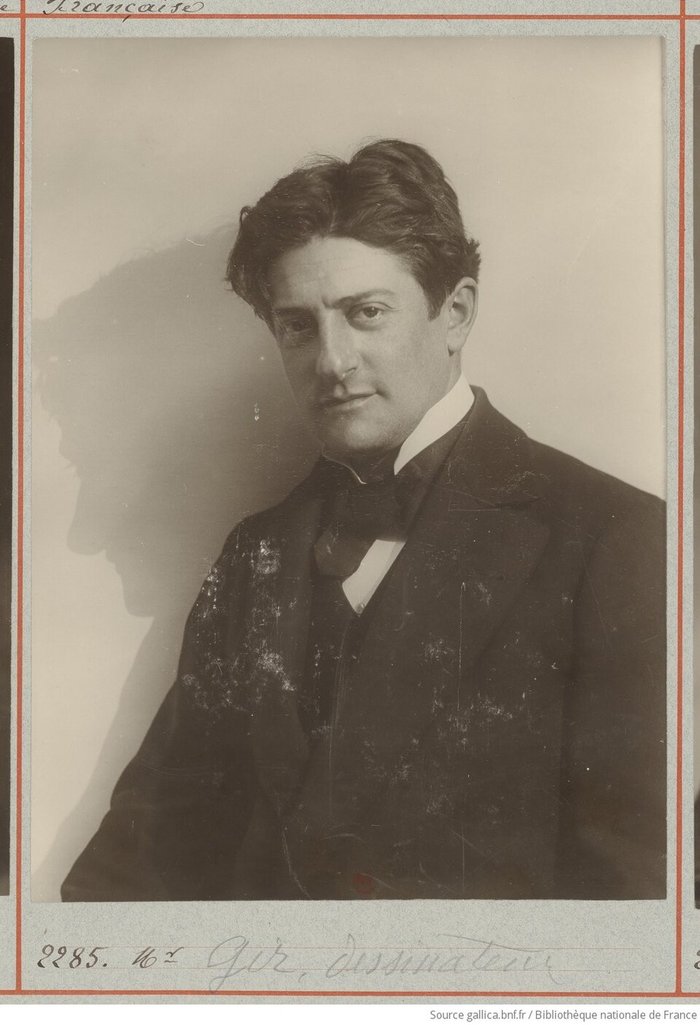
Identity record from the BnF, Department of Prints and Photography. The handwritten caption reads "Gir, draughtsman".
From Tours to Paris — escape by bicycle
Born in Tours on 1 November 1883, son of Félix André Girard (1853-?) and Denise Léonide Charlotte Gence (1862-1925), grandson of a musician who directed the Tours Conservatoire, Charles learned the violin as a boy. While working at a Tours bookshop, he escaped to Paris by bicycle, where he attended classes at the École Boulle and then at the École supérieure de dessin et de modelage Germain-Pilon. He began frequenting the Opéra Garnier on a daily basis, an assiduity that would last seventeen years — it was there that he met Jeanne Fusier, his future wife.
Belle Époque poster designer and illustrator
Charles Gir made his name with theatre posters for Belle Époque Paris. From 1900, he ran a graphic-arts workshop, the "Atelier Charles Gir", which brought together several draughtsmen. He illustrated numerous literary works, including Chantecler by Edmond Rostand, Luxures by Maurice Dekobra (Éditions d'art des Tablettes, Paris, 1924) and La vie est belle by André Sauger (51 drawings, 1927), and published his own lithographic albums: La Halle aux vins (52 folios, 300 numbered and signed copies, 1939). His drawings appeared in Le Rire, Fantasio and La Vie parisienne.
The Montmartre circle
In Pigalle and Montmartre, Charles Gir moved in a circle of artists and writers that traced the bohemian life of early-20th-century Paris: Raoul Dufy, Francis Carco, Roland Dorgelès, Mac Orlan, Colette, Jehan Rictus, Paul Colin, Georges Courteline, Francisque Poulbot. He brought back sketches of the young Mussolini from Italy, went to paint in Spain and Morocco (a stay in Marrakesh in 1926), exhibited paintings and sculptures in America, and even performed on stage with an orchestra, executing pastels live. "A bon vivant and a rascal", in his biographers' summary — Montmartre and the era lent themselves to it.
War caricaturist and chronicler of the wings
Mobilised during the First World War, Charles Gir produced many battle scenes (the Musée d'Art moderne of Troyes holds Battle scene in Champagne, oil on canvas, 1918) and a bronze of a soldier with his pack, now at the Musée Historial de la Grande Guerre at Thiepval. After the war, he took part in the Salons d'automne, des indépendants, des humoristes. A friend of Sacha Guitry, he frequented theatres and their wings, of which he became the graphic chronicler.
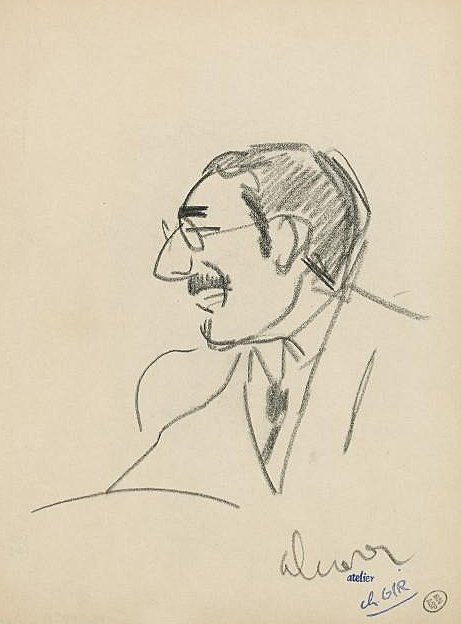
The bespectacled, moustachioed actor caught in profile in pencil — figure of Money by Marcel L'Herbier (1928). Signature at lower right: "atelier ch GIR".
The Bal Tabarin with Paul Colin (1928)
In 1928, Charles Gir collaborated with his friend Paul Colin (the poster artist who launched Josephine Baker) on the decoration of the Bal Tabarin, the famous Pigalle music hall. He drew modern dance, the French Cancan and the black ballets — subjects he would revisit in his album French Cancan de Tabarin, hier et aujourd'hui, shown at the Galerie d'art du quartier Saint-Georges in March 1939. The same year, he took part with Paul Colin and Marcel Vertès in the mural decoration of the Théâtre du Perchoir, 43 rue du Faubourg-Montmartre, reopened as the Théâtre de la Caricature.
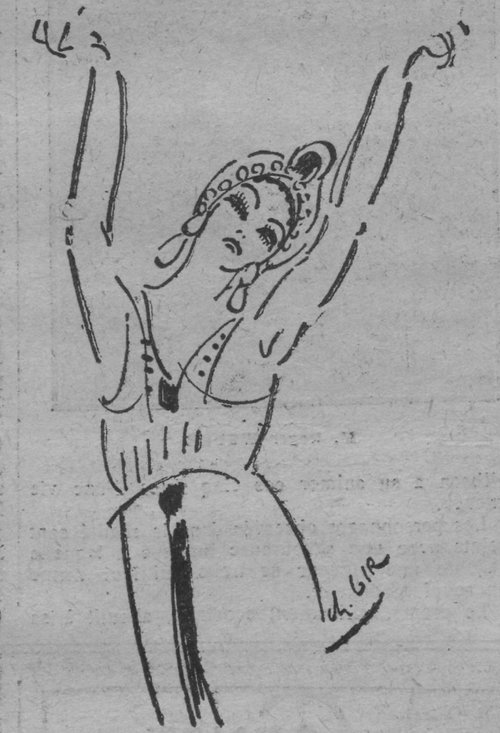
Ink sketch published in the entertainment press of the 1920s. The dancer is caught at the height of a jump, arms raised in a V, in an orientalising costume with pendants — the music-hall vein Gir loved.
The 1929 turning point — Grisy-les-Plâtres
In 1929, Charles and Jeanne bought a farmhouse at Grisy-les-Plâtres in the Vexin (Val-d'Oise). Charles converted an old stable into a monumental studio by tripling its volume: "He lit this vast space by cutting glazed roof-lights that connected it to the sky. He had thus arranged his nest of work, of dream and of life", his son François recalled. Charles Gir withdrew gradually from Parisian social life, but the 34 boulevard de Clichy apartment remained his pied-à-terre, while Jeanne returned frequently for filming and theatrical performances. He painted in solitude the lights and colours of the Vexin, the churches of Bréançon, Livilliers and Theuville, and modelled his monumental Don Quichotte from the village clay.
The Don Quichotte — fate of a royal commission
Charles Gir's Don Quichotte is his masterpiece. The project was commissioned in 1930 by King Alphonso XIII of Spain, but the fall of the monarchy and the Spanish Civil War led to its abandonment. Charles Gir completed the sculpture in 1934 but could not find a sponsor to cast it before his death in 1941. His family later tried to have it installed in Spain. It was not until 1978 — 37 years after his death — that the monumental sculpture was finally cast in bronze and installed on the place de la Préfecture in Cergy-Pontoise, where it can still be seen.
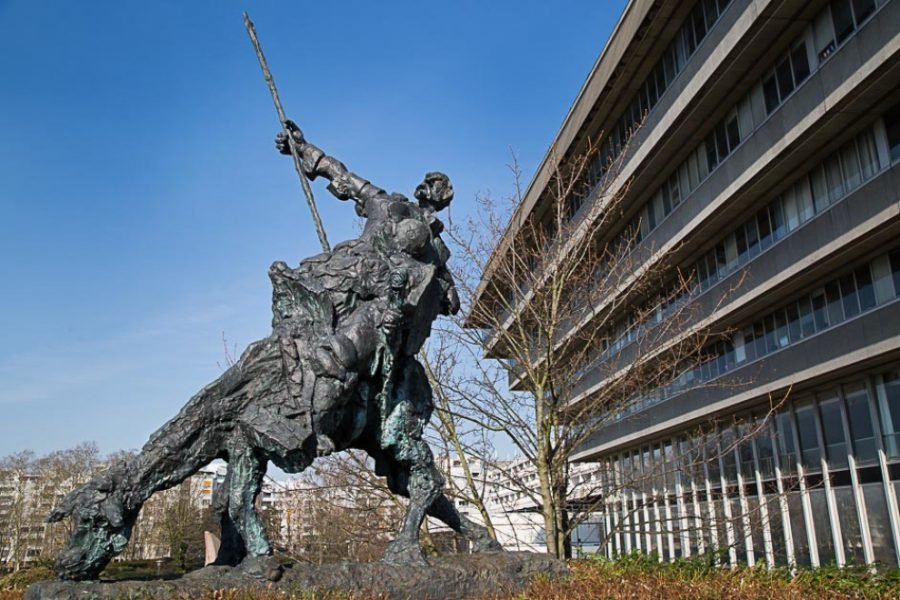
Place de la Préfecture, Cergy-Pontoise. The knight of La Mancha, lance raised, modelled in Grisy-les-Plâtres clay in the large studio Gir had set up at his Vexin farm. Cast in bronze 37 years after the artist's death, through the efforts of his family.
Sculptor of war memorials
Besides Don Quichotte, Charles Gir created several memorials to the Great War: The mourner and the poilu, the war memorial of Saint-Amour (Jura); the war memorial of Vouvray (Indre-et-Loire), 1921; Soldier with his pack, bronze, Musée Historial de la Grande Guerre, Thiepval. He is also the author of the monument to Giacomo Meyerbeer (monumental bronze, Alexis Rudier foundry) installed in 1912 in the Sept-Heures park at Spa, Belgium. His works are today at the Musée de Montmartre, the Musée Camille-Pissarro of Pontoise, the Musée d'Art moderne of Troyes, and at the BnF (caricatures).
The end — the Second World War, exile, death
The outbreak of the Second World War in 1939 broke Charles Gir definitively, a man already marked by the trenches of 1914-18. Devastated by this new conflict and ill, he left Paris for the Charentes, with friends. He died alone in the Bordeaux hospital on 22 March 1941, aged 57. His son François said of him that he was "a frank, ironic, sometimes biting man, but of immense kindness". He rests in the cemetery of Grisy-les-Plâtres, joined by Jeanne Fusier-Gir in 1973. The Maison des associations of Grisy-les-Plâtres, inaugurated in September 2012, now bears the name "Charles Gir, painter-sculptor, and Jeanne Fusier-Gir, actress".
34 boulevard de Clichy — Building C to the left
According to the oral tradition of the 34, Charles and Jeanne occupied the apartment in Building C, to the left. Their son François Gir, born on 13 March 1920 in the 18th arrondissement of Paris — therefore most probably at this address — would later live in the ground floor of the same building. This is one of the rare cases, in the history of 34, where we can document two successive generations of the same family of artists: the Belle Époque generation (Charles the painter + Jeanne the actress) on the first floor, and the generation of cinema and television (François the director) on the ground floor. During the 1930s and 1940s, the address combined the smell of turpentine, the friction of brushes, the piano Jeanne practised for her musical roles, and — later — the hum of projectors and film sets.
Sources & resources
- Wikipedia — Charles Gir: reference biography, works, exhibitions
- Municipality of Grisy-les-Plâtres — biography written from the documents of his son François Girard
- Museums: Musée de Montmartre · Musée Camille-Pissarro of Pontoise · Musée d'Art moderne of Troyes · Musée Historial de la Grande Guerre, Thiepval
- BnF — Charles Gir caricature collection
- Public works: Don Quichotte, place de la Préfecture, Cergy-Pontoise (1978); Giacomo Meyerbeer, Sept-Heures park, Spa, Belgium (1912); war memorials of Saint-Amour (Jura) and Vouvray (Indre-et-Loire, 1921)
- Public tribute: Maison des associations "Charles Gir, peintre-sculpteur et Jeanne Fusier-Gir, comédienne", Grisy-les-Plâtres, inaugurated September 2012