History of the boulevard
Boulevard de Clichy results from the 1864 merger of three former roads that followed the Wall of the Farmers-General: boulevard des Martyrs, boulevard Pigalle and the boulevard de Clichy proper. This 24-kilometre enclosure wall, built between 1784 and 1791 by the architect Claude-Nicolas Ledoux, encircled Paris to enable the collection of excise taxes (octroi). Lined inside and outside with boulevards and patrol roads, it was nicknamed "the red belt" of the capital — because of the colour of the barriers, but also because of the popular resentment it provoked: it was to its tax duties that Parisians owed the inflated price of every commodity.
At the foot of the Barrière de Clichy — defended by Marshal Moncey in 1814 — stretched, until the annexation of Montmartre by Paris in 1860, a still largely rural neighbourhood. The removal of the wall allowed, in 1864, the three former roads to be merged into a single open boulevard, and the area very quickly became one of the high points of the Parisian Grands Boulevards — populated with cafés-concerts, guinguettes and cabarets, an atmosphere that boulevard de Clichy would preserve right through the Belle Époque.
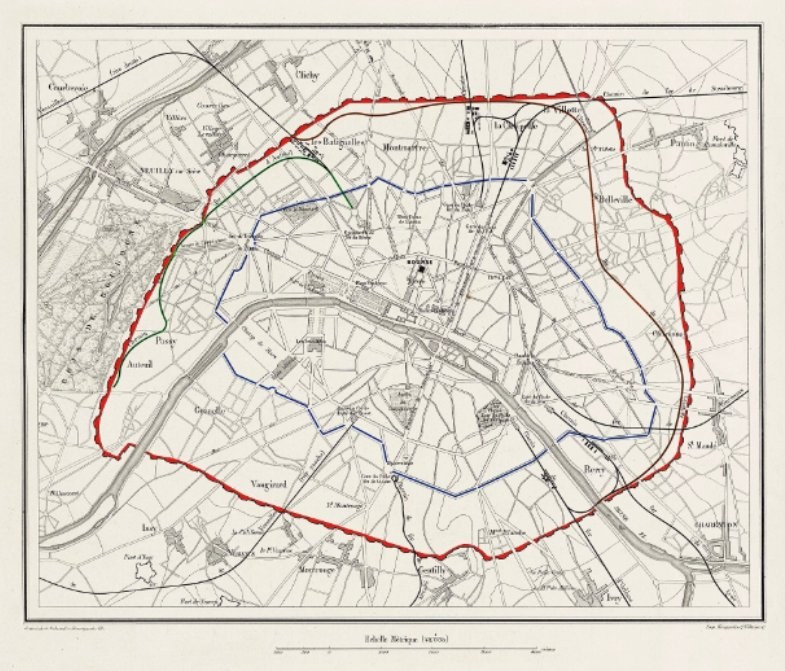
No. 34 of the future boulevard de Clichy was then outside the walls, in the commune of Montmartre still independent of Paris (annexed in 1860). Map engraved at Erhard, 42 rue Bonaparte; Kaeppelin printers, 17 quai Voltaire, Paris; scale 1:40,000.
The boulevard successively bore the names boulevard des Martyrs, then boulevard Pigalle, before taking its current name — that of the commune of Clichy outside the city, to which the Barrière de Clichy led.
Military and police presence on the boulevard
Before becoming the boulevard of cabarets and café-concerts, boulevard de Clichy was, for more than a century and a half, a line of surveillance — first fiscal and military, then policed.
- The Barrière de Clichy as a functioning guard post. The barrière itself (on the site of today's place de Clichy, about 200 metres from no. 34) housed, behind its iron gates, the Farmers-General's clerks and the « chasseurs aux barrières » — a paid National Guard force specifically tasked with overseeing the octroi. This post remained active until 1860, the date when the wall was suppressed; but the institution of the Parisian octroi itself continued in different forms until 1943, maintaining a presence of fiscal officers in the immediate vicinity (source: Dictionnaire numérique de la Ferme générale, MESHS).
- The battle of the Barrière de Clichy, 30 March 1814. During the Campaign of France, Marshal Moncey, leading part of the Paris National Guard, defended the gate against the advancing Russian contingent. The episode — one of the last in the defence of the capital before its capitulation — was immortalised by Horace Vernet in La Barrière de Clichy (1820, Louvre). Military combat took place 200 metres from what would become no. 34 (source: Wikipedia, Barrière de Clichy).
- Pigalle between 1932 and the Liberation: raids and crackdowns. With the rise of the Pigalle underworld in the inter-war period, the Préfecture police multiplied raids, round-ups and cabaret closures all along boulevard de Clichy. The police presence was dense, sustained and conspicuous — continuous enough to leave a deep imprint on the oral memory of the neighbourhood (source: Wikipedia, Pigalle, Paris).
- The Occupation 1940-1944: a neighbourhood under close surveillance. During the Occupation, Pigalle was placed under tight German and French surveillance — no. 34 itself bears the tragic mark of this period with the deportation to Auschwitz of the Cwejbak family in 1942, of whom only Albert Cwejbak returned. This documented event testifies to the efficiency of the police control apparatus exerted on the building and its surroundings.
Geography: a boulevard straddling two arrondissements
Boulevard de Clichy has the peculiarity of straddling two arrondissements: the even numbers (north side, climbing towards Montmartre) are in the 18th, the odd numbers (south side) are in the 9th. The central median of the boulevard, laid out above line 2 of the métro, has become a pedestrian walkway made up of several named promenades: promenade Coccinelle, promenade Georges-Ulmer, promenade Jacques-Canetti, promenade Roland-Lesaffre, promenade Marcel-Carné.
34 boulevard de Clichy — construction and studios
Among the buildings lining the boulevard, 34 boulevard de Clichy deserves a closer look: it is one of the few plots that has preserved, behind an unremarkable shopfront, its inner courtyard and 19th-century artist studios. This site is devoted to a detailed historical investigation of no. 34 — what follows is a summary of what is known about its construction, its studios and its earliest occupants.
Construction of the main building (1801-1850)
According to the Paris cadastre (reference DQ18, held in the Archives de Paris), the main street-front building — four storeys, classical elevation in millstone and plaster — was built between 1801 and 1850. At that time the address was not yet on the present boulevard de Clichy: the area lay outside the city walls, in the then independent commune of Montmartre, along the Wall of the Farmers-General. The road running outside the wall was called at the time chemin de ronde de la barrière de Clichy.
Three events transformed this modest plot into a fully Parisian address:
- 1860 — annexation of Montmartre by Paris (law of 16 June 1859, effective 1 January 1860). No. 34 enters the newly created 18th arrondissement.
- 1864 — fusion of three former roads (boulevards des Martyrs, Pigalle and Clichy) into a single boulevard de Clichy. No. 34 receives its definitive number.
- 1860-1864 — demolition of the Wall of the Farmers-General (built 1784-1791 by Claude-Nicolas Ledoux) and gradual development of the central reservation, which would become, above the Métro line 2 (opened 1903), a pedestrian promenade.
The plot: 1,867 m² and a double courtyard
No. 34 occupies a 1,867 m² plot, which is unusually large for the boulevard. This generosity explains the building's distinctive layout: behind the street-front block, a first paved courtyard rises gently towards a row of studios and two small "doll-houses" at the end of the alley; then, surprisingly, a second miniature courtyard hidden behind the rear building opens onto further studios buried under vegetation. This is what is known in Parisian typology as a cour-atelier (courtyard-studios complex).
The rear-courtyard studios (late 19th — early 20th century)
The complex today comprises sixteen studios, in brick and timber framing, crowned with large north-facing studio skylights. Their precise dating has not been formally established, but the construction techniques place them between the late 19th century and the very early 20th — the period of the great Paris artist colonies (La Ruche 1902, the Bateau-Lavoir before 1889, the Villa des Arts 1888).
The Paris-Promeneurs website describes these studios as "emblematic of the golden age of Montmartre", buried under vegetation and having retained much of their character. They are photographically documented by the blog Paris-bise-art in an article dated 26 February 2021. A 1989 conversion (planning permit held in the Archives de Paris) turned certain spaces into artist live/work units, extending the historic vocation of the site. As late as 2009, roof windows were still being installed for use as a residential artist studio — proof that the studio function has never been interrupted.
First, identifying the building: the number 34 in enamelled cartouche
Before examining the detail of the pediment, we must make sure that the period photographs to be commented on are indeed those of 34 boulevard de Clichy and not of a neighbour. A photograph of the shopfront, taken at the turn of the 20th century, removes any ambiguity: on either side of the entrance, the number "34" in an enamelled cartouche identifies the building beyond doubt.
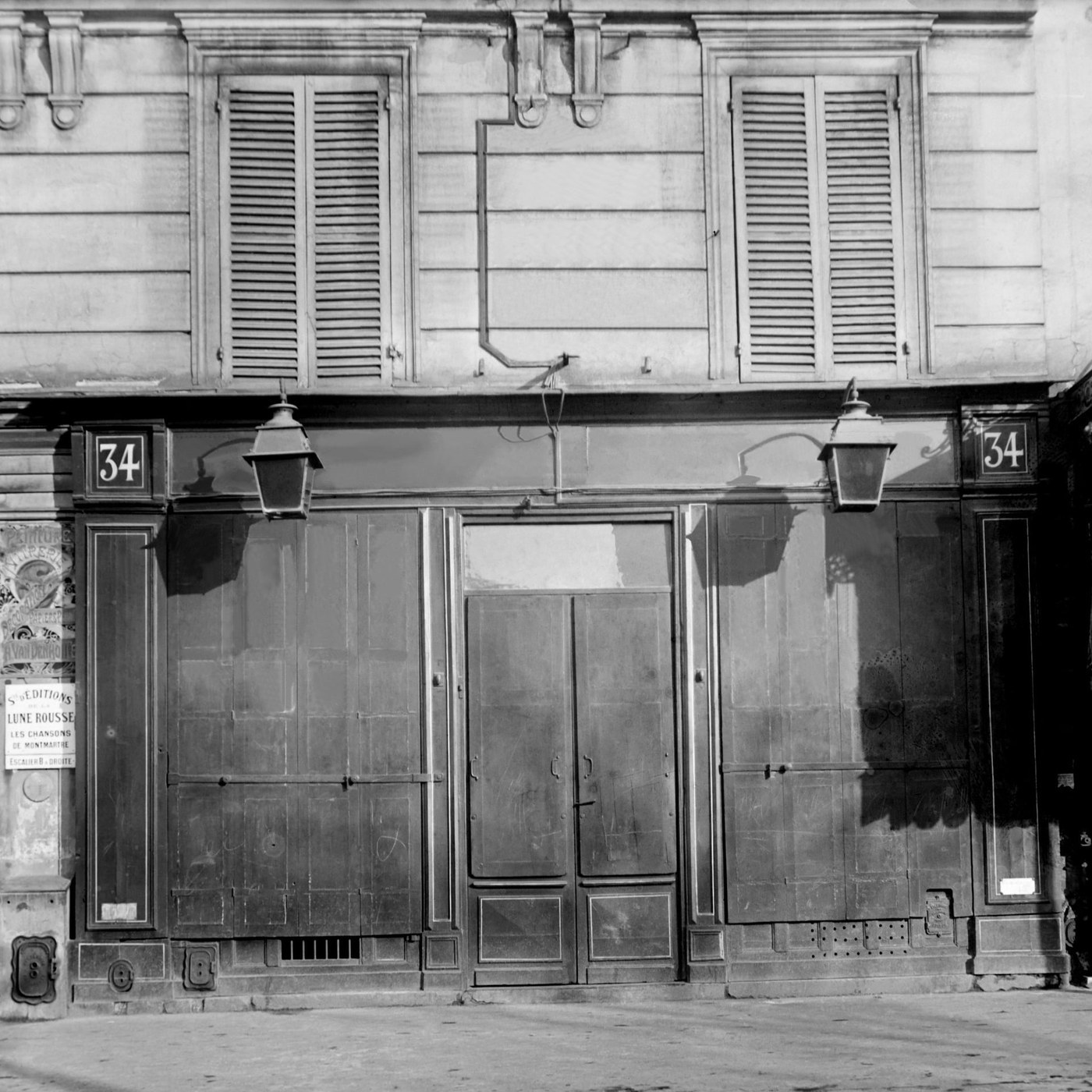
On either side, the number "34" in an enamelled cartouche is clearly visible, along with two wall-mounted lanterns and, on the left, a poster for "Les Chansons de Montmartre" by the Éditions de la Lune Rousse — the atmosphere of the neighbourhood at the turn of the 20th century. This photograph confirms the identification of no. 34, and allows us to examine, with certainty, the detail of the carved pediment visible in the other period photograph.
A date on the pediment: 1896
On the period photograph of the Cabaret du Ciel and the Cabaret de l'Enfer at no. 34, a hitherto-overlooked detail proves decisive for dating the ground floor: above the central door (between the two cabaret entrances), a sculpted pediment bears the clearly legible date « 1896 ».
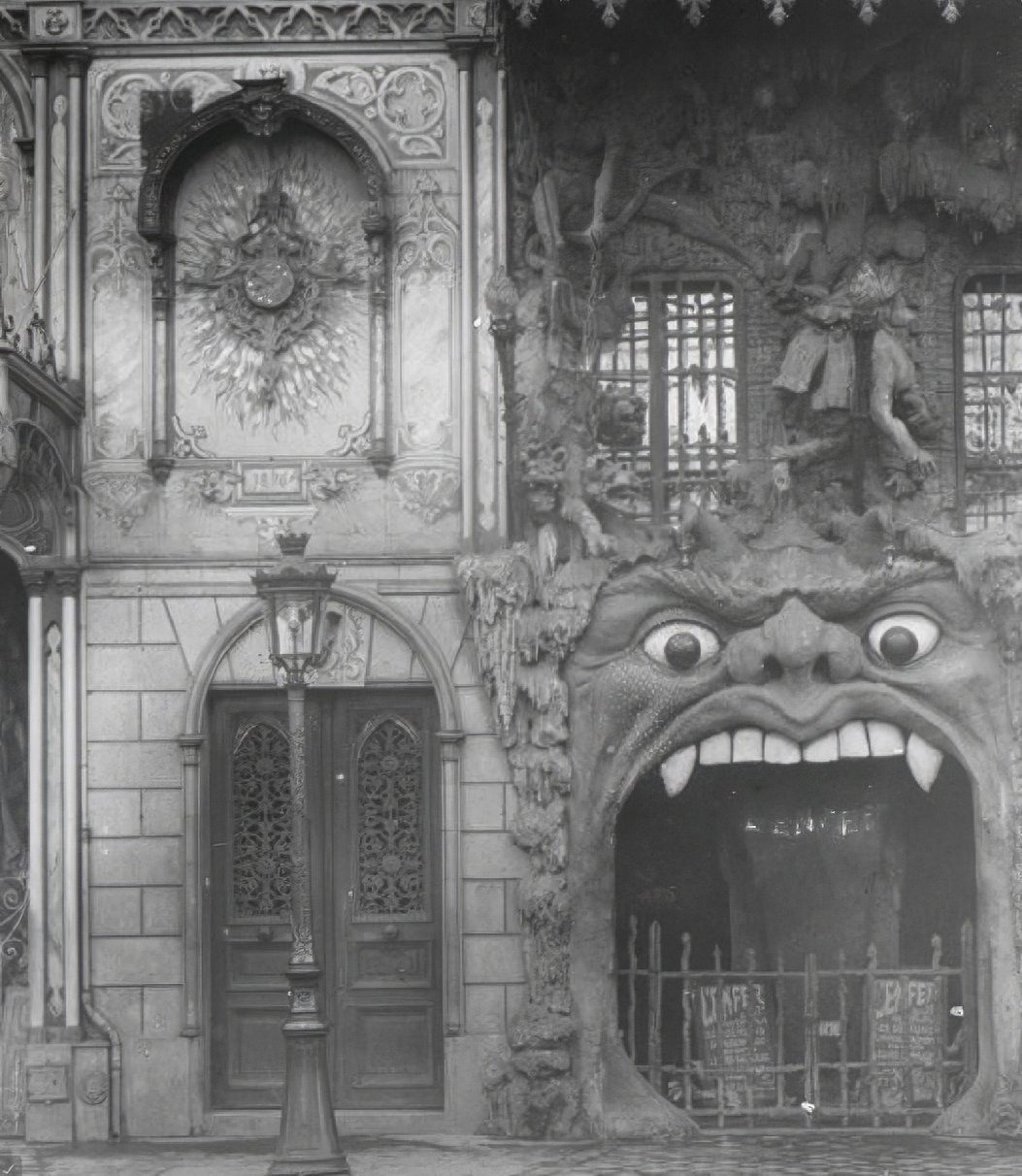
Period photograph (between 1896 and 1898), digitally restored print. On the left, the Neo-Gothic entrance of the Cabaret du Ciel; on the right, the devil's mouth of the Cabaret de l'Enfer; in the centre, the access door of the main building of no. 34, surmounted by the sculpted pediment dated 1896.
Source: period press photograph, unidentified archive — discovery of the heritage investigation.
This date provides a firm landmark in the architectural history of no. 34: it most likely corresponds to a refurbishment or redecoration campaign of the ground-floor façade, carried out at the time of (or shortly before) the installation of the themed cabarets — the Cabaret de l'Enfer opened around 1892, the Cabaret du Ciel shortly afterwards, and the fitting-out of their spectacular façades (carved devil's mouth, opposing Neo-Gothic architecture, ornamental ironwork) required substantial work.
The date 1896 is also fully consistent with the other datable elements of the ground floor: the succession of breweries since 1870 (Reichshoffen, Riester, Coq d'Or), the takeover of the premises by the themed cabarets from 1892 onwards, and the gradual demolition of the Mur des Fermiers généraux in the 1860s, which had freed the boulevard for new spectacular uses. The main building on the street (1801-1850) remains in place; the ground-floor façade is itself rebuilt in 1896 to accommodate the new festive vocation of the place.
Documents and sources
- Archives de Paris — cadastre (reference DQ18), dating of the building (1801-1850); population census POPP 1926 and 1936; successive planning permits (notably 1989).
- Napoleonic cadastre and 19th-century parcel maps (Bibliothèque historique de la Ville de Paris) — state of the parcels before the 1864 road merger.
- Erhard / Kaeppelin engraved maps, c. 1860 — showing no. 34 still outside the walls in the then independent commune of Montmartre.
- Musée d'Orsay Salons database — address "34 boulevard de Clichy" recorded in the booklet of the 10th Salon des Indépendants (1894), for Hippolyte-Louis Lebourgeois.
- INHA-Agorha authority record — studio of Pierre-Luc Feitu at no. 34.
- BHVP-Actualités collection — advertising cards of the successive breweries (Reichshoffen, Riester, Coq d'Or).
- Vienna Secession, 1905 exhibitor record — address "34 boulevard de Clichy" for Julius von Kollmann.
- Enamelled lava plaque mounted inside no. 34 — memorial to the eight residents who fell in the Great War.
- Autobiographical account by Gilles Walusinski, "Eugène", magazine délibéré, 25 July 2018 — studio 5 in 1969-1970 and the Nadar-Carrière bequest.
Detailed timeline of no. 34
Over 162 years, the address has hosted an unbroken succession of uses — café-concert, cabarets, breweries, studios, cinema, live/work units — making the building a remarkable witness to the cultural history of Pigalle.
- 1801 — 1850: construction of the main street-front building (cadastre DQ18).
- 1860: annexation of Montmartre, no. 34 enters the 18th arrondissement.
- 1864: merger of three former roads into the boulevard de Clichy.
- 1870 — 1885: Café-Brasserie Reichshoffen on the ground floor (Alsatian establishment run by a man named Renault).
- c. 1875 — 1900: studio of Paul-Joseph-Victor Dargaud, painter of the Sacré-Cœur construction site.
- 1878 — 1879: Édouard Manet paints the Reichshoffen cycle on the ground floor — the Bar Maid and several café-concert scenes.
- 1880 — 1887: Eugène Pottier, returning from exile after the 1880 amnesty, rents a textile-designer's studio at no. 34. There he completes the Chants révolutionnaires (1887), in which the text of L'Internationale appears in print for the first time.
- c. 1885 — 1892: succession of breweries — Grande Brasserie Riester then Grande Brasserie du Coq d'Or (Eugène Becker).
- 1892 — 1895: Cabaret de l'Enfer (Antonin Alexander) at no. 34, before its move to no. 53.
- 1894: Hippolyte-Louis Lebourgeois exhibits at the 10th Salon des Indépendants from the no. 34 address.
- 1895 — c. 1950: Cabaret du Néant (Antonin Dorville) — coffin-shaped tables, undertaker waiters, macabre optical illusions.
- 1896: refurbishment of the ground-floor façade — date carved on the sculpted pediment above the central door, between the Cabaret du Ciel and the Cabaret de l'Enfer (visible on a period photograph, discovery of the heritage investigation).
- 1898 — 1920s: Georges Baltha, chansonnier, published by the Société de la Lune Rousse at 34/36.
- c. 1900 — 1905: Julius von Kollmann, German painter, studio at no. 34 (XXIIIrd Vienna Secession, 1905).
- 1904 — 1914: Société d'éditions de la Lune Rousse, staircase B on the right — Les Chansons de Montmartre.
- 1913 — 1914: Georges Petit, lyric baritone of the Paris Opera and the Théâtre des Champs-Élysées, lives at no. 34.
- 1914 — 1918: eight residents of no. 34 fallen for France — enamelled lava memorial plaque inside the building.
- First half of 20th century: Henri Marre then his daughter Sébastienne Marre — studio 4. Pierre-Luc Feitu, Breton sculptor — studio 7 (oral tradition).
- 1930s: Pierre Dac, humorist and Resistance fighter, lived at no. 34 before his departure for London in 1943 (local oral memory).
- 1920s-1930s — 1942: Cwejbak family, Polish Jewish tailors. All four deported to Auschwitz in 1942; only Albert returned.
- 1938 — 1981: cinema on the ground floor (Ciné-Vox-Pigalle, Le Clichy, Agora, Scarlett).
- 1951 — 1992: Hella Guth, Czech painter of the École de Paris — studio 6 (oral tradition), 41 years of presence.
- c. 1960 — 1969: Jean Ségalat, picture researcher for the Bibliothèque de la Pléiade.
- 1969 — 1970: studio 5 — collective of young photographers from the Vaugirard school, around Gilles Walusinski; Nadar-Carrière bequest from neighbour Nane, who also owned a Picasso and a painting by Eugène Carrière (oral tradition).
- 1989: conversion turning some spaces into artist live/work units (planning permit).
- 2009: installation of roof windows for an artist studio — the studio vocation has never been interrupted.
- today: around twenty residents, architects, designers, directors, artists — including Frédéric Tellier (studio 12, oral tradition), Fabrice Minier, Michel Batlle.
For the detailed sourced records on each figure, see the historical investigation of 34 boulevard de Clichy.
Artists of boulevard de Clichy — painters and writers
For 80 years (c. 1860-1940), boulevard de Clichy was the densest artistic artery of Paris alongside Montparnasse. Here are the main documented artists, in ascending order of numbers (north side then south side):
Even-numbered side (18th): from the Moulin Rouge to place Pigalle
- No. 6 — Edgar Degas lived here on the 5th floor and died here in 1917, aged 83 (commemorative plaque). The set designer Jacques Dupont later lived here.
- No. 8 — Boris Vian lived here in 1951, in a 6th-floor maid's room, with his companion the dancer Ursula Kübler.
- No. 10 — Commemorative plaque for the composer Darius Milhaud.
- No. 22 — Today, the Bouillon Pigalle, a popular brasserie emblematic of the neighbourhood.
- No. 34 — The Brasserie Reichshoffen, where Édouard Manet painted in 1878-1879 his iconic series of waitresses serving beer (The Waitress / La Serveuse de bocks, At the Café). Studio of Eugène Pottier from 1880 to 1887, where he completed the Chants révolutionnaires, the first printed publication of the text of the Internationale. Cabaret du Néant (1895-c. 1950). Ciné-Vox-Pigalle cinema then Scarlett (1938-1981). Artists' studios in inner courtyard, occupied continuously for 162 years: Paul-Joseph-Victor Dargaud, Henri Marre, Sébastienne Marre, Pierre-Luc Feitu, Hella Guth (41 years on site, 1951-1992), Michel Batlle. See the complete heritage investigation.
- No. 36 — La Lune Rousse cabaret (1904-1914), today the Théâtre des Dix-Heures. Honoré Daumier lived here from 1869 to 1873. The painter Jules Pascin (1885-1930) set up his studio here in 1923 and took his own life there on 2 June 1930.
- No. 54 — Maxime Lisbonne founded here around 1880 Les Frites révolutionnaires, then the Taverne du Bagne (Penal Colony Tavern).
- No. 58-60 — Villa des Platanes, building constructed in 1896 by Edmond Delœuvre.
- No. 62 — Café du Tambourin, where Vincent van Gogh came regularly in 1887, gave some of his first paintings to the owner in exchange for meals, and held his first exhibition. Seurat and Toulouse-Lautrec also ate there.
- No. 82 — Moulin Rouge, founded in 1889. The most famous cabaret in the world, immortalised by the posters of Toulouse-Lautrec.
- No. 92 — Cité Véron, small dead-end courtyard opening onto the boulevard. Boris Vian and Jacques Prévert rented an apartment-studio there above the Moulin Rouge in the 1950s.
- No. 128 bis — Studio of Paul Signac from 1886 to 1888, where he painted Paris, Boulevard de Clichy in 1886 (Minneapolis Institute of Art). Neighbour of Georges Seurat.
- No. 130 / 130 ter — First Parisian home of Pablo Picasso in 1901-1904, on the 6th floor, during his Blue Period.
Odd-numbered side (9th): place Pigalle and surroundings
- No. 1 — The painter Ignacio Merino lived here, as did Frank Myers Boggs and his family (including his son Frank-Will) during the First World War.
- No. 4 — Former anarchist bookshop of Jules Erelbach, known as Ducret, murdered by Léon Lacombe in 1912 for allegedly betraying Garnier of the Bonnot Gang.
- No. 9 — Passage Alfred-Stevens.
- No. 11 — Former mansion of the Wallet then Théophile Delcassé families. Its courtyard studios hosted Sarah Bernhardt (1873-1877), Auguste Renoir (1887-1890), Pablo Picasso and Fernande Olivier (1909-1912). It is here, and not at no. 34, that analytical cubism developed with Georges Braque. See Picasso in Pigalle for the 34/11 disambiguation.
- No. 20 — Cinéma Atlas, the last pornographic cinema in Paris still in activity.
- No. 37 — The painter Maurice Eliot lived here.
- No. 43 — Former music hall Le Moulin de la Chanson.
- No. 53 — Site of the former cabarets Le Ciel (Heaven) and L'Enfer (Hell), famous themed cabarets of the Belle Époque.
- No. 71 — Commemorative plaque for the Swedish painter Anders Zorn.
- No. 122 — Base of a statue of Charles Fourier (1772-1837), utopian theorist, sculpted by the anarchist Émile Derré. Inaugurated in 1899, the statue was destroyed by the Germans in 1942. A Giant Apple by Franck Scurti has replaced it since 2011.
Works depicting boulevard de Clichy
The boulevard has been immortalised by three major paintings of modern art (Goeneutte 1876, Signac 1886, Van Gogh 1887) and by several great photographers of the 20th century — Eugène Atget, Brassaï, Robert Doisneau. Here is the heritage iconography of the boulevard, in the chronological order of its creation.
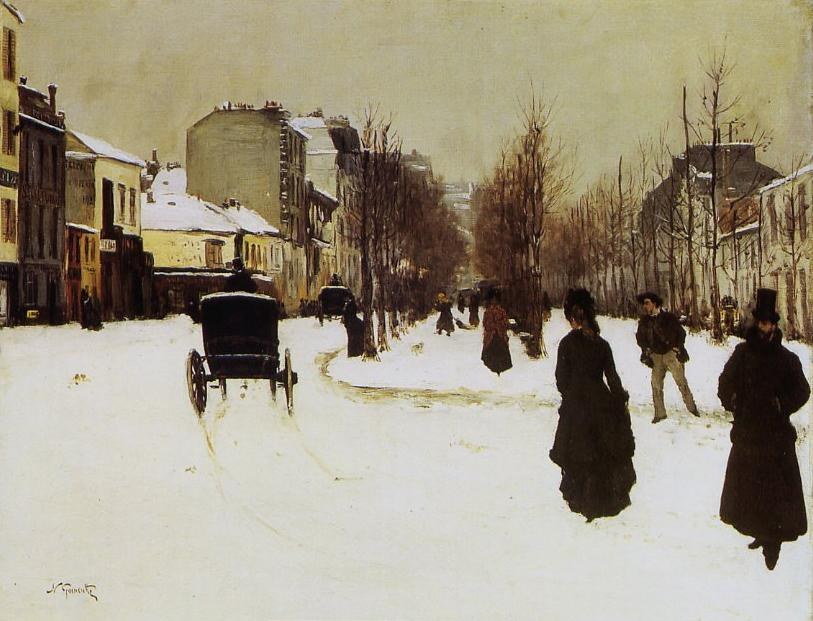
First of the three great paintings to depict the boulevard, painted the year following its definitive opening. Goeneutte (1854-1894), a painter and engraver and friend of Renoir and admirer of Manet, was at the time exhibiting at the Salon from 23 rue de Laval (now rue Victor-Massé), 300 metres from the boulevard. He painted the scene at the age of 22, alongside his friend Jean Béraud. The off-centre composition and the back-lit silhouettes reveal the influence of Japanese woodblock prints, then very much in fashion among Parisian artists. Work exhibited at the 1876 Salon.
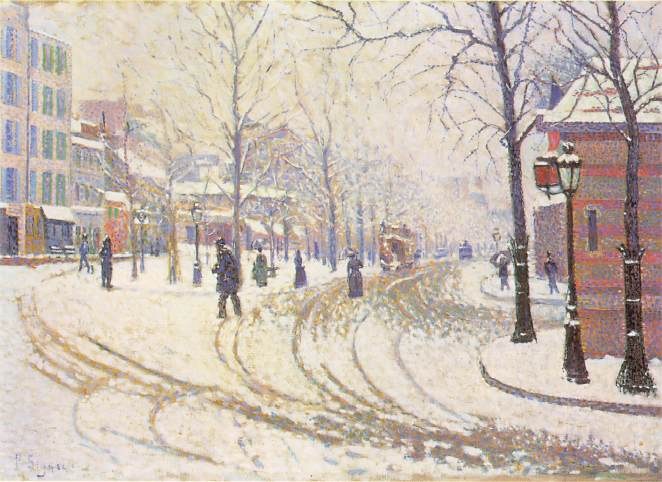
Pointillist painting made from the studio that Signac (1863-1935) occupied at 128 bis boulevard de Clichy, where he had as neighbour Georges Seurat. The same year 1886 saw Seurat exhibit A Sunday Afternoon on the Island of La Grande Jatte at the last Impressionist exhibition — the founding moment of neo-impressionism, of which Signac was the theorist. Boulevard de Clichy, and particularly the stretch towards Pigalle, was thus the visual laboratory of pointillist painting in its early days.
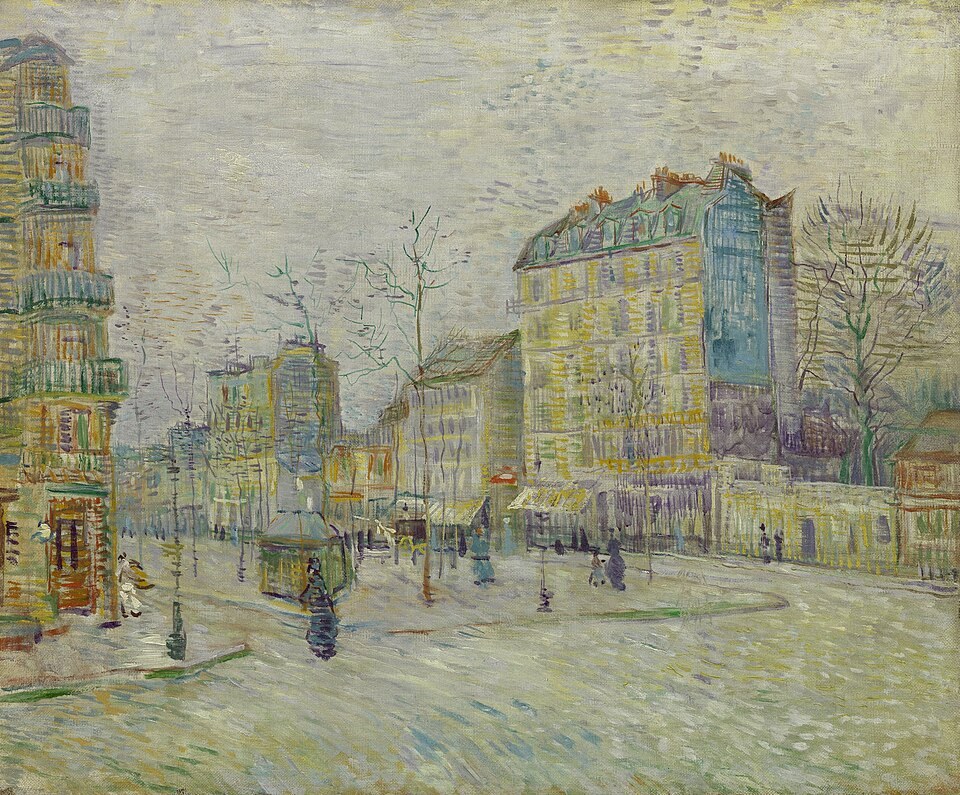
Painted during the painter's Paris period (1886-1888), when he was staying at the home of his brother Theo van Gogh at 54 rue Lepic, in Montmartre — a ten-minute walk from the boulevard. It is the year when he frequented the Café du Tambourin at no. 62 of boulevard de Clichy, where he exhibited part of his Japanese prints and where he painted his famous Agostina Segatori at the Café du Tambourin. The painting on this page captures the light palette and fragmented brushwork Van Gogh then adopted, under the influence of the Impressionists and neo-Impressionists (Pissarro, Signac) he met in Paris.
- Norbert Gœneutte, Le Boulevard de Clichy, par un temps de neige, 1876, Tate Britain, London (N04538).
- Paul Signac, Le Boulevard de Clichy, la neige, 1886, Minneapolis Institute of Arts (USA).
- Vincent van Gogh, Boulevard de Clichy, 1887, Van Gogh Museum, Amsterdam.
- Édouard Manet, Reichshoffen cycle (painted at the Brasserie Reichshoffen, in all likelihood at no. 34 — see the Manet entry), 1874-1879 — four canvases scattered between the National Gallery in London, the Musée d'Orsay, the Walters Art Museum in Baltimore, and the Reinhart Collection in Winterthur.
Photographs of the Cabaret de l'Enfer by Eugène Atget (c. 1900)
Eugène Atget (1857-1927), the documentary photographer who roamed Paris with his 18×24 cm view camera to capture the "old Paris" threatened with disappearance, photographed the façade of the Cabaret de l'Enfer at 53 boulevard de Clichy several times between 1898 and 1910. His albumen paper prints are held at the Prints and Photography Department of the BnF, and at the Musée Carnavalet and the Bibliothèque historique de la Ville de Paris.
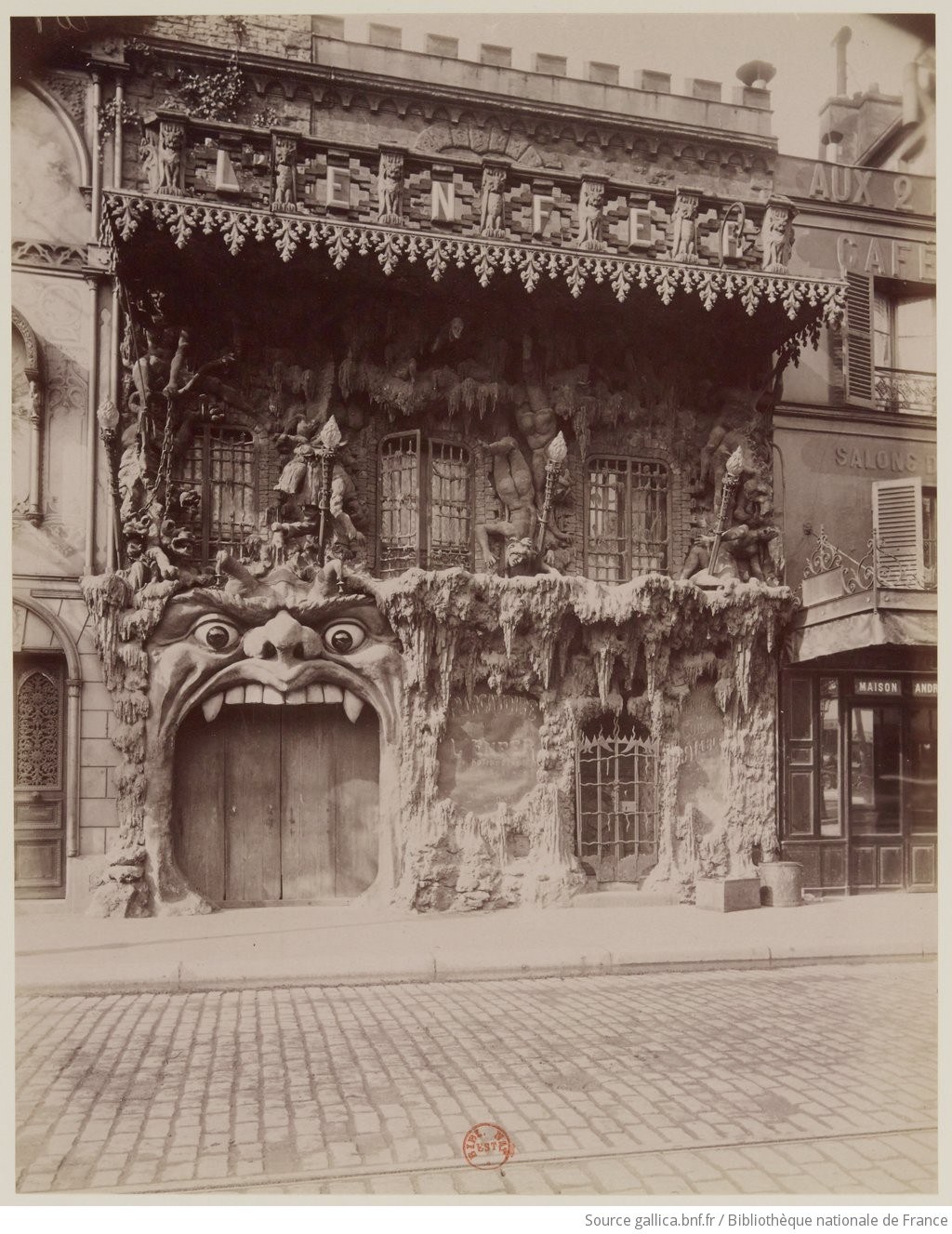
Full view of the façade: at the top, on the crenellated band, can be read the letters "L'ENFER" and "MAISON ANDRÉ" on the right. The main entrance opens through the wide-open jaws of a demonic figure sculpted in stucco, surrounded by stalactites, sculpted damned souls climbing the walls, and torches held by arms emerging from the rock. On the right, the sign of a corner café "AUX 2", and above the neighbouring shop, the inscription "SALON D…" (probably "salon de coiffure" or "salon de barbier" — hairdressing or barber shop). It is a theatrical shopfront typical of the macabre Belle Époque, in the same vein as the Cabaret du Néant at no. 34. This sculptural aesthetic, from the same workshop that probably created the skull of the Cabaret du Néant at no. 34, is one of the most striking inventions of the Parisian macabre genre between 1892 and 1914.
Brassaï at Pigalle (c. 1930-1932)
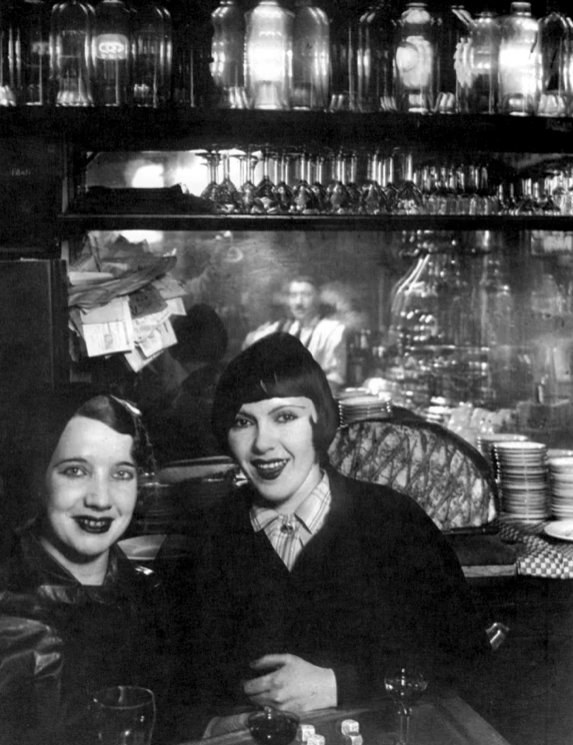
Two young women leaning on the counter of a night bar, with a knowing smile — behind them, the bar mirrors in its glass the silhouette of the owner, the rows of upturned bottles, the stacks of saucers, the addictions of the night. This photograph belongs to the cycle Paris de nuit (Paris by Night) that Brassaï published in 1932 with Arts et Métiers Graphiques — a founding book of nocturnal photography and a collective portrait of the nightlife of Pigalle, Montparnasse and Les Halles. A Hungarian émigré who arrived in Paris in 1924, Brassaï inherited the ethnographic eye of Atget but applied it to the night — boulevard de Clichy is one of his favourite hunting grounds.
Robert Doisneau, L'Enfer-boîte de nuit (1952)
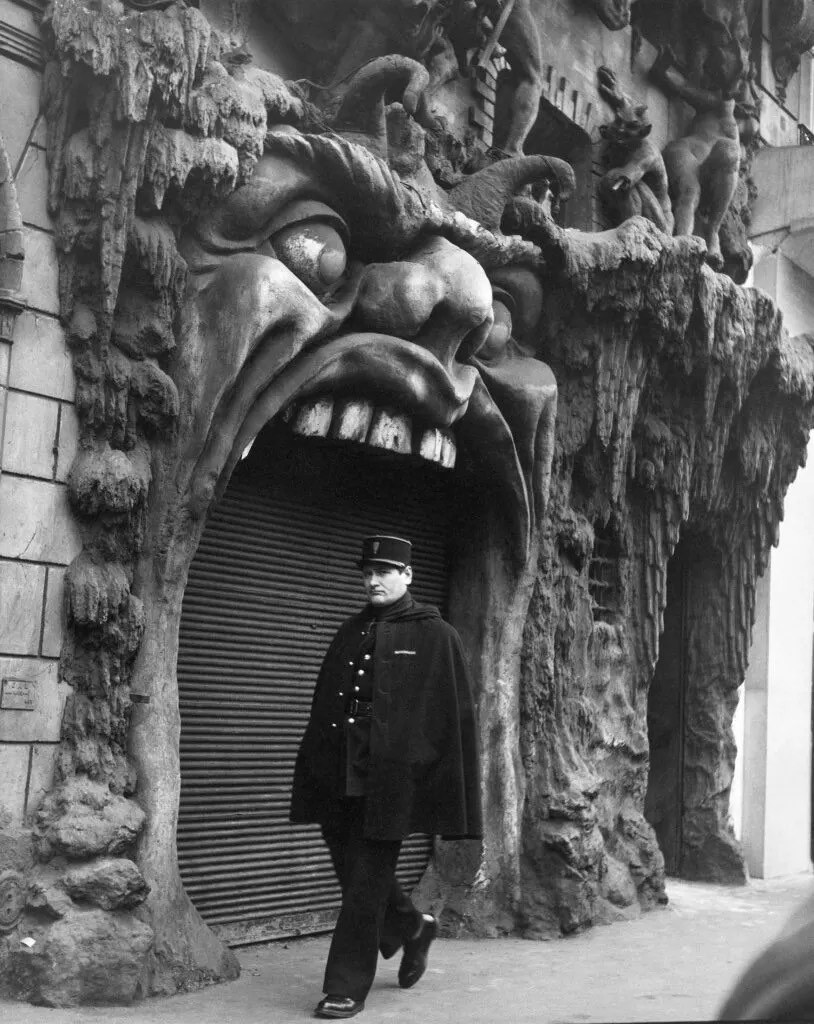
Fifty years after Atget, Doisneau photographed the same façade of the Cabaret de l'Enfer — but this time, a police officer in cape and kepi walks beneath the demonic jaws, in the meantime turned into a mere "nightclub". The stucco sculpture is still holding firm, intact, but would be destroyed shortly afterwards. It is a pivotal image of the boulevard's iconography: Doisneau explicitly cites Atget, transforms a Belle Époque setting into a post-war one, plays on the irony of a representative of order walking under the jaws of the devil. The contrast between the rigidity of the uniform and the baroque grotesque of the sculpture is one of the peaks of Doisneau's visual humour.
The boulevard today
Boulevard de Clichy remains one of the busiest avenues in Paris, with a triple superimposed identity:
- International tourism around the Moulin Rouge (no. 82) — daily flow of visitors.
- Popular life with the bouillons (Bouillon Pigalle at no. 22, Bouillon Service at no. 18) and the traditional brasseries.
- Nightlife with the Folies Pigalle (no. 11 place Pigalle), the cocktail bars of "SoPi" (South Pigalle), and — a legacy of the 1969-1990 period — the sex shops, still concentrated on the boulevard.
- Artistic memory: 34 boulevard de Clichy publicly documents 162 years of occupation by artists in its inner courtyard; further along, the Cité Véron (no. 92) still houses several studios.
Map: artistic points of interest on boulevard de Clichy and in Montmartre
Boulevard de Clichy runs east-west between place Pigalle and place de Clichy, over nearly 1.3 km. To the north, the butte Montmartre with its historic studios (Bateau-Lavoir, Moulin de la Galette, Montmartre Cemetery, Sacré-Cœur). The map below shows the main artistic points of interest, in the order one meets them from Pigalle.
Legend — from east to west, from place Pigalle
- No. 6 boulevard de Clichy — Edgar Degas plaque, the painter's last address, died in 1917.
- No. 22 boulevard de Clichy — Bouillon Pigalle, popular brasserie (lunch, dinner); in the same building, the former Café-Bar Le Pigalle (1954, listed as a Historic Monument for its décor).
- No. 34 boulevard de Clichy — Our building. Brasserie Reichshoffen painted by Manet (1878-1879), studio of Eugène Pottier (author of The Internationale), Cabaret du Néant, Ciné-Vox-Pigalle then Scarlett cinema, courtyard artists' studios. Read the investigation.
- No. 53 boulevard de Clichy — Historic location of the Cabarets du Ciel and de l'Enfer, demolished; today a Monoprix.
- No. 64 boulevard de Clichy / 2 rue Coustou — Art Deco building by Charles Lemaresquier (1925), formerly home to the Cinéma Agora (1932-1995, basement) and the Trois Baudets theatre of Jacques Canetti (1947) where Brassens, Brel, Vian, Gainsbourg and Gréco made their debuts.
- No. 82 boulevard de Clichy — Moulin Rouge, founded in 1889 by Joseph Oller and Charles Zidler; the icon of the neighbourhood.
- No. 92 boulevard de Clichy — Cité Véron, former artists' colony accessible from the boulevard, where lived Boris Vian, Jacques Prévert and Christiane Rochefort.
- No. 128 bis boulevard de Clichy — Studio of Paul Signac (c. 1880-1890), on the 6th floor: it was from this studio that he painted Boulevard de Clichy under the snow (1886).
- No. 130 boulevard de Clichy — First Parisian home of Pablo Picasso (1901), studio first shared with Casagemas, then taken over alone after the latter's suicide.
To the north, on the butte Montmartre
Beyond the boulevard, the butte Montmartre extends the artistic ecosystem. On foot, from no. 34, allow 10-15 minutes' uphill walk via rue Lepic or rue des Abbesses to reach:
- 10 — 54 rue Lepic — apartment of Théo van Gogh where his brother Vincent lived from March 1886 to February 1888; this was his Paris period, when he discovered the Impressionists, painted Montmartre, the Moulin de la Galette, and evolved his palette towards the bright colours that herald Arles. Commemorative plaque.
- The Bateau-Lavoir — 13 place Émile-Goudeau; Picasso's studio (1904-1909), where he painted Les Demoiselles d'Avignon (1907).
- The Moulin de la Galette — 83 rue Lepic; painted by Renoir (1876, Musée d'Orsay) and Van Gogh (1886).
- The Montmartre Cemetery — entrance 20 avenue Rachel; graves of Degas, Truffaut, La Goulue, Stendhal.
- The Sacré-Cœur basilica — top of the butte, panorama of Paris.
- The Musée de Montmartre & the Renoir Gardens — 12 rue Cortot; former studio of Renoir, Suzanne Valadon, Utrillo, Émile Bernard, Raoul Dufy.
Walking plan: the boulevard on foot
From east to west, starting at place Pigalle (métro 2, 12):
- Place Pigalle — terraces, Pigalle statue.
- Boulevard de Clichy no. 34 — Manet, Pottier, Cabaret du Néant, artists' studios (investigation).
- Boulevard de Clichy no. 22 — Bouillon Pigalle (lunch / dinner).
- Boulevard de Clichy no. 6 — Edgar Degas (plaque).
- Place Blanche (métro 2) — opposite the Moulin Rouge.
- Boulevard de Clichy no. 82 — Moulin Rouge.
- Boulevard de Clichy no. 92 — Cité Véron.
- Boulevard de Clichy no. 128 bis — Paul Signac's studio.
- Boulevard de Clichy no. 130 — Picasso's first home (1901).
- Place de Clichy (métro 2, 13) — end of the boulevard.
Going further
- What to do in Pigalle? — neighbourhood guide (Bouillon Pigalle, Folies, Moulin Rouge)
- Picasso in Pigalle and Montmartre — complete itinerary, 34/11 disambiguation
- 5 little-known courtyard-studios in Montmartre
- What to do in Paris in 2 days for art lovers
- Heritage investigation of 34 boulevard de Clichy
Main sources
Frequently asked questions
Where is boulevard de Clichy?
Boulevard de Clichy is a Parisian boulevard located on the border of the 9th and 18th arrondissements. The even numbers (north side, towards Montmartre) are in the 18th; the odd numbers (south side) are in the 9th. It stretches from place de Clichy (to the west) to rue des Martyrs (to the east) over nearly one kilometre. Three métro stations serve it: Place de Clichy (lines 2 and 13), Blanche (line 2) and Pigalle (lines 2 and 12).
When was boulevard de Clichy created?
Boulevard de Clichy was created in 1864 by merging the patrol roads that ran on both sides of the Wall of the Farmers-General, demolished after the annexation of the surrounding communes by Paris in 1860. The boulevard has successively borne the names of boulevard des Martyrs, then boulevard Pigalle, before taking its current name.
Which artists lived on boulevard de Clichy?
Many artists lived or worked on boulevard de Clichy: Édouard Manet (at no. 34, Brasserie Reichshoffen, 1878-1879), Eugène Pottier (at no. 34, studio 1880-1887), Vincent van Gogh (no. 62 at the Café du Tambourin, 1887), Edgar Degas (at no. 6, died there in 1917), Pablo Picasso (at no. 130 ter in 1901-1904, then at no. 11 from 1909 to 1912), Sarah Bernhardt (at no. 11, 1873-1877), Auguste Renoir (at no. 11, 1887-1890), Boris Vian (at no. 8, 1951), Paul Signac (at no. 128 bis, 1886-1888), Jules Pascin (at no. 36, 1923-1930). 34 boulevard de Clichy also hosted Hella Guth (1951-1992), Pierre-Luc Feitu, Henri Marre, Michel Batlle.
Why is boulevard de Clichy famous?
Boulevard de Clichy is world-famous for the Moulin Rouge (at no. 82, founded in 1889), for having been a high point of Parisian artistic bohemia (Manet, Van Gogh, Picasso, Degas, Toulouse-Lautrec, Renoir lived or worked there), for its historic Belle Époque cabarets (Cabaret du Néant, Cabaret de l'Enfer, Cabaret du Ciel), and today for its concentration of popular bouillon brasseries (Bouillon Pigalle at no. 22) and sex shops (since 1969). It borders the Pigalle district and lower Montmartre.
Which métros serve boulevard de Clichy?
Three métro stations serve boulevard de Clichy: Place de Clichy (lines 2 and 13, to the west), Blanche (line 2, opposite the Moulin Rouge), and Pigalle (lines 2 and 12, to the east). Line 2 runs underground beneath the central median of the boulevard along its entire length. Bus routes 30, 54 and 74 also serve the boulevard.