Pierre Dac, born André Isaac, was one of the most beloved French humorists of the 20th century. Born into a modest Alsatian Jewish family that settled in Paris in 1896, son of a butcher named Salomon Isaac, he grew up in the working-class district of La Villette. Above his father's shop, he absorbed louchébem — the secret slang of Parisian butchers — from which he would later draw the word "loufoque" (zany, off-the-wall) that defined his entire artistic vision.
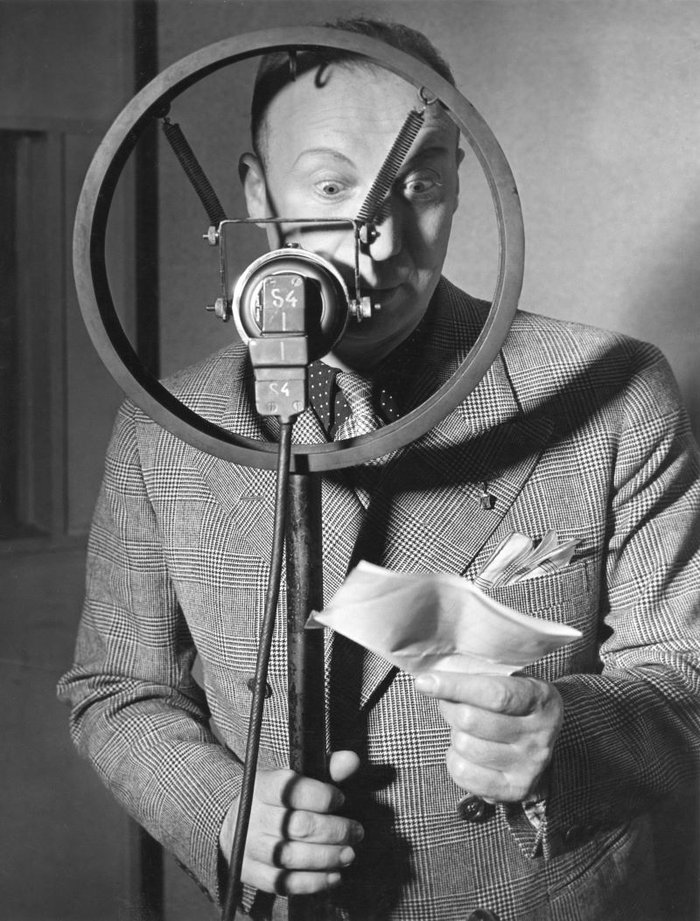
The humorist is at the peak of his first fame: daily star of the Poste Parisien and the Montmartre cabarets. The massive studio microphone, lent by the Hungarian Brassaï to his theatrical framing, literally turns Pierre Dac into a voice before a face — which is what he will remain his whole life, for millions of listeners.
From the Great War to Montmartre cabarets
Mobilised in August 1914, he returned from the front with two wounds: a shell fragment had shortened his left arm by twelve centimetres. His older brother Marcel was killed in action — a grief he would carry for the rest of his life.
In the 1930s, he became a fixture of Montmartre cabarets: La Lune Rousse, Le Coucou, Théâtre de 10 Francs, Les Noctambules, the Casino de Paris. He developed a deadpan delivery, a humour of the absurd, and in 1938 founded L'Os à moelle, a satirical weekly that sold up to 400,000 copies per issue.
Pierre Dac and 34 boulevard de Clichy
According to the oral memory of a neighbour who knew him, Pierre Dac is said to have lived at 34 boulevard de Clichy in the 1930s, before his departure for London in 1943. The address does not appear in official biographies — which generally only mention the family home at 48 rue de Clignancourt and, after the war, 49 avenue Junot — but it is geographically and chronologically consistent with this period, when he performed nightly in the cabarets along the boulevard, located just a few steps from no. 34.
At the time, no. 34 housed the Lune Rousse editions, which published the chansonniers of Montmartre, as well as artist studios at the rear of the courtyard and several residential floors on the street side. The idea that he kept a flat there, or at least a pied-à-terre, is entirely plausible for a chansonnier who spent his evenings in the neighbourhood — especially as his immediate neighbours at no. 36 housed the cabaret La Lune Rousse and the headquarters of the publishing company of the same name.
Radio Londres and the Resistance
Taking refuge in Toulouse in 1940 (42 boulevard de Strasbourg), he twice tried to reach London via the Pyrenees. Arrested and imprisoned in Barcelona and then Perpignan, he was eventually exchanged for sacks of grain. He arrived in London on 12 October 1943 and became one of the best-loved voices on Radio Londres in the programme "Les Français parlent aux Français".
On 10 May 1944, the collaborationist Philippe Henriot attacked his Jewish origins on Radio Paris. Pierre Dac replied the next day with the legendary "Bagatelle sur un tombeau": his brother Marcel's tombstone reads "Died for France", whereas Henriot's would one day read "Died for Hitler, shot by the French". Henriot was killed by the Resistance forty-eight days later.
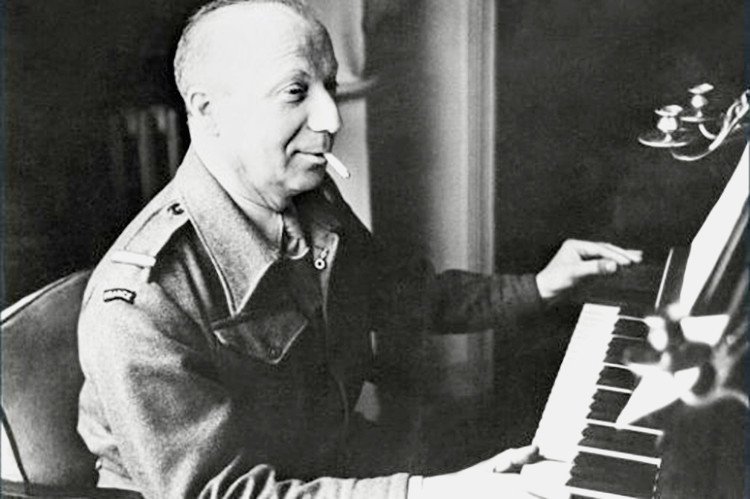
During his London years at Radio Londres, Pierre Dac composes most of his texts accompanying himself at the piano. Cigarette at his lips, the battle-dress of the Free French Forces, the photograph captures the whole condition of the chansonnier turned soldier: writing in the morning, recording in the evening, striking Vichy through the airwaves.
The golden age with Francis Blanche
After the war, he moved to 49 avenue Junot with Dinah Gervyl, whom he married in October 1944. With Francis Blanche, he formed one of the great comic duos of the 20th century:
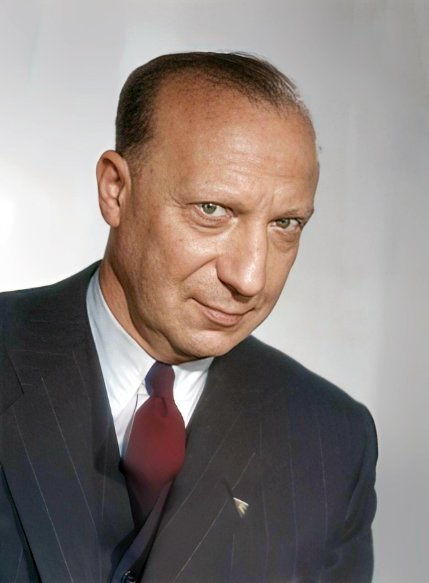
Back in Paris after London, the humorist resumes his activities: press, cabaret, radio. The sidelong gaze and half-smile are the signature of the "king of the loufoques", who will soon meet a young Francis Blanche and with him invent the most famous radio duo of the following decade.
- Malheur aux barbus (1951-1952), radio serial
- Signé Furax (1956-1960), 1,034 episodes on Europe 1
- Bons Baisers de Partout (1965-1974), 740 episodes on France Inter
- Le Sâr Rabindranath Duval, cult sketch
He invented the Schmilblick (a useless object that can serve any purpose), the biglotron, noodle jam, and even ran for the French presidency under the banner of the M.O.U. (Unified Undulatory Movement).
Known Paris addresses
- 48 rue de Clignancourt (18th) — family home, until his thirties
- 34 boulevard de Clichy (18th) — home in the 1930s, before his departure for London (local oral tradition)
- 49 avenue Junot (18th) — post-war home with Dinah Gervyl
Honours
- Croix de Guerre 1914-1918 and 1939-1945
- Medal of the Resistance
- Knight of the Legion of Honour
- A rue Pierre-Dac near avenue Junot, named in his honour in 1995